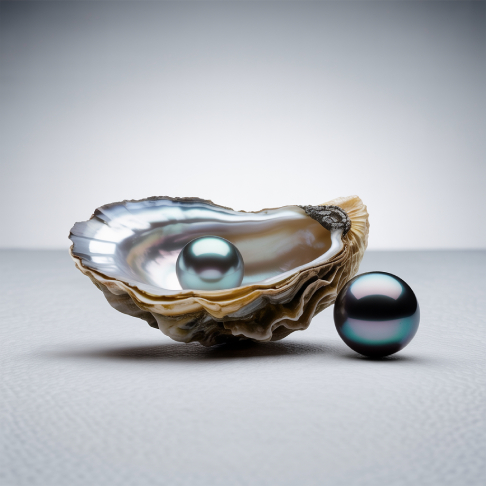
Black Pearl
Born inside the black-lipped oyster of Tahiti and French Polynesia, the black pearl shifts through peacock.
- The black-lipped oyster (Pinctada margaritifera) that produces black pearls can weigh up to 5 kilograms and live 30 years.
- Tahitian black pearls grow over 18 to 24 months inside their oysters.
- Peacock pearls are Tahitian pearls with a green dominant overtone, the most prized color.
- Most dyed black pearls in low-price jewelry are actually dyed Chinese freshwater pearls, not true Tahitian.
- Natural (non-cultured) black pearls are effectively absent from the modern market and exist only in historical collections.
- Fine jewelry buyers seeking a sophisticated dark pearl
- Heirloom gift buyers for wedding anniversaries and milestones
- Readers drawn to Tahitian and Polynesian cultural themes
- Collectors of biogenic gemstones alongside pearl, amber, and ammolite
- Practitioners working with crown and third eye chakra contemplative themes
- Buyers under $100 per pearl for quality (try dyed freshwater pearl)
- Shoppers who want durable daily-wear ring stones (pearls are soft)
- Readers looking for faceted transparent gems
What Is Black Pearl?
Black pearls are organic biogenic gemstones produced naturally by the black-lipped oyster (Pinctada margaritifera) in the lagoons of French Polynesia, the Cook Islands, and other central Pacific locations. The characteristic dark body color is produced by the oyster's mantle tissue, which secretes nacre layers containing dark pigmentation.
The finest black pearls show what the trade calls peacock overtones: shifting colors of green, violet, rose, and steel blue that appear to move across the surface as light angles change.
Almost all commercial black pearls are cultured: a small piece of mantle tissue and a spherical mother-of-pearl bead are surgically implanted in the oyster, which then secretes nacre around the nucleus over 18 to 24 months. Truly natural (non-cultured) black pearls are extraordinarily rare and command collector premiums.
Tahitian pearl culturing was pioneered by Jean-Marie Domard in the 1960s and commercialized by Robert Wan starting in 1973, transforming French Polynesia into the world's black-pearl capital.
Pearl composition is primarily calcium carbonate (aragonite) with small amounts of organic conchiolin binding the crystalline layers. The IMA does not classify pearl because it is biogenic rather than a mineral per se, but pearl is one of three officially recognized biogenic gemstones alongside amber and ammolite.
Hardness is low (Mohs 2.5 to 4.5), and pearls are sensitive to acids, salts, and chemicals that can damage the surface luster. Typical black Tahitian pearl sizes range from 8 to 14 millimeters, with exceptional pearls reaching 18 mm or more.
How Black Pearl Compares
| Property | Black Pearl (Tahitian) | White Pearl | Onyx |
|---|---|---|---|
| Hardness | 2.5 - 4.5 | 2.5 - 4.5 | 6.5 - 7 |
| Price / pearl | $$ Mid-range | $ Budget | $ Budget |
| Rarity | Moderate (cultured) | Common (cultured) | Common |
| Best For | Fine jewelry, heirloom | Classic fine jewelry | Budget black accents |
Meaning and Symbolism
Pearl has been prized across many cultures for thousands of years, from Roman senators who wore natural pearl signet rings to Chinese royalty who ground pearls into medicinal powders.
Black pearls specifically were rare in antiquity because the black-lipped oyster is native only to the central and southern Pacific, and natural black pearls had to travel exceptional distances to reach other gem markets.
Queen Isabella I of Castile wore Pacific black pearls brought back by Spanish explorers in the sixteenth century, marking one of the stone's first European appearances.
In traditional Polynesian and Tahitian culture, pearls are woven into creation mythology: the god Oro is said to have descended from the heavens on a rainbow and gifted the black pearl to a Polynesian princess named Bora Bora.
This cultural lineage has shaped the modern meaning of Tahitian pearls, which carry both French Polynesian national identity and a specific oceanic spiritual association. Contemporary black pearl jewelry often draws on this heritage in branding and design.
In contemporary crystal tradition, black pearl is traditionally associated with the crown and third eye chakras, and with themes of mature wisdom, quiet authority, and contemplative mystery. Practitioners believe the stone supports readers in leadership, creative mastery, or spiritual teaching roles where quiet presence matters more than loud charisma.
Because black pearls can trace unique individual histories (each grown over years in a specific oyster in a specific lagoon), contemporary crystal literature often frames them as stones of personal story and mature identity.
Historical Timeline
Healing Tradition
Emotional
Practitioners believe black pearl is a stone of quiet emotional maturity and contemplative authority. In crystal healing tradition, it is said to support a wearer who has grown through difficult experiences and is now settling into a steadier, wiser presence.
Many find black pearl a useful companion during career maturation, spiritual teaching roles, or any life stage where the reader is asked to hold space for others without needing to perform.
Black pearl is often paired with rose quartz for heart-centered softness alongside mature authority, with smoky quartz when old difficulties need gentle grounding, and with clear quartz when amplifying intentions tied to quiet leadership. Practitioners tend to describe black pearl as grave and luminous rather than bright or dramatic.
Spiritual
In crystal healing tradition, black pearl is said to anchor the crown and third eye chakras with a specifically oceanic, mature energy. Practitioners believe the stone supports readers whose spiritual path has matured through long practice, whose silence carries as much weight as their speech.
Because Tahitian pearl is tied to specific Polynesian oceanic traditions, many practitioners treat black pearl with cultural awareness, particularly when working with pieces sourced directly from French Polynesia.
Traditional associations with the Moon and water extend to black pearl through its biogenic water-origin, and many readers use black pearl in evening meditation, lunar ceremonies, and intentional contemplation of leadership responsibilities.
Physical
Practitioners believe black pearl supports what they describe as hormonal balance and quiet nervous-system settling, folklore that draws on pearl's traditional association with the Moon and water. Crystal healing tradition connects black pearl to the upper body (throat, lungs, head) in gentle metaphorical terms rather than clinical senses.
Many find wearing a Tahitian black pearl pendant or necklace comforting during leadership responsibilities, menopausal or hormonal transitions, or long periods of holding quiet authority. Black pearl is not a substitute for medical care, and practitioners frame its role as supportive rather than curative.
Readers with hormonal, thyroid, or emotional regulation concerns are encouraged to rely on qualified medical guidance.
Zodiac, Birthstone and Gifts
Pearl (including black pearl) is the traditional June birthstone alongside alexandrite and moonstone. Cancers, the primary June sign in Western astrology, are often read as naturally matched to pearl's oceanic, emotional, water-element qualities. Pisceans with their watery emotional sensitivity also frequently adopt black pearl, particularly for its mature, quiet tone.
Modern Western astrology associates pearl with the Moon for its lunar symbolism. Vedic astrology (Jyotish) treats pearl (moti) as the primary stone of the Moon (Chandra), prescribed to strengthen lunar influences in a chart; black pearl is sometimes used as a variant when a darker, more protective lunar stone is desired.
Care and Cleansing
Black pearl requires the gentlest cleansing of almost any gemstone. Wipe with a soft damp cloth after each wear, using only plain water (never soap, ammonia, or abrasive cleaners). Never ultrasonic, never steam, never saltwater, and never strong household chemicals. Avoid vinegar, lemon, and any acidic cleaners, which damage nacre almost immediately.
Moonlight cleansing is traditionally recommended for pearl and fits the stone's lunar symbolism. Very brief sunlight exposure is acceptable, but prolonged UV exposure can dry out the nacre and cause micro-cracking over years. Smoke cleansing with palo santo or sage is gentle and safe.
Sound cleansing with a singing bowl placed at a small distance (not touching the pearl) is appropriate. Dry salt placement is not recommended because salt grains can abrade the surface. Many practitioners recharge pearls by resting them on a clear quartz cluster or selenite slab overnight.
- DO wipe black pearls with a soft damp cloth after each wear.
- DO NOT expose pearls to perfumes, lotions, hairsprays, or strong chemicals.
- DO store pearls in a silk pouch, flat, away from other jewelry.
- DO NOT use ultrasonic, steam, or saltwater cleaning on pearls.
- DO wear pearls against the skin occasionally to maintain nacre moisture.
- DO ask whether a pearl is cultured Tahitian, natural, or dyed freshwater.
- Note: Tahitian black pearls carry origin certificates from the French Polynesian government for premium pieces.
Real vs Fake
Genuine Tahitian black pearls show the characteristic dark body color with peacock overtones of green, violet, steel blue, or rose that shift with viewing angle.
Common substitutes and confusions include dyed Chinese freshwater pearls (much cheaper, usually visible dye concentration near the drill hole), imitation pearls (glass beads coated with essence d'orient), Mabe pearls (assembled half-pearls), and Akoya pearls dyed black.
Under 10x magnification, real Tahitian pearls show the natural crystalline structure of nacre layers with subtle color variation across the surface. Dyed freshwater pearls typically show concentrated dark color at the drill hole where dye pooled. Glass imitations show mold seams and uniform color.
The tooth test (gently rubbing a pearl against the tooth enamel) reveals the gritty feel of real nacre compared with the smooth feel of glass; this is a traditional but imperfect test.
For any black pearl priced above $200, a certificate of origin from the French Polynesian government or an American Gem Trade Association report confirms Tahitian provenance. The Tahitian Pearl Producers Association and similar organizations also provide certification programs.
Practical clues include weight (real pearl is heavier than glass for similar size), temperature (pearls feel cool initially and warm slowly against skin), and the characteristic growth rings occasionally visible under magnification. Buy from reputable pearl dealers or established fine jewelers for confidence in authenticity.
Black Pearl Jewelry & Gifts
Tahitian black pearl pricing depends on size, shape, color, luster, surface quality, and nacre thickness. Small round pearls (8 to 9 mm) run $100 to $500 per pearl. Mid-size (10 to 12 mm) well-matched pearls with strong peacock overtones run $500 to $1,500 per pearl.
Large (13 to 16 mm) exceptional pearls with ideal color and luster run $1,500 to $5,000 per pearl. Truly exceptional pearls above 17 mm with perfect round shape and vivid peacock color can exceed $10,000 per pearl, and perfect matched strands reach significant six-figure prices.
French Polynesia supplies over 90% of the world's cultured black pearls. The Cook Islands, Micronesia, and other Pacific locations produce smaller quantities. For buyers, look for: round or near-round shape (baroques are less valuable but still beautiful), high luster (the pearl's surface reflection sharpness).
Clean surface (minimal spots or blemishes), strong overtones (peacock green is most prized). Thick nacre (better durability and color depth).
Dyed Chinese freshwater pearls are a legitimate but much cheaper category and should be disclosed clearly. For significant purchases, request a certificate of origin and a recent grading report from a reputable pearl laboratory.
Where to Buy Black Pearl
Affiliate disclosure: Some links below earn us a small commission at no extra cost to you. See our affiliate disclosure page.
Handmade, raw, and tumbled pieces from independent sellers worldwide.
Shop Black Pearl on Etsy →Accessories, tools, and specimen sets with fast Prime delivery.
Shop Black Pearl on Amazon →Certified loose gemstones graded and photographed for online buyers.
Shop Black Pearl on GemSelect →Pairs Well With




Where Black Pearl Is Found

