
Ruby
Born in Burmese marble and Mozambique basalt, ruby is the red gem of vitality, courage, and passion.
- The first working laser, built in 1960, used a rod of synthetic ruby as its gain medium.
- The Sunrise Ruby, a 25.59 carat Burmese stone, sold for over $30 million at Sotheby's Geneva.
- Fine untreated pigeon blood ruby can trade for a higher price per carat than comparable diamond.
- Ruby and sapphire are the same mineral species; only chromium-colored red stones get the name ruby.
- Burmese rubies typically show strong red fluorescence under UV light, part of what gives Mogok stones their glow.
- Buyers who want an heirloom gemstone that keeps its fire on a daily-wear ring
- July birthstone seekers shopping for a milestone gift
- Collectors drawn to classic pigeon blood Burmese color
- Practitioners working with root chakra vitality and heart chakra courage
- Engagement ring shoppers wanting a colored alternative to diamond
- Budget-conscious buyers under $100 per carat (consider garnet or red spinel)
- Those who prefer cool, understated tones (try sapphire or tanzanite)
- Shoppers who dislike standard heat treatment disclosure (try unheated spinel)
What Is Ruby?
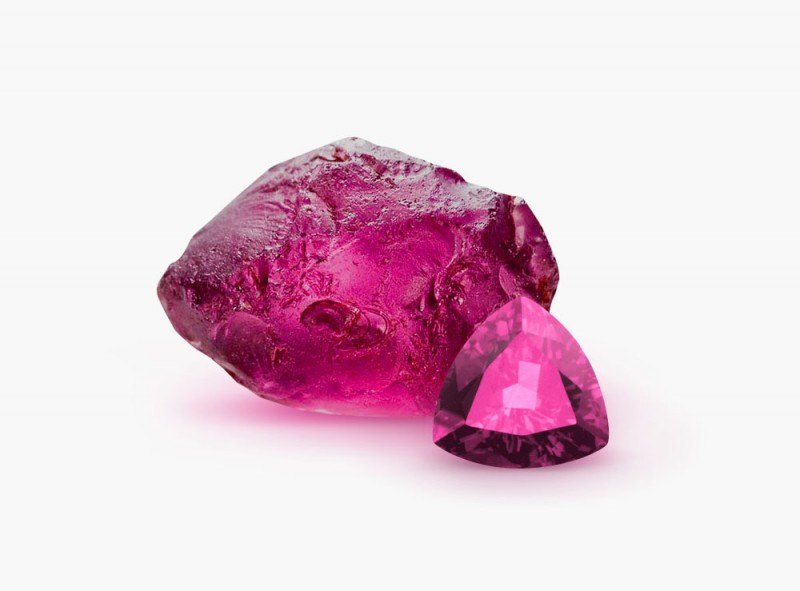
Ruby is the red variety of the mineral corundum, colored by trace chromium ions that replace aluminum in the crystal lattice. The same species in any other color is called sapphire, which is why gemologists describe ruby and sapphire as sister stones. It rates 9 on the Mohs hardness scale.
With a Mohs hardness of 9, ruby is the second-hardest natural gem after diamond, making it one of the most durable colored stones you can set in a ring. The International Mineralogical Association (IMA) symbol for corundum is Crn.
The name ruby comes from the Latin rubeus, meaning red. Rubies typically form in metamorphic marble deposits, where aluminum-rich rocks are heated and squeezed deep in the earth, as in the legendary Mogok Valley of Myanmar.
A younger generation of rubies forms in basalt-hosted environments such as Mozambique's Montepuez district, now among the largest known supplier by volume. Marble rubies tend to show a pure, slightly fluorescent red; basalt rubies run darker and often carry a subtle iron tint.
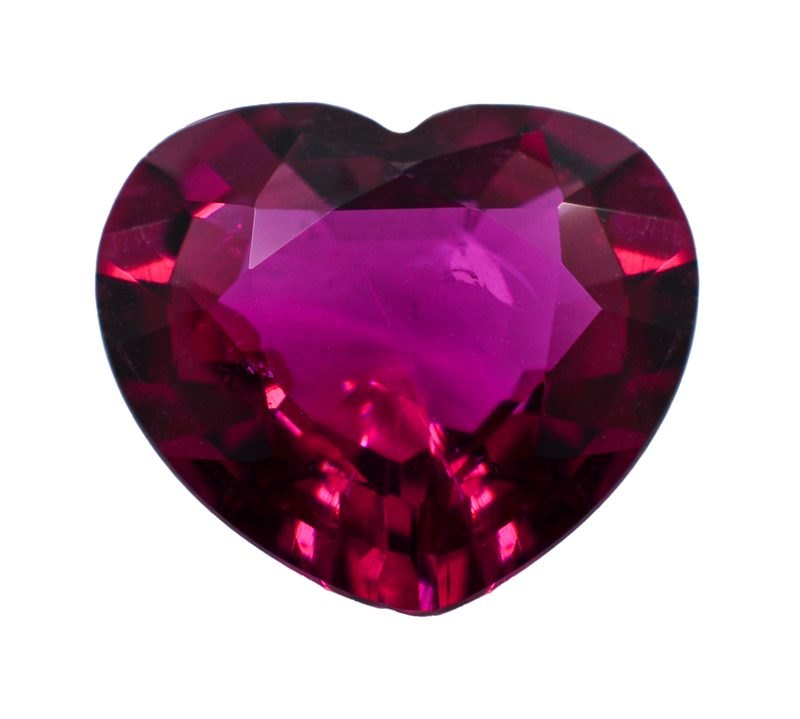
Top color is called pigeon blood, a trade term that describes a pure red with a faint bluish undertone and strong fluorescence. Clarity is judged relative to emerald standards, since most rubies carry visible inclusions; a completely clean ruby above one carat is rare enough to raise authenticity questions.
Most commercial rubies are heat-treated to improve color and clarity, a standard and stable treatment disclosed by reputable sellers.
How Ruby Compares
| Property | Ruby | Red Spinel | Garnet |
|---|---|---|---|
| Hardness | 9 | 8 | 6.5 - 7.5 |
| Price / carat | $$$ Premium | $$ Mid-range | $ Budget |
| Rarity | Rare (fine color) | Rare | Common |
| Best For | Investment, heirloom | Daily wear, value | Everyday jewelry |
Meaning and Symbolism
Ruby has been called the king of gems for nearly four millennia. Sanskrit texts named it ratnaraj, literally lord of gemstones, and described the finest stones as carrying an inner fire that could not be dimmed. In Hindu tradition, offering a ruby to Krishna was said to secure rebirth as an emperor.
Burmese warriors are said to have embedded rubies beneath their skin in the belief the stone made them invincible in battle.
Medieval Europeans associated ruby with the blood of life and the heart of a king. Ruby rings were thought to darken when danger approached, warning the wearer, and to glow when good fortune neared.
The Black Prince's Ruby in the British Imperial State Crown, actually a red spinel, reflects how central the color red was to royal symbolism long before mineralogy separated the two species. Ruby is the traditional gift for fifteenth and fortieth wedding anniversaries in the United States.
In modern crystal practice, ruby is traditionally associated with passion, courage, and life force. Practitioners believe ruby activates the root and heart chakras together, anchoring bold action in love rather than aggression.
Many find it a useful stone during periods of creative block, low motivation, or shyness, since its reputation is for warming rather than cooling.
Historical Timeline
Healing Tradition
Emotional
Practitioners believe ruby is a stone of courage, passion, and motivation. In crystal healing tradition, it is said to warm the emotional body, encouraging the wearer to take action on stalled plans, speak honestly about desire, and reclaim vitality after burnout or grief.
Many find ruby especially grounding during periods of creative block or lingering shyness, with the stone traditionally associated with moving forward rather than retreating.
Practitioners often pair ruby with rose quartz when they want courage tempered by kindness, or with black tourmaline when the work involves stepping back into a world that previously felt unsafe.
Ruby is also said to support leaders and teachers who give a great deal emotionally, helping them replenish the fire they spend on others. It is not considered a calming stone; people sensitive to high energy sometimes find ruby better suited for daytime wear or brief ritual use rather than overnight carry.
Spiritual
In crystal healing tradition, ruby is said to bridge the root and heart chakras, linking survival-level energy to the capacity for committed love. Practitioners believe this combination is what makes ruby the classic stone of devotion, both romantic and spiritual.
Many find ruby useful in meditations that focus on life purpose, dharma, or the question of what one is genuinely called to do. The stone has long been used in kingship and leadership rites across South and Southeast Asia. Modern practitioners often hold it during ceremonies marking commitment, vows, or major thresholds.
Ruby is traditionally associated with the Sun and Mars in Western and Vedic astrology, which practitioners interpret as a combination of radiance and drive. Carrying a ruby during new moon intentions is a common ritual; so is wearing one on the left ring finger during marriage or anniversary work.
Physical
Practitioners believe ruby supports what they describe as the body's fire element, and it has long been used in traditions that map gems to circulation, warmth, and stamina.
Folklore associates ruby with the blood, the heart as a physical organ, and overall vigor; in Ayurvedic gem therapy, ruby is said to strengthen the Sun's influence on the body. Many find wearing a ruby pendant at the sternum or a ruby ring comforting during seasonal transitions, fatigue, or times of convalescence.
Ruby is not a substitute for medical care, and practitioners are careful to frame its role as supportive rather than curative. For readers with high blood pressure, hyperactive tendencies, or strong heat in the body, crystal healing tradition sometimes recommends limiting continuous ruby wear.
Crystal healing tradition sometimes recommends limiting continuous ruby wear and alternating with cooler stones such as pearl or moonstone.
Zodiac, Birthstone and Gifts
Ruby is the modern US birthstone for July, shared by late-season Cancers and solar Leos. Astrologers traditionally associate ruby with the Sun, and many Leos are drawn to it for that reason; the stone is said to mirror the sign's warmth, generosity, and flair.
For Cancer, ruby offers a bolder counterpoint to the sign's ruling Moon, encouraging outward action without losing emotional depth. In Vedic tradition, ruby (manik) is prescribed for those seeking to strengthen the Sun's placement in their chart, provided the Sun is well-dignified.
Practitioners suggest wearing ruby in gold, traditionally on the ring finger of the right hand, and charging it briefly in morning sunlight before first use.
Care and Cleansing
Ruby is one of the easier stones to cleanse because it tolerates most common methods. Running tap water for under a minute is safe for a loose, unset ruby, as is a brief rinse in lukewarm soapy water with a soft brush to remove skin oils from jewelry.
Avoid prolonged soaking if the stone is set, since older mountings can loosen and some clarity-enhanced rubies carry surface-reaching filler.
Sunlight cleansing is traditionally recommended for ruby, since the stone is associated with the Sun and does not fade. A thirty-minute morning sun bath is considered sufficient. Moonlight, smoke cleansing with palo santo or sage, and sound cleansing with a singing bowl are all considered safe.
Salt cleansing should be dry only, never a saltwater soak, because saltwater can corrode metal settings over time. Many practitioners recharge ruby by resting it on a clear quartz cluster overnight between uses.
- DO rinse ruby jewelry in lukewarm soapy water and dry with a soft cloth after long wear.
- DO NOT use ultrasonic or steam cleaners on fracture-filled rubies, which are increasingly common in commercial stones.
- DO store ruby separately from softer gems to avoid scratching pearls, opals, and turquoise.
- DO NOT soak set rubies for long periods; prolonged soaking can weaken adhesives in older mountings.
- DO remove ruby rings before heavy housework or gardening, even though the stone is hard and tough.
- DO ask for disclosure of any heat treatment, lead-glass filling, or dyeing at the point of purchase.
- Note: lead-glass-filled rubies are not considered fine jewelry and should be priced accordingly.
Real vs Fake
A genuine ruby is almost always included to the naked eye. Typical natural inclusions include rutile silk, which creates the soft velvety appearance of fine Burmese rubies, and color zoning that shows as uneven bands under magnification.
A stone marketed as ruby that appears perfectly clean under a 10x loupe is either an exceptional specimen worth five-figure scrutiny, a synthetic, or a different red stone entirely.
Common imitations include red spinel, garnet, tourmaline, and red glass. Glass imitations often show curved gas bubbles and swirl marks under magnification, while natural ruby inclusions are angular or threadlike. Synthetic rubies, including flame-fusion and flux-grown stones, can be chemically identical to natural ruby, so separation requires gemological testing.
A certificate from an independent gemological lab is the most reliable check for any ruby over about one carat.
Practical at-home checks include a hardness test (genuine ruby will scratch quartz easily), a fluorescence check (most Burmese rubies glow red under long-wave UV, while most basalt rubies from Thailand and Australia do not), and a careful look at color under different light sources.
Be wary of heavily fractured red stones with obvious surface-reaching fissures; these are often lead-glass-filled composites sold as ruby. Lead-glass-filled stones are fragile, can be damaged by ordinary jewelry cleaners, and should be disclosed and priced as a separate category.
Ruby Jewelry & Gifts
Ruby pricing varies by more than two orders of magnitude depending on origin, color, clarity, and treatment. Entry-level heat-treated commercial rubies from Thailand and Mozambique start around $100 to $500 per carat in small sizes.
Mid-grade heated Mozambique rubies with good red color and reasonable clarity run roughly $1,000 to $5,000 per carat. Top unheated Burmese pigeon blood rubies from Mogok can exceed $50,000 per carat at auction, and rare large specimens trade for well above $100,000 per carat.
Heat treatment is standard and accepted in the trade and does not require a premium discount if disclosed. Lead-glass filling is a separate category: these composite rubies are inexpensive but require special care and should never be sold at natural-ruby prices.
For engagement rings or heirloom pieces, ask for a grading report from an independent gemological lab confirming natural origin and any treatments.
Unheated Mozambique material with strong red color has become a popular mid-tier alternative to classic Burmese stones.
Where to Buy Ruby
Affiliate disclosure: Some links below earn us a small commission at no extra cost to you. See our affiliate disclosure page.
Handmade, raw, and tumbled pieces from independent sellers worldwide.
Shop Ruby on Etsy →Accessories, tools, and specimen sets with fast Prime delivery.
Shop Ruby on Amazon →Certified loose gemstones graded and photographed for online buyers.
Shop Ruby on GemSelect →Pairs Well With




Where Ruby Is Found


