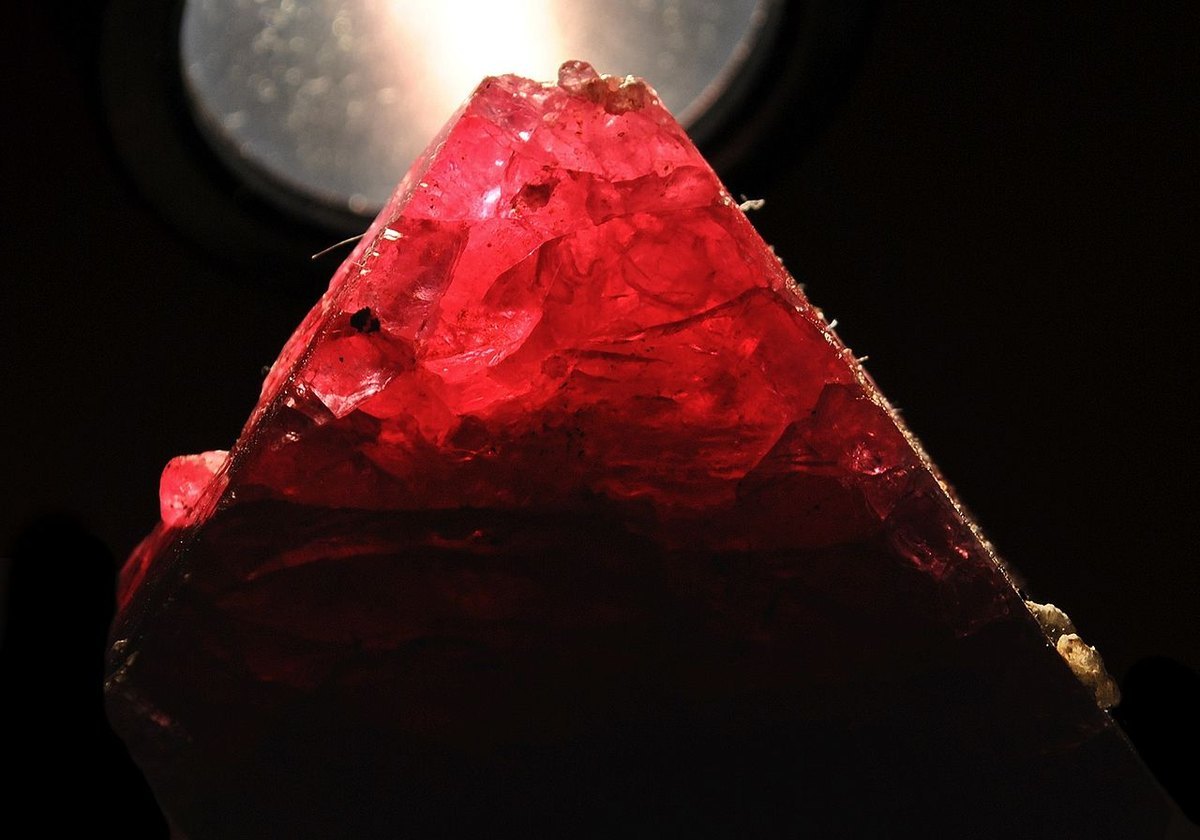
Red Spinel
For centuries called ruby by kings and conquerors, red spinel is the.
- The 170 carat Black Prince's Ruby in the British Imperial State Crown is actually a red spinel.
- The 352 carat Timur Ruby on a necklace of the British Crown Jewels is also a red spinel.
- Red spinel was named an official August birthstone alongside peridot in 2016.
- Most red spinel is untreated, setting it apart from the heat-treated ruby market.
- The historical trade name balas ruby refers to Badakhshan, a Central Asian region that produced spinel for the Silk Road.
- Ruby seekers who want comparable color at lower price points
- Engagement ring buyers drawn to untreated colored stones
- August birthstone seekers looking beyond peridot
- Collectors pursuing spinel across all its color varieties
- Readers working with root-heart chakra warmth and passion
- Buyers under $200 per carat for fine Burmese color (try garnet)
- Shoppers who specifically want the ruby name for heirloom significance
- Readers seeking ancient named tradition (red spinel was historically called ruby)
What Is Red Spinel?
Red spinel is a chromium-colored variety of the mineral spinel, magnesium aluminum oxide (MgAl₂O₄). Chromium ions substitute into the crystal lattice in trace amounts to produce the characteristic red, pink-red, and orange-red colors. It rates 8 on the Mohs hardness scale.
Spinel crystallizes in the cubic system and forms octahedral crystals in metamorphic marble environments alongside ruby, which is why fine red spinel and ruby are often mined from the same deposits in Myanmar and Tanzania.
Historically, many famous “rubies” in royal collections are in fact red spinels. The Black Prince's Ruby and the Timur Ruby, both part of the British Crown Jewels, are red spinels from Central Asia that were long misidentified. French mineralogist Jean-Baptiste L.
Rome de l'Isle formally separated spinel from corundum as a distinct species in 1783, and modern gemological testing easily distinguishes the two. The IMA symbol for spinel is Spl.
Hardness is 8 on the Mohs scale, softer than ruby (Mohs 9) but harder than most colored gemstones, making red spinel well suited to daily wear. Refractive index is approximately 1.718 to 1.735, specific gravity 3.58 to 3.80, and the stone is singly refractive (unlike ruby, which is doubly refractive).
Red spinel is typically untreated, which is a major selling point compared with ruby's standard heat treatment. Spinel was named an official August birthstone alongside peridot in 2016, giving the stone a modern consumer platform.
How Red Spinel Compares
| Property | Red Spinel | Ruby | Red Garnet |
|---|---|---|---|
| Hardness | 8 | 9 | 6.5 - 7.5 |
| Price / carat | $$ Mid-range | $$$ Premium | $ Budget |
| Rarity | Rare (fine red) | Rare (fine color) | Common |
| Best For | Engagement, daily | Heirloom, investment | Everyday jewelry |
Meaning and Symbolism
Red spinel has a centuries-long history of being mistaken for ruby, which has complicated its cultural meaning. For most of recorded gem history, the spinels in Central Asian treasuries and European crown jewels were simply called rubies or balas rubies.
The latter a trade name referring to Badakhshan, the historical mining region in present-day Tajikistan and Afghanistan.
Marco Polo described the balas ruby mines in the late thirteenth century, and spinels from these deposits passed through Mongol, Timurid, Ottoman, Mughal, and European hands over the following centuries.
Because mineralogists only formally distinguished spinel from corundum in 1783, the stone's older metaphysical meanings are inherited from ruby-associated traditions: passion, courage, royal authority, and life-force vitality. In modern crystal tradition, red spinel is traditionally associated with the root and heart chakras together.
Practitioners believe the stone supports grounded passion and warm motivation, often framing it as a lighter, more accessible counterpart to ruby for daily wear and for readers who find ruby's intensity too sharp.
The 2016 decision by the American Gem Trade Association and Jewelers of America to name spinel an official August birthstone alongside peridot has given red spinel a growing modern profile.
Contemporary jewelry designers are increasingly using red spinel as an engagement ring center stone, drawn by its natural untreated status, Mohs 8 hardness, and prices that reach only a fraction of fine ruby. This has helped red spinel build its own meaning separate from its long history of mistaken identity.
Historical Timeline
Healing Tradition
Emotional
Practitioners believe red spinel is a stone of warm, grounded passion. In crystal healing tradition, it is said to support a wearer who needs to rekindle enthusiasm after a long tired season, speak up about what they actually want, or return to creative work left behind.
Many find red spinel a useful companion during career relaunches, dating seasons, or artistic reawakenings where steady warmth matters more than dramatic intensity. Red spinel is often paired with rose quartz when the work involves keeping the heart tender alongside rising desire.
With smoky quartz when old shame needs grounding before new passion can arrive. With black tourmaline when protective clarity matters during vulnerable moments.
Practitioners tend to describe red spinel as lighter and more supple than ruby, which makes it a natural daily-wear option for readers who find ruby's energy too sharp.
Spiritual
In crystal healing tradition, red spinel is said to bridge the root and heart chakras, connecting survival energy to committed love without the weight or intensity practitioners sometimes associate with ruby.
Because spinel has no single ancient tradition of its own (its meaning was long absorbed into ruby folklore), contemporary practitioners often treat red spinel as a blank-slate stone of vitality, suited to intentional programming at purchase.
Many use red spinel during new-moon intention-setting on themes of energy, motivation, and committed work, and some practitioners wear it during creative projects, athletic training, or extended periods of steady effort. Traditional associations with the Sun and Mars in Western astrology extend to red spinel through its color and chromium chemistry.
Physical
Practitioners believe red spinel supports what they describe as steady physical vitality, circulation, and stamina, with folklore tying the stone's chromium-rich red to the body's fire element.
Crystal healing tradition associates red spinel with the same general areas as ruby (heart as physical organ, blood, overall vigor) but often frames the stone as more sustainable for long-term wear, less likely to overheat a reader's system.
Many find wearing a red spinel pendant or ring comforting during seasonal transitions, fatigue, or demanding physical projects. Red spinel is not a substitute for medical care, and practitioners frame its role as supportive rather than curative.
Readers with cardiovascular concerns, hypertension, or strong heat in the body are encouraged to rely on qualified medical guidance and treat crystal practice as one element of a broader routine.
Zodiac, Birthstone and Gifts
Red spinel, as part of the spinel family, is an official August birthstone alongside peridot since 2016. Leos, ruled by the Sun and often read in astrology as drawn to warm, confident stones, are a natural match for red spinel's fire.
Sagittarians with a love of adventure and open-hearted energy also frequently adopt red spinel for daily wear. In modern Western astrology, red spinel is associated with the Sun and Mars, echoing ruby's traditional planetary assignments.
Vedic astrology (Jyotish) treats spinel as a substitute for ruby (manik) when ruby is unavailable or contraindicated, and red spinel is often prescribed to strengthen the Sun's influence in a chart on the same principle.
Care and Cleansing
Red spinel is among the easier stones to cleanse because the material is chemically robust and not typically treated. Lukewarm soapy water and a soft brush handle daily maintenance.
Ultrasonic and steam cleaners are generally safe for untreated red spinel but should be avoided if a specific stone has been fracture-filled or glass-infilled, which is uncommon but possible.
Sunlight cleansing is traditionally recommended because red spinel is color-stable; a thirty-minute morning sun bath is sufficient. Moonlight, smoke cleansing with palo santo or sage, and sound cleansing with a singing bowl are all safe.
Dry salt placement is acceptable, and saltwater is unusually tolerable for red spinel because the stone is chemically stable, though prolonged saltwater soaks are still discouraged for metal settings. Many practitioners recharge red spinel overnight on a clear quartz cluster or selenite slab between uses.
- DO rinse red spinel in lukewarm soapy water and dry with a soft cloth after wear.
- DO NOT use ultrasonic cleaners on fracture-filled or glass-infilled red spinel.
- DO store red spinel separately so it does not scratch softer gems.
- DO NOT expose red spinel to strong household cleaners or abrasive pastes.
- DO remove red spinel rings during sports and heavy housework to protect the setting.
- DO ask for disclosure of any treatment at the point of sale; untreated is the standard for fine material.
- Note: antique “rubies” inherited in families may in fact be red spinels; a lab test can confirm identity.
Real vs Fake
Genuine red spinel is distinguished from ruby by several reliable tests. Under a dichroscope, red spinel shows a single color (it is singly refractive), while ruby shows two slightly different red tones (it is doubly refractive). Refractive index of approximately 1.718 to 1.735 is distinct from ruby (1.762 to 1.770).
Specific gravity of 3.58 to 3.80 is slightly lower than ruby (3.97 to 4.05). Common substitutes and confusions include garnet, synthetic red spinel, red glass, and ruby itself.
Under 10x magnification, natural red spinel shows characteristic octahedral inclusions, particularly small negative crystals that outline the stone's cubic symmetry, and occasionally mineral inclusions of apatite or zircon with tension halos. Natural ruby shows three-phase inclusions, silk, and color zoning different from spinel.
Synthetic red spinel (flame-fusion) shows curved striae and gas bubbles under magnification, and red glass shows mold seams and swirl marks.
A reputable gem lab report from GIA, Mindat, and USGS, a reputable lab, a reputable lab, or a reputable lab distinguishes natural red spinel from ruby, synthetic spinel, and other substitutes conclusively. For any red spinel above one carat or priced above $500 per carat, a lab report is considered worthwhile.
Historical “rubies” inherited in families should also be tested, since centuries of mistaken identity mean many antique red stones labeled as ruby are in fact red spinel (sometimes increasing rather than decreasing the stone's collector value).
Red Spinel Jewelry & Gifts
Red spinel pricing depends on color, origin, clarity, and size. Small stones under one carat in commercial red run $100 to $300 per carat. One to two carat stones with good vivid red color run $400 to $1,500 per carat.
Fine Burmese Mogok red spinel with pure saturated color above two carats reaches $2,000 to $5,000 per carat, and exceptional “jedi”-colored spinel (a trade term for hot pink-red material from Man Sin, Myanmar) can command higher prices at auction.
Burmese Mogok red spinel carries the strongest collector premium, followed by Tanzanian Mahenge spinel (a deeper pink-red from the Mahenge plateau). Tajik material from Kuh-i-Lal reaches the market occasionally with historical provenance. Treatments are uncommon; the stone is typically sold untreated, which is a major selling point over ruby.
For fine pieces above one carat, a recent lab report confirming species (to distinguish from ruby and synthetic spinel), origin, and treatment status is considered standard practice. Untreated status and documented Burmese or Tanzanian origin are the main drivers of top-tier pricing.
Where to Buy Red Spinel
Affiliate disclosure: Some links below earn us a small commission at no extra cost to you. See our affiliate disclosure page.
Handmade, raw, and tumbled pieces from independent sellers worldwide.
Shop Red Spinel on Etsy →Accessories, tools, and specimen sets with fast Prime delivery.
Shop Red Spinel on Amazon →Certified loose gemstones graded and photographed for online buyers.
Shop Red Spinel on GemSelect →Pairs Well With




Where Red Spinel Is Found


