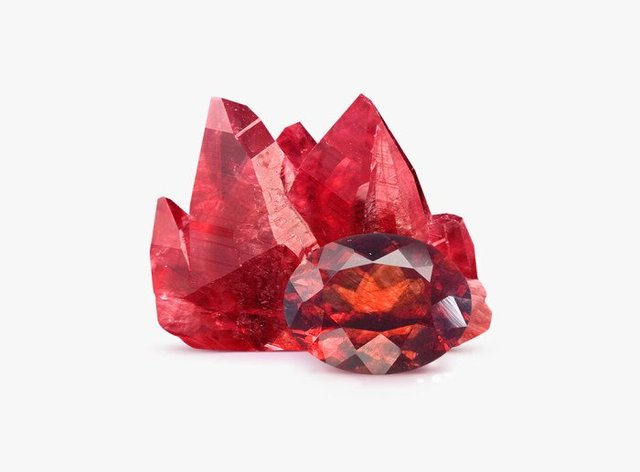
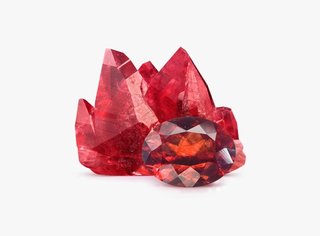
Pink in gemstones is typically a paler or lower-saturation red, with distinct optical mechanisms. Manganese colors morganite and rhodochrosite. Iron colors some pink sapphire. Trace titanium or manganese colors rose quartz. Chromium pulls pink-to-red in tourmaline.
In this guide, we cover the 12 most important pink gemstones, the optics behind the color, and the cultural history of pink, a color whose symbolic associations have changed dramatically over the last 150 years (including the well-documented 20th-century reversal of pink-versus-blue gender coding).
Pink in gemstones comes from several mechanisms. Morganite's pink is manganese (Mn2+) substituting in beryl. Pink tourmaline is manganese and sometimes titanium. Pink sapphire is a chromium-plus-iron mix in corundum, shading from red (ruby) down to pink as chromium content decreases.
Rose quartz is colored by dumortierite or titanium microfibers, not dissolved impurities. Rhodochrosite and rhodonite get their pink from manganese in their primary lattice.
Rose quartz is the pink variety of quartz. Mohs 7. Most colors derive from pink dumortierite microfibers, not dissolved chromophores. Brazil is the primary commercial source. Massive material is common; gem-grade transparent rose quartz is rarer.
Morganite is the pink variety of beryl (Be3Al2Si6O18), colored by manganese. Mohs 7.5 to 8. Named for financier J.P. Morgan in 1911 by George F. Kunz. Major sources include Brazil and Madagascar.
Pink tourmaline is an elbaite silicate colored by manganese. Mohs 7 to 7.5. Rubellite is the deepest red-pink tourmaline variety. Brazil is a major source.
Rhodochrosite is manganese carbonate. Mohs 3.5 to 4. Argentina and Colorado produce exceptional material. Banded “Inca rose” varieties are popular for carvings.
Kunzite is the pink-lilac variety of spodumene (LiAlSi2O6). Mohs 6.5 to 7. Perfect cleavage requires careful setting. Color can fade in prolonged strong sunlight (sometimes called an “evening stone” for this reason).
Pink diamond is one of the rarest diamond colors, produced by lattice distortion rather than chemical impurity. Mohs 10. The Argyle mine (closed 2020) historically produced the majority; remaining stones appreciate rapidly.
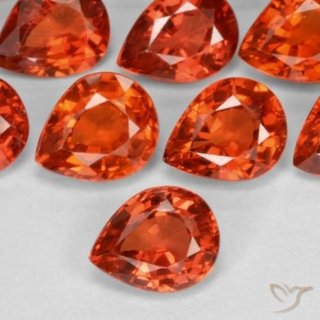
Natural pink topaz is rare (historically from Ouro Preto, Brazil). Most pink topaz in commerce is produced by heating pink-tinged yellow topaz. Mohs 8.
P
11
Pezzottaite
Pezzottaite is a cesium-rich beryl-family mineral discovered in Madagascar in 2002. Pink to raspberry. Mohs 8. A collector curiosity.
Pink opal is an opaque Peruvian opal variety colored by palygorskite impurities. Mohs 5.5 to 6.5. No play-of-color, just soft pastel pink.
Cultural history of pink
Pink has had a volatile symbolic history. In 18th-century Europe, pink (called rose) was worn by aristocratic men and was considered a diluted form of red, hence martial and vigorous. In early 20th-century US, pink was commonly recommended for boys and blue for girls.
The modern pink-girl / blue-boy coding emerged in the 1940s and 50s via marketing. Pink ribbon campaigns (breast cancer awareness, starting 1992) made pink a public-health symbol. Contemporary pink signals range from punk (sex pistols shocking pink) to millennial aesthetics to gender-expansive identity.
Pink gemstones by intent
For engagement rings: pink sapphire (Mohs 9), pink diamond (premium), morganite with care.
For birthstone jewelry: pink tourmaline (October alternate).
For gift pendants: rose quartz (budget), morganite (mid-tier), pink sapphire (premium).
For collectors: Argyle pink diamond, Mahenge spinel, Russian rhodochrosite.
Buying notes and care
Morganite: typically heat-treated to remove orange; stable and disclosed.
Pink sapphire: heat-treated in most commercial material; unheated commands premium.
Kunzite: can fade in strong sunlight; keep display indoors.
Rhodochrosite: very soft; handle and clean gently, avoid acids.
Frequently asked questions
What is the most popular pink gemstone?
Rose quartz is the most popular at affordable pricing. Morganite is the rising star in engagement rings for its warm color at moderate cost. Pink sapphire leads at fine-jewelry pricing.
Is pink sapphire the same as ruby?
Pink sapphire and ruby are both red corundum; the line between them is a judgment call based on color saturation. An independent gemological lab uses strict threshold criteria; some trade sellers are looser.
Will rose quartz fade?
Most rose quartz is stable. Some deeply-colored material can pale slightly under prolonged UV. Display out of direct sun for maximum color retention.
Why is pink diamond so expensive?
Pink diamond is extraordinarily rare, with natural production measured in small quantities annually. Argyle mine closure in 2020 further constrained supply, driving price appreciation.
What chakra is pink linked to?
Crystal tradition pairs pink with the heart chakra, especially for self-love and gentle emotional work. See our heart chakra stones page.