
Morganite
Named for J.P. Morgan and colored by trace manganese, morganite is the peachy-pink beryl adored for soft, romantic engagement rings.
- Morganite was named after financier J.P. Morgan, one of the great mineral collectors of the Gilded Age.
- The Rose of Maine, a 50-pound morganite crystal found in Buckfield, Maine in 1989, is one of the largest gem beryls ever discovered.
- Morganite is in the same mineral family as emerald and aquamarine; only the trace element changes the color.
- The color of morganite can shift subtly under warm versus cool light, a phenomenon jewelers call pleochroism.
- Most morganite on the market is gently heated to enhance the cool pink tone; the treatment is stable and industry-accepted.
- Engagement ring buyers wanting a soft, romantic alternative to diamond
- Brides building a rose-gold wedding set with warm pink stones
- Gift givers shopping for Valentine's Day, anniversaries, or new motherhood
- Readers working with heart chakra practice who want a faceted stone
- Collectors of the beryl family (emerald, aquamarine, heliodor)
- Buyers on a strict budget (consider rose quartz or kunzite)
- Those who want a vivid, saturated pink (try pink sapphire)
- Daily-wear ring buyers seeking maximum scratch resistance (consider sapphire)
What Is Morganite?
Morganite is the peachy-pink variety of beryl, the same mineral family as emerald (green), aquamarine (blue), and heliodor (yellow). It rates 7.5 - 8 on the Mohs hardness scale.
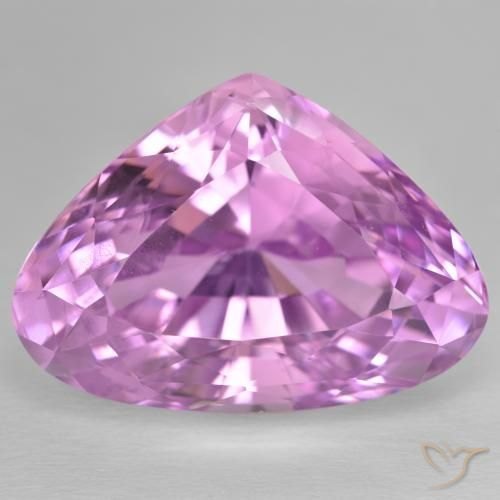
The pink color comes from trace manganese, and the shade ranges from pale salmon to a soft rose to a deeper, more peach-tinged pink. Most commercial morganite leans toward the lighter end of this range.
At Mohs 7.5 to 8, morganite is harder than rose quartz but slightly softer than topaz. It is well suited to daily-wear jewelry in protected settings, although energetic knocks should be avoided because beryl has a tendency toward brittle cleavage.
Morganite forms in pegmatite veins alongside aquamarine and other beryls. Large, clean crystals are scarce, which is why most commercial material is faceted in larger sizes (2+ carats) to show off color density rather than in small melee.
The stone was first described in 1911 by George Frederick Kunz, the prominent American gemologist, who named it in honor of financier and mineral patron J.P. Morgan.
Most morganite on the market is gently heated to remove yellow undertones and enhance the cool pink shade. This treatment is stable, industry-accepted, and essentially permanent, and it should be disclosed by reputable sellers. Untreated morganite with fine natural color commands a modest premium.
How Morganite Compares
| Property | Morganite | Pink Sapphire | Rose Quartz |
|---|---|---|---|
| Hardness | 7.5 - 8 | 9 | 7 |
| Price / carat | $$ Mid-range | $$$ Premium | $ Budget |
| Rarity | Uncommon | Rare | Common |
| Best For | Rose-gold engagement rings | Heirloom jewelry | Healing work, facial rollers |
Meaning and Symbolism
Morganite is a relatively new gem in historical terms, first described in 1911 by prominent American gemologist George Frederick Kunz. Kunz named the stone for J.P. Morgan, one of the most influential mineral collectors of the nineteenth century, whose collection became foundational to the American Museum of Natural History.
Before 1911, the stone was known informally as pink beryl and traded at modest prices without much marketing identity.
The modern morganite boom began in the 2010s as rose-gold wedding jewelry rose in popularity. The warm pink of morganite pairs beautifully with rose-gold settings, and the larger size available at moderate prices made it a natural alternative to small diamonds in engagement rings.
It is now one of the most popular non-diamond engagement stones on the American market.
In crystal healing tradition, morganite is associated with divine love, compassion, and heart-centered healing. Practitioners describe it as similar in energetic quality to rose quartz but with a clearer, more focused quality appropriate for active romantic partnership rather than passive self-love work.
It pairs naturally with aquamarine as its beryl sibling and with kunzite for combined pink-stone work.
Historical Timeline
Healing Tradition
Emotional
Practitioners believe morganite supports emotional healing centered on active partnership and mature love. In crystal healing tradition, it is often recommended for engaged or married couples, for people re-entering dating after grief, and for anyone working through the practical patience that sustained relationships require.
Many readers wear morganite jewelry during relationship-focused periods of life, and practitioners sometimes recommend sleeping with a tumbled stone on the bedside table during engagement or wedding preparation weeks.
Practitioners pair morganite with rose quartz when the emotional work bridges self-love and partnership, and with amethyst when clarity of mind is needed alongside tenderness.
Because its reputation is focused and clear rather than broadly receptive, morganite is sometimes described as a stone for mature heart-work rather than first-wave healing.
Spiritual
Morganite is traditionally associated with the heart chakra and with what crystal workers call the higher heart or divine-love center. Practitioners describe it as clarifying rather than opening, supporting discernment about where to invest love.
Many readers keep a faceted morganite or a small tumbled piece on a meditation altar during relationship-intention work, and some set a morganite at the center of a wedding-preparation grid surrounded by clear quartz points.
In modern crystal healing tradition, morganite is sometimes linked with angelic or Christ-consciousness frameworks and is used in practices focused on divine love as a spiritual force. It pairs readily with aquamarine in grids and is said to add a quality of tender clarity to devotional work.
Physical
Practitioners believe morganite supports what they describe as heart and chest-area rhythm balance, echoing the classical connection between pink stones and cardiovascular wellness. Folk tradition links it with relief from stress-related chest tightness and with general soothing of nervous-system overwhelm.
In modern crystal healing practice, morganite is most often placed over the heart or along the sternum during sessions focused on relationship stress or grief recovery.
Many readers wear a morganite pendant or ring during periods of relationship transition and describe the stone as a visual anchor of tenderness during difficult conversations. It is not a substitute for medical care, and practitioners frame its role as supportive alongside proper treatment.
Because morganite is harder than rose quartz and chemically stable, it is a practical daily-wear option for readers who want heart-stone energy in a durable jewelry form.
Zodiac, Birthstone and Gifts
Morganite is strongly associated with Venus-ruled signs in Western astrology, particularly Taurus and Libra. Practitioners describe morganite as an ally for Taurus's long-term commitment temperament and for Libra's partnership focus. For Cancer, morganite is sometimes recommended as a supporting stone for tender family bonds and emotional steadiness.
Although morganite is not a formal US birthstone, it is an increasingly popular engagement-ring choice for weddings in any month and is sometimes given as a sentimental alternative to a classic February amethyst or October pink tourmaline.
Care and Cleansing
Morganite is among the easier gems to maintain. Warm soapy water and a soft brush are safe for most stones, and this is the recommended routine cleansing method for set jewelry.
Ultrasonic and steam cleaners are generally safe for untreated or heat-treated morganite but should be avoided for fracture-filled stones or antique settings.
Moonlight cleansing is traditional and carries no risk. Smoke cleansing with palo santo or sage is effective and also safe, as is sound cleansing with a singing bowl. Saltwater soaks are chemically safe for the stone but may corrode metal settings on jewelry and should be limited.
The one method to approach with care is prolonged direct sunlight. Some morganite fades slightly with months of UV exposure, so storing jewelry in a pouch or box when not worn is the traditional advice. Many readers cleanse morganite on a selenite plate overnight before engagements, weddings, or anniversary-focused rituals.
- DO rinse morganite jewelry in warm soapy water and dry with a soft cloth.
- DO NOT leave morganite in prolonged direct sunlight; color can fade over months.
- DO remove morganite rings before gardening, lifting, or heavy housework to protect the setting.
- DO NOT use ultrasonic cleaners on fracture-filled or oil-treated morganite.
- DO store morganite in a soft pouch separate from harder stones.
- DO ask for treatment disclosure; most commercial morganite is gently heated.
- Note: the beryl family is slightly brittle; avoid sharp impacts on prongs and edges.
Real vs Fake
Genuine morganite shows a soft natural peachy-pink color, distinct pleochroism (color shift between light sources), and may contain small liquid or crystal inclusions under 10x magnification. Stones that appear perfectly uniform and intensely saturated are either top-grade natural morganite (with documentation) or suspicious imitations.
Common imitations include pink glass (cold to touch, often shows gas bubbles or swirl patterns), synthetic spinel or synthetic corundum in pink shades (different refractive indices), pink cubic zirconia (heavier and more sparkly than morganite), and heated or dyed quartz.
A basic gemological test with a refractometer quickly separates morganite from most imitations, and hardness scratches against corundum or topaz can rule out softer fakes.
Within the morganite market itself, the most important distinction is between natural-color and heat-treated material. Heat treatment is standard, stable, and industry-accepted, but untreated stones with fine color command a modest premium. For any significant purchase, ask the seller to disclose treatment in writing.
Synthetic morganite grown in laboratories is rare because the natural material is moderately priced, but it does exist. A gemological laboratory report using advanced spectroscopy can separate synthetic from natural origin for stones where the price justifies it.
Morganite Jewelry & Gifts
Morganite is a mid-market gem with prices ranging from $80 per carat for small, pale commercial stones to over $500 per carat for large, clean, saturated Brazilian or Malagasy material.
A standard 1-2 carat faceted morganite for a rose-gold engagement ring typically runs $150 to $300 per carat. Larger sizes (5+ carats) with strong color can reach $400 to $600 per carat. The most important buying variable is color saturation. Pale morganite is abundant; richer peachy-pink material commands significant premium.
Heat treatment is nearly universal and should be disclosed. When buying, look at color in daylight and incandescent light to assess pleochroism, check eye-clean clarity under a 10x loupe, and choose a cut that maximizes color face-up.
Oval, cushion, and emerald cuts are traditional favorites because they carry color well. For engagement rings, choose a protective halo or bezel setting because beryl has slight cleavage and can chip on exposed prongs. Reputable sellers will disclose origin (Brazil, Madagascar, Mozambique, Maine) and treatment status.
Where to Buy Morganite
Affiliate disclosure: Some links below earn us a small commission at no extra cost to you. See our affiliate disclosure page.
Handmade, raw, and tumbled pieces from independent sellers worldwide.
Shop Morganite on Etsy →Accessories, tools, and specimen sets with fast Prime delivery.
Shop Morganite on Amazon →Certified loose gemstones graded and photographed for online buyers.
Shop Morganite on GemSelect →Pairs Well With



Where Morganite Is Found


