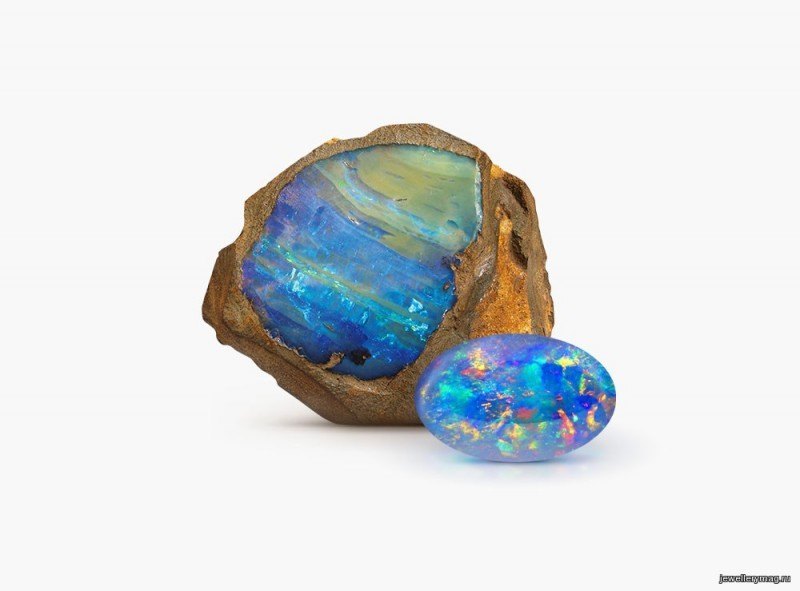
October has two modern birthstones: opal and tourmaline. Each one is almost an entire category in itself. Opal is the play-of-color stone that shifts between rainbow flashes as it moves in the light.
It ranges from the milky white base common in Australia to the dark body color black opal from Lightning Ridge and the glassy bright Ethiopian welo.
Tourmaline is a mineral group that covers nearly every color a reader can name, including the distinctive watermelon slices that show pink and green in one crystal.
The two stones suit very different preferences. This page covers both, flags the care opal requires, and lays out tourmaline’s color families so a buyer can find the right October piece.
The two October birthstones
Top October gemstone picks


Opal
Opal is a hydrated silica gel that forms in voids in volcanic or sedimentary rock. Play of color comes from stacked microscopic silica spheres that diffract light like a biological structural color.
Opal contains water (typically three to ten percent), which is why dry heat, ultrasonic cleaning, and sudden temperature change can crack the stone, a condition the trade calls crazing.
Australian precious opal, Ethiopian welo opal, and Mexican fire opal are the main sources; Lightning Ridge in Australia is famous for black opal with a dark body color that makes the play of color sing.
Tourmaline
Tourmaline is a borosilicate mineral group that crystallises in elongated prisms and produces gems in almost every color. Elbaite is the chemical group that produces most gem tourmaline.
Commercial colours include: rubellite (pink to red), indicolite (blue), verdelite (green), paraiba (a neon cuprian blue to green, mined in Brazil, Nigeria, and Mozambique), chrome tourmaline (saturated chromium green), and watermelon (a bicoloured crystal with pink core and green rim sliced for display).
A short history of the October stone
Opal was prized by Romans who called it opalus, the queen of gems. Its reputation wavered in the Victorian period because of the 1829 Walter Scott novel Anne of Geierstein, which portrayed opal as a portent of bad luck; the superstition took and persisted in some quarters into the twentieth century.
Australian discoveries in the late nineteenth century brought opal back as a major jewelry stone. Tourmaline was known in Europe from Sri Lankan imports in the eighteenth century; its modern prominence dates from Brazilian paraiba discoveries in the 1980s.
Meaning and tradition
Practitioners have long associated opal with creativity, inspiration, and emotional range because of its color play. Tourmaline, particularly black tourmaline (schorl), is widely carried in crystal tradition as a protective stone said to absorb negative energy; the coloured tourmalines carry associations that match their color.
- Traditional associations are not medical advice.
- Opal should never go in an ultrasonic or steam cleaner.
- Avoid hot cars, dry heat, and sudden temperature changes.
- Wipe opal gently with a soft damp cloth; avoid solvent cleaners.
- Doublet and triplet opals (thin slice bonded to a dark backing) should never be submerged.
Is an October stone right for you?
- You love shifting color that changes as the piece moves (opal).
- You want a hard stone in a wide color palette (tourmaline).
- You like visually unique stones over classic looks.
- You are willing to give opal the care it asks for.
- You need a daily ring that takes hard impact (opal is delicate).
- You want the consistent look of a single color (opal is always playing).
- You dislike the strong color saturation of some tourmaline varieties.
Gift ideas and pairings
For an October birthday, an Australian opal pendant in yellow gold shows play of color without the wear concerns of a ring. Black opal earrings are a dramatic gift.
Tourmaline is the easier daily wear pick: a watermelon tourmaline slice pendant, a pink tourmaline stud set, or a classic emerald cut green tourmaline in yellow gold all read well. Paraiba is the ultra tier option for a very special October gift.
Zodiac overlap for October
October spans Libra (through October 22) and Scorpio (from October 23). Libra is traditionally given opal and lapis; the October opal pairing is perfect for Libra. Scorpio leans toward darker stones like topaz, obsidian, and black tourmaline; Scorpio readers often prefer black tourmaline or topaz to opal.