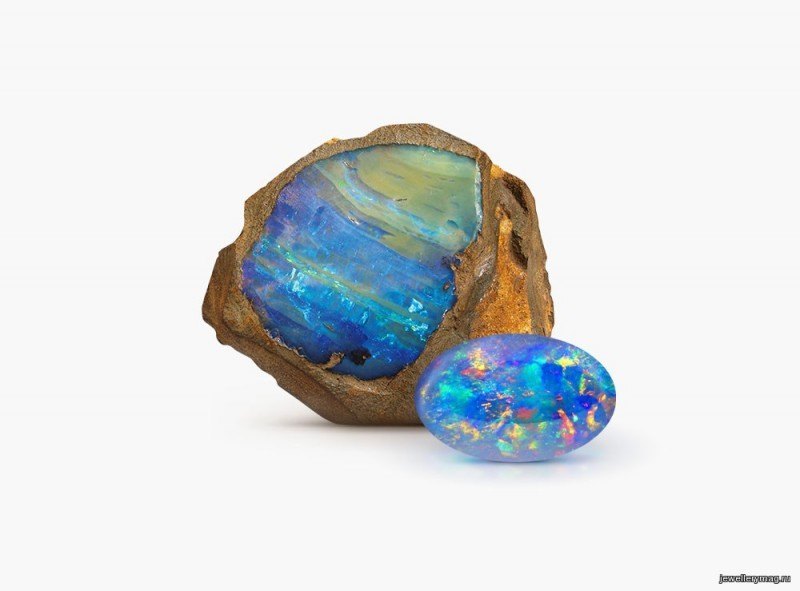
Opal
A hydrated silica spun with sub-micron spheres, opal is the October birthstone famed for its rainbow.
- Australia has supplied over 90 percent of the world's precious opal since the early twentieth century.
- Opal contains water; extremely dry conditions can eventually cause some stones to craze (develop fine internal cracks).
- Hydrophane Welo opals can temporarily absorb water and become transparent, returning to opaque as they dry.
- Opal is the state gem of both Australia and South Australia, and Queensland, and the official gemstone of Nevada.
- The Virgin Rainbow, a 1.4-kilogram Coober Pedy opal, is considered one of the most valuable opals ever found.
- October birthstone seekers shopping for a gift with rainbow play-of-color
- Romantics who want a stone that looks different from every angle
- Practitioners working with creativity, emotion, and the crown chakra
- Buyers drawn to organic, nature-like patterns in jewelry
- Those willing to give a softer stone gentle care in exchange for unique beauty
- Daily-wear engagement ring shoppers (consider sapphire or moissanite instead)
- Buyers who want low-maintenance jewelry that tolerates rough handling (try ruby or spinel)
- Those sensitive to care fussiness (try quartz varieties or topaz)
What Is Opal?
Opal is a hydrated, amorphous form of silica with a water content that typically ranges from three to twenty-one percent. Unlike most gemstones, it does not have a crystal lattice; instead, precious opal is composed of stacked sub-micron silica spheres that diffract light into rainbow flashes known as play-of-color.
The regularity and size of those spheres determine whether a stone fires red, green, blue, or a full spectrum. Common opal, sometimes called potch, lacks this regular sphere structure and shows no play-of-color.
Opal forms when silica-rich groundwater seeps into cavities and fractures in host rock, slowly depositing silica gel that sets over geological time. Australia supplies the majority of precious opal globally, including black opal from Lightning Ridge, white opal from Coober Pedy.
Boulder opal from Queensland where the gem is still attached to its ironstone matrix. Ethiopia's Welo Province has produced hydrophane opal since 2008, a dramatic new source that can absorb water and temporarily change appearance.
The main trade categories are black opal (dark body tone with play-of-color, most valuable), white opal (light body tone, widely available), fire opal (transparent orange or red body with or without play-of-color, primarily from Mexico), boulder opal (natural ironstone backing), and crystal opal (transparent to translucent with play-of-color).
Doublets and triplets are assembled stones with a thin opal slice glued to a backing and should always be disclosed at lower prices.
How Opal Compares
| Property | Opal | Moonstone | Labradorite |
|---|---|---|---|
| Hardness | 5.5 - 6.5 | 6 - 6.5 | 6 - 6.5 |
| Price / carat | $ Budget | $ Budget | $ Budget |
| Optical Effect | Play-of-color | Adularescence | Labradorescence |
| Best For | Pendants, occasional rings | Everyday pendants | Everyday casual |
Meaning and Symbolism
Opal's name comes from the Sanskrit upala, meaning precious stone, through the Greek opallios and Latin opalus. Pliny the Elder wrote that opal contained the fires of carbuncle, the brilliance of amethyst, and the sea-green of emerald all in a single stone.
Roman senators prized opal as a symbol of hope and purity, and one famous account describes the senator Nonius choosing exile over surrendering a hazelnut-sized opal to Mark Antony.
Medieval Europeans associated opal with vision and the ability to become invisible, leading to its reputation as a thieves' stone. The gem's popularity collapsed briefly after Sir Walter Scott's novel Anne of Geierstein (1829), whose fatal opal was widely misread as proof of bad luck.
Queen Victoria singlehandedly restored opal's reputation by favoring Australian stones in her jewelry after the 1880s, and the trade has never looked back.
In modern crystal healing tradition, opal is associated with creativity, emotional expression, and amplification of the wearer's own qualities. Practitioners believe it supports the crown and heart chakras and many find it a responsive stone that reflects mood back rather than imposing a fixed vibration.
Opal is the traditional October birthstone and the gift for the fourteenth wedding anniversary.
Historical Timeline
Healing Tradition
Emotional
Practitioners believe opal is a mirror stone that amplifies whatever emotional state the wearer brings to it. In crystal healing tradition, it is said to heighten spontaneity, creativity, and emotional expression, which is why many find it useful during artistic projects, songwriting, or open-hearted conversations.
Practitioners often caution that opal's amplifying reputation means it can intensify anxiety or overwhelm as easily as joy; for that reason, opal is traditionally paired with grounding stones like hematite or smoky quartz when someone is already emotionally activated.
Because the stone is traditionally associated with Venus, opal has long been used in love-related rituals and for supporting vulnerable honesty between partners. Many readers keep opal for evening wear rather than high-stress daytime use, treating it more like a theater costume than an everyday uniform.
Spiritual
In crystal healing tradition, opal is associated with the crown and heart chakras, and practitioners believe it supports visionary states, dreamwork, and connection with what some traditions call the higher self.
Opal's play-of-color is often interpreted metaphorically as the many facets of consciousness, and the stone has long been used during solo retreats, creative incubation, and the new-moon portion of lunar cycles. Black opal is considered especially powerful in this regard; white opal is lighter and more everyday.
Hydrophane opals from Ethiopia, which temporarily change with water, have attracted practitioners who work with themes of permeability and transformation. Opal is traditionally said to enhance psychic receptivity, a reputation practitioners treat with respect and hedging rather than certainty.
Physical
Practitioners believe opal's water content ties it to fluid systems in the body and to what traditions describe as the eyes. Folklore from medieval Europe associated opal with clear vision and with the gentle nervous system, and some practitioners still rest a polished opal briefly on closed eyes during meditation.
Opal is not a substitute for medical care, and its fragility means it is usually not worn against skin in the way harder stones are. Australian Aboriginal traditions describe opal as the fallen colors of the rainbow serpent, a story that practitioners treat with respect when working with the stone.
Readers prone to emotional overwhelm are traditionally advised to wear opal only briefly and to ground afterward with tea, a walk, or a grounding stone.
Zodiac, Birthstone and Gifts
Opal is the modern US birthstone for October, shared with tourmaline, and serves Libras born in the first three weeks and Scorpios born later in the month. Astrologers traditionally associate opal with Venus, which resonates with Libra's aesthetic, relational orientation.
For Scorpio, opal offers a softer, more expressive counterpoint to the sign's intensity, and some astrologers recommend black opal specifically as a Scorpio-friendly option.
Practitioners often suggest choosing the opal type that matches one's energetic need: white opal for gentle everyday support, black opal for depth work, fire opal for creative fire, and boulder opal for grounded, nature-connected expression.
Care and Cleansing
Opal needs gentle cleansing. Wipe with a soft damp cloth to remove skin oils and dust, and dry immediately with a lint-free cloth. Avoid prolonged soaking, hot water, ultrasonic cleaners, and steam.
Australian opals tolerate brief contact with lukewarm water; Ethiopian hydrophane opals should never be soaked because they can absorb water, turn temporarily transparent, and sometimes fail to return to their original appearance.
Moonlight is the traditional cleansing method for opal given its lunar, Venusian character. Smoke cleansing with palo santo or sage is safe, as is sound cleansing with a soft singing bowl or tuning fork. Avoid salt (dry or wet), direct sunlight for long periods, and any chemical cleaners.
Many practitioners recharge opal in a small bowl of water resting beside, but not touching, another bowl of charged water, preserving the stone from direct contact. Store opal separately from harder stones to prevent scratching.
- DO store opal in a soft pouch separate from harder jewelry to prevent scratches.
- DO NOT soak opal, especially hydrophane Ethiopian opal, in water for prolonged periods.
- DO keep opal away from sudden temperature changes; extremes can cause crazing (internal cracking).
- DO NOT use ultrasonic cleaners, steam, bleach, or household solvents on opal.
- DO remove opal rings before washing hands, gardening, or using lotions and perfumes.
- DO NOT leave opal in very dry environments (like a hot car or safe-deposit box) for long periods.
- Note: doublets and triplets should never be submerged; water can seep between the glued layers.
Real vs Fake
Genuine opal shows a play-of-color that shifts as you rotate the stone; the colors move through broad patches, pinfire points, or rolling flashes, and the effect is three-dimensional. Synthetic opal (Gilson, Kyocera) can show a very regular mosaic pattern, sometimes called lizard skin or honeycomb structure, visible under magnification.
Plastic imitations (opalite, Slocum stone) often have a flat, glassy appearance with color that sits on the surface rather than within the stone.
A classic test is to view the stone from the side: natural opal's color patches should extend down into the stone, while doublets and triplets show a clean dark line where the opal slice meets the backing.
Triplets add a protective clear dome on top and look perfectly glassy; a cabochon that is too perfectly domed and too thin deserves a second look. Weight helps: solid opal is light (specific gravity around 2.1) while glass imitations are noticeably heavier.
For Ethiopian Welo opals, check whether the stone is described as hydrophane; if so, avoid water contact and be aware that the stone's appearance may change temporarily with humidity.
For any opal over a few hundred dollars, insist on origin disclosure, treatment disclosure (smoke treatment, sugar-acid treatment, and polymer impregnation are all in use), and ideally a lab report. Reputable Australian dealers include locality information (Lightning Ridge, Coober Pedy, Queensland) on certificates.
Opal Jewelry & Gifts
Opal pricing is driven by body tone, brightness, pattern, dominant color, and origin. White opals from Coober Pedy start around $10 to $100 per carat for commercial stones and rise to $500 per carat for bright multi-color pieces.
Black opals from Lightning Ridge begin around $200 per carat for small pinfire stones and exceed $10,000 per carat for top-gem red-on-black specimens. Boulder opals from Queensland price by piece rather than carat because the ironstone backing is integral.
Ethiopian Welo opals run roughly $30 to $500 per carat for bright crystal material.
Common disclosures include doublets (thin opal on dark backing), triplets (doublet plus clear dome), smoke treatment (for Welo opals), and polymer impregnation. Each treatment should be marked at purchase and priced accordingly.
solid natural Australian opal remains the benchmark for fine jewelry, and Ethiopian hydrophane opal has emerged as a popular mid-tier option when properly disclosed. For engagement or heirloom pieces, ask for lab confirmation of solid (not assembled) opal and of the origin country.
Where to Buy Opal
Affiliate disclosure: Some links below earn us a small commission at no extra cost to you. See our affiliate disclosure page.
Handmade, raw, and tumbled pieces from independent sellers worldwide.
Shop Opal on Etsy →Accessories, tools, and specimen sets with fast Prime delivery.
Shop Opal on Amazon →Certified loose gemstones graded and photographed for online buyers.
Shop Opal on GemSelect →Pairs Well With


Where Opal Is Found


