The third eye chakra, called Ajna in Sanskrit, sits between and slightly above the brows. It is the sixth of the seven classical chakras. In modern crystal healing tradition, practitioners associate it with intuition, inner sight, and clear perception.
In this guide, we gather the 9 stones most often paired with the third eye chakra, with hedged use notes and mineralogy cited throughout. This is documented tradition. Stones are used as supports for reflection and ritual, not as medical tools. Mineralogy is factual; symbolism is hedged.
Third eye chakra at a glance
Sanskrit name
Ajna
Location
Between and slightly above the brows
Element
Light
Color association
Indigo, deep violet-blue
Number of petals
2 (with 96 inner divisions in some systems)
Seed sound (bija)
Om / Aum
Theme
Intuition, insight, perception, inner sight
Zodiac cross-reference
Pisces, Sagittarius, Aquarius
9 stones traditionally associated with the third eye chakra
The third eye list is dominated by deep blue, violet, and iridescent stones. Amethyst is the crossover stone that also appears on crown lists. Lapis, sodalite, and azurite hold the dark-blue end. Labradorite, moonstone, and iolite bring the shifting-light character practitioners associate with intuitive work.
Amethyst, the purple quartz, is the crossover third eye plus crown stone. Its dark-violet saturation aligns with the traditional third eye color. Mohs 7.
Iolite, the gem variety of cordierite, is strongly pleochroic (shows different colors at different angles). Historically called the “Viking's compass” stone for its use as a polarizing lens. Mohs 7 to 7.5.
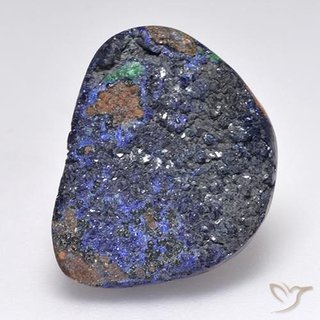
Azurite, a deep blue copper carbonate, is associated in crystal writing with what practitioners describe as piercing inner sight. Mohs 3.5 to 4; soft, avoid water and acids.
Fluorite, especially purple and rainbow-banded material, is paired with third eye for what practitioners describe as mental clarity and pattern recognition. Mohs 4; soft.
Clear quartz is the amplifier, paired with any third-eye stone for practitioners who want to intensify focus. Mohs 7.
How practitioners place third eye stones
Lie flat on the back, a light blanket over the body, eyes closed.
Place one small, smooth stone on the forehead between and slightly above the brows.
Breathe slowly, in for four counts and out for six, for several cycles.
Set a hedged intention such as “I am willing to notice what I notice.”
Stay 5 to 10 minutes on first sessions.
Close by lifting the stone, thanking the practice, and blinking slowly back into the room.
Cleanse after: sound bath is safe for all. Avoid water on azurite, celestite, and most soft carbonates.
When practitioners turn to third eye stones
For you if...
Decision fatigue and clarity practice
Dream journaling and sleep memory work
Meditation focus when thoughts race
Creative insight rituals
Consider other options if...
In place of clinical care for sleep disorders or cognitive issues
Expecting medical outcomes
Wetting azurite or other soft copper minerals
Third eye stones for jewelry
Third eye work is often done with small circlets, headbands with a focal stone, or long pendant chains that let the wearer touch the stone to the brow during meditation. Pierced crown rings or stud earrings with small amethyst or moonstone serve some practitioners as daily cues.
Third eye stone pairings
Common pairings include amethyst with clear quartz (amplified crown plus third eye), labradorite with moonstone (doubled light play for dream work), and lapis with sodalite (deep blue clarity).
Frequently asked questions
What is the main third eye chakra stone?
Amethyst is the most-cited third eye stone in modern sources, often paired with labradorite for intuitive work specifically.
Is the third eye a physical thing?
In yogic tradition, Ajna is an energetic center, not a physical organ. Some writers loosely connect it to the pineal gland by position, but this is a metaphor, not an established anatomical claim.
Can I sleep with a stone on my forehead?
Lying on the back briefly is safe with a stable stone. Do not roll over with a stone on the face. Many practitioners use a pillow beside the head instead for overnight support.
Are third eye stones safe for children?
Small stones are choking hazards for young children. For older children, tumbled stones in pouches are safer than raw crystals. Always supervise stones near the face.
What color is the third eye chakra?
Indigo is traditional, sometimes described as deep violet-blue. Some systems extend to purple and blue-violet.