Blue gemstones range from the royal-navy saturation of sapphire to the pale sky tone of aquamarine, and the mechanisms behind each blue differ. Iron, titanium, copper, vanadium, cobalt.
Charge-transfer interactions all produce blue in minerals, and the exact wavelength the stone transmits or absorbs determines whether it reads cornflower, cerulean, teal, or indigo.
In this guide, we cover the 14 most important blue gemstones, the optics behind the color, the mineral families involved. The cultural history of blue itself, from ancient Egyptian lapis glazing to Yves Klein's trademark ultramarine and the way blue became.
Unusually for antiquity, the color of mourning in Byzantium and the color of divine maternity in Western religious art.
Most blues in gemstones come from one of several mechanisms. Sapphire's blue is a charge-transfer coupling between iron (Fe) and titanium (Ti) in corundum. Aquamarine's pale blue is from iron (Fe2+) in beryl. Lapis lazuli's blue is sulfur-radical centered color from lazurite (Na8-10Al6Si6O24S2-4). Turquoise's blue is from copper in its copper-aluminum-phosphate lattice.
Tanzanite's blue-violet is vanadium-driven. Each blue has its own spectral fingerprint, visible in a spectroscope to a trained gemologist.
Sapphire is corundum (Al2O3). Mohs 9, second only to diamond among common gems. Kashmir, Myanmar (Burma), and Sri Lanka (Ceylon) are the most famous blue origins. Most commercial blue sapphire is heat-treated to deepen color; unheated stones command significant premiums.
Aquamarine is the blue variety of beryl (Be3Al2Si6O18). Pale to medium blue, Mohs 7.5 to 8. Brazil and Madagascar are major sources. Heat-treatment removes yellow tones from mixed aquamarine rough.
Lapis lazuli is a metamorphic rock composed mainly of lazurite with calcite and pyrite. Afghanistan (Sar-e-Sang deposit) has been mined for lapis since at least 7000 BCE. Mohs 5 to 6.
Turquoise is a copper aluminum phosphate. Mohs 5 to 6. Iran and the US Southwest are the dominant fine sources. Stabilization treatment (resin impregnation) is common and should be disclosed.
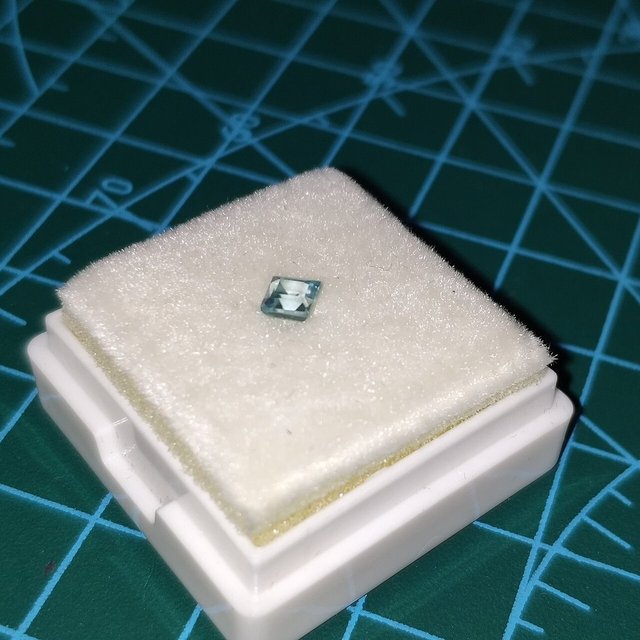
Blue zircon (ZrSiO4) gets its sky to teal blue from heat treatment of Cambodia-sourced brown rough. Mohs 7.5 with exceptional brilliance and dispersion (higher than diamond on some measures).
Larimar is a rare blue pectolite, mined only in the Dominican Republic. Mohs 4.5 to 5; protect from chemicals and heat.
B
14
Blue tourmaline
Blue tourmaline, most famously the indicolite variety, is part of the tourmaline silicate group. Mohs 7 to 7.5.
Cultural history of blue
Blue is the color most prized across multiple ancient cultures for symbolic use. The Egyptians mined lapis from Afghanistan for pharaonic burials, ground it for eye shadow, and glazed faience vessels with copper-silicate blue.
Medieval European painters reserved ground lapis pigment (ultramarine) for the robes of the Virgin Mary because the material cost more than gold. Chinese Qing dynasty emperors wore blue silk for the annual Temple of Heaven ceremony.
Blue became the color of Navy, police, and post services in the 19th century; today it is the single most-preferred color in global consumer surveys.
Blue gemstones by intent
For engagement rings: blue sapphire (Mohs 9), the only routinely-used blue stone durable enough for daily ring wear.
For daily necklaces: aquamarine, blue topaz (irradiated), tanzanite in pendants (avoid ultrasonic).
For travel amulet: turquoise, the classical long-distance talisman.
For collectors: kashmir cornflower sapphire, unheated blue spinel, natural blue zircon.
Buying notes and care
Sapphire: most commercial is heated; unheated disclosed with certification and costs more.
Tanzanite: avoid ultrasonic and steam cleaning; protect from impact (cleavage).
Turquoise: disclose stabilization; avoid perfume, oils, and prolonged sun.
Larimar: fragile; keep off rings or use protective bezels.
Frequently asked questions
What is the most popular blue gemstone?
Blue sapphire is the most popular for jewelry due to its durability and long classical status. Aquamarine and blue topaz are the most common at lower price points.
Is sapphire always blue?
No. Sapphire is any color of corundum except red (which is called ruby). Yellow, green, pink, and colorless sapphires exist. The word “sapphire” alone usually means blue by convention.
Is tanzanite a type of sapphire?
No. Tanzanite is zoisite, a completely different mineral species. Its blue-violet color is superficially similar, but its hardness, chemistry, and optical properties differ.
Why is lapis so expensive?
Fine lapis (deep Afghan blue with little calcite and golden pyrite flecks) is mined from one primary deposit, making supply limited. Afghan lapis commands the highest prices.
What chakra is blue linked to?
Crystal tradition pairs blue with the throat chakra (sky blue) and third eye (darker indigo).