
Turquoise
Mined from copper-belt deserts across Iran, Arizona, and China, turquoise is the blue-green stone of sky, protection, and friendship.
- The Egyptian word mefkat meant both turquoise and joy.
- The English word turquoise entered the language in the thirteenth century from Old French, meaning Turkish.
- Sleeping Beauty turquoise, named for a mountain resembling a reclining figure, closed to commercial mining in 2012, making new material collectible.
- Many Native American jewelers prefer natural turquoise even with matrix over pure sky-blue stone, prizing the individuality of each matrix pattern.
- Turquoise can change color when exposed to skin oils and cosmetics over time; Iranian tradition considered the color shift a sign of the stone protecting its wearer.
- December birthstone seekers wanting a historic southwestern gift
- Practitioners working with throat-chakra expression and heart protection
- Collectors drawn to Sleeping Beauty, Kingman, or Persian varieties
- Travelers seeking a traditional amulet for safe passage
- Jewelry buyers wanting cabochon statement pieces in silver settings
- Those needing a water-safe stone (turquoise absorbs oils and liquids readily)
- Buyers seeking transparent faceted gems (turquoise is opaque)
- Shoppers on the strictest budget wary of stabilization (try dyed howlite substitutes only with clear disclosure)
What Is Turquoise?
Turquoise is a hydrous phosphate of copper and aluminum with the formula CuAl6(PO4)4(OH)8·4H2O. The blue-to-green color comes from the copper content, with iron substitution pushing the hue toward green. It rates 5 - 6 on the Mohs hardness scale.
At Mohs 5 to 6, turquoise is softer than the quartz family and requires care in setting and wear; most gem-quality material is cut into cabochons rather than faceted.
The name turquoise comes from the Old French turquois, meaning Turkish, because early European supplies reached the Mediterranean through Turkish trade routes from Persia. The stone forms in arid copper-rich environments, typically as a secondary mineral in oxidized zones above copper ore bodies.
Major deposits occur in Iran, considered the historic quality benchmark, and the American Southwest spanning Arizona, Nevada, and New Mexico, as well as China's Hubei province and several deposits in Mexico and Afghanistan.
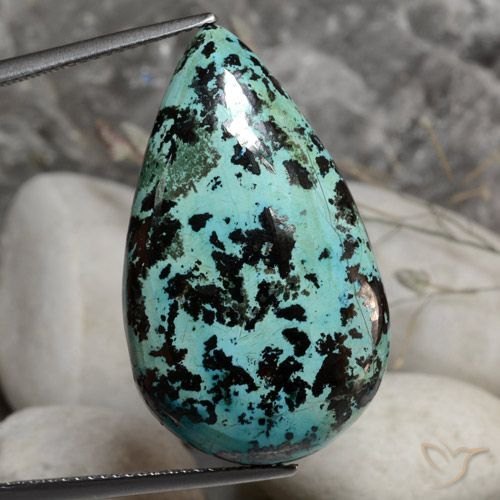
Matrix refers to the dark veining in turquoise, remnants of the host rock that often form distinctive spiderweb or patchy patterns prized by collectors.
Pure, matrix-free robin-egg blue was historically the top grade (Sleeping Beauty from Arizona and Persian Neyshabur material are classic examples), but spiderweb matrix is now equally valued, especially in Native American jewelry traditions.
Most commercial turquoise is stabilized with resin to harden the porous stone for jewelry use, a treatment that is standard and should be disclosed.
How Turquoise Compares
| Property | Turquoise | Chrysocolla | Howlite (dyed) |
|---|---|---|---|
| Hardness | 5 - 6 | 2 - 4 | 3.5 |
| Price / carat | $ Budget | — | — |
| Rarity | Moderate to rare (fine) | Common | Common (imitation only) |
| Best For | Statement jewelry, healing | Budget blue-green substitute | Not a true substitute |
Meaning and Symbolism
Turquoise is one of the oldest gemstones in human use. Egyptian mines in Sinai produced turquoise continuously from at least 5500 BCE, and the stone appeared in the burial mask of Tutankhamun and in jewelry from every dynasty after.
Aztec and Mayan cultures prized turquoise from Mexican and southwestern US sources for ceremonial masks and mosaics. The Persians made turquoise the national stone by the medieval period, and Persian Neyshabur material set the global benchmark for fine blue.
Native American cultures of the Southwest have used turquoise for thousands of years, and the stone remains central to Navajo, Zuni, Hopi, and Pueblo jewelry traditions. In many Native traditions, turquoise is considered a piece of sky brought to earth and is used in ceremonies, trade, and rites of passage.
The silver-and-turquoise jewelry style that became iconic of the American Southwest developed through Spanish-colonial silversmithing influence layered on far older Indigenous stone traditions, with Navajo and Zuni silversmiths elevating the craft.
In crystal healing tradition, turquoise is associated with protection, safe travel, and clear truthful speech. Practitioners often describe it as a bridge stone between heart and throat, supporting the emotional integrity needed for honest expression.
Many readers give turquoise as a friendship gift, a practice with deep roots in Middle Eastern and Native American traditions, and the stone has a long reputation as an amulet that is said to shatter or lose color when the wearer faces danger.
Historical Timeline
Healing Tradition
Emotional
Practitioners believe turquoise is a steadying, protective stone that supports honest emotional expression. In crystal healing tradition, it is associated with the courage to speak from the heart without defensiveness, making it a classic recommendation for readers working through long-stalled conversations or friendship repairs.
Many wear turquoise as a pendant or bracelet during periods that require both boundary-setting and warmth. Crystal workers often pair turquoise with rose quartz for gentler heart-centered speech or with black tourmaline when the protection quality is primary.
Unlike stones focused on transformation, turquoise is generally described as a sustained daily support, and readers often keep a piece visible on a desk or altar for ongoing calm protection.
It is also traditionally given as a friendship and safe-travel amulet, with many practitioners framing the exchange itself as part of the stone's traditional meaning.
Spiritual
In crystal healing tradition, turquoise is linked with throat and heart chakras and with the bridge between earth and sky. Practitioners often describe it as a stone of spoken prayer, said to carry intention from the heart into articulated words.
Many readers keep turquoise in meditation spaces dedicated to honest communication, vows, or ceremonies of reconciliation. The stone has long been used in protective amulets across many cultures, and crystal workers often set turquoise at the entry to a home or at a traveler's bedside as a gentle watch stone.
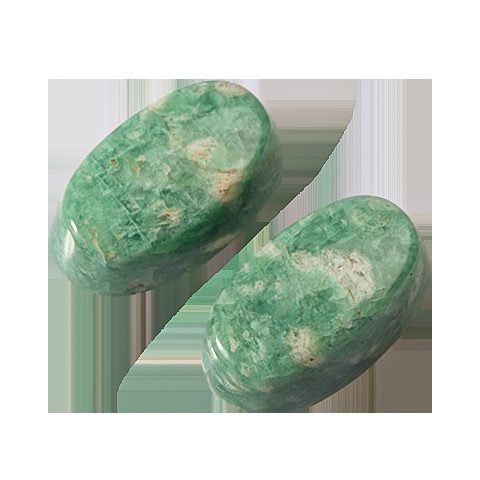
Turquoise pairs readily with amazonite for stronger throat-chakra work and with clear quartz for grid amplification. Crystal workers typically describe it as a daytime stone and charge it briefly in morning light, since practitioners say that prolonged sun can shift its color.
Physical
Practitioners believe turquoise supports what they describe as respiratory and immune resilience, associations drawn loosely from the stone's long use in travel amulets and amulets worn around the neck.
Crystal healing tradition links turquoise with overall vitality during travel and seasonal change, and many readers wear a turquoise pendant during times that require physical endurance. The stone is also traditionally associated with joint and throat comfort, with the blue color echoing its throat-chakra placement.
Turquoise is not a substitute for medical care, and practitioners frame its role as accompanying rather than curing. Crystal workers sometimes recommend removing turquoise during hot, sweaty activity because skin oils and salts can gradually alter the color.
The color change is described in folk traditions across the Middle East and Native American Southwest as the stone having absorbed harm on behalf of its wearer, a belief that continues in modern crystal practice.
Zodiac, Birthstone and Gifts
Turquoise is one of three modern US birthstones for December alongside tanzanite and blue zircon. Astrologers traditionally link turquoise with Venus and Neptune, a combination many find echoes the Sagittarian travel spirit and the Piscean emotional depth that both overlap with the December calendar.
For Sagittarius readers, practitioners suggest turquoise as a classic travel and friendship amulet, aligning with the sign's explorer temperament. For Pisces, the stone is said to help turn empathic emotion into articulate spoken truth.
Turquoise is also associated in some folk traditions with the planet Jupiter, which strengthens the Sagittarius link and adds an expansive, philosophical quality to the stone's traditional protective reputation in Western astrology.
Care and Cleansing
Turquoise is porous and chemically sensitive and requires careful cleaning. Wipe with a soft dry cloth to remove oils and dust. If deeper cleaning is needed, use a barely damp cloth with plain water only, followed by immediate drying. Avoid soap, detergent, solvents, ultrasonic cleaners, and steam cleaning entirely.
Saltwater and salt crystal cleansing should be avoided because salt can chemically alter the copper-phosphate structure over time. Dry salt cleansing is tolerable if the stone is placed on a small cushion above the salt rather than in direct contact.
Moonlight cleansing is the preferred energetic method, and smoke cleansing with sage or palo santo is safe at a distance. Sound cleansing with a singing bowl is also considered safe. Prolonged direct sunlight should be avoided because UV can slowly fade turquoise color and heat can dry out the stone.
Brief morning sun is traditional for turquoise charging but should be limited to a few minutes; prolonged exposure can dry the stone's porous interior and gradually shift the color toward greener tones.
- DO NOT submerge turquoise in water for extended periods; the stone is porous.
- DO keep turquoise away from perfume, cosmetics, hairspray, and household chemicals.
- DO NOT use ultrasonic or steam cleaners on turquoise.
- DO wipe turquoise jewelry with a soft dry cloth after wearing to remove skin oils.
- DO NOT expose turquoise to prolonged direct sunlight, which can dry and discolor the stone.
- DO store turquoise separately from harder gems to prevent scratches.
- Note: most commercial turquoise is stabilized with resin; disclosure of stabilization and any dye should be clear from your seller.
Real vs Fake
Genuine turquoise shows a natural color variation and often visible matrix veining of brown, black, or golden host rock. High-grade stones exhibit a waxy to vitreous luster and a tight microcrystalline texture.
Scratch hardness falls between a steel knife (Mohs 5.5) and a fingernail (2.5), and genuine stones feel cool at first touch and warm slowly.
Common imitations include dyed howlite, dyed magnesite, reconstituted turquoise powder, and plastic. Dyed howlite often shows color pooling in matrix lines and scratches easily because howlite is only Mohs 3.5. Reconstituted turquoise is made from powdered genuine material pressed with resin and is disclosed as a separate category.
Plastic imitations feel warm and light and typically display perfectly uniform color without any natural zoning, veining, or the irregular matrix character that distinguishes genuine turquoise from artificial substitutes.
Practical at-home checks include a hardness test against glass (a true turquoise may scratch glass slightly), examination of matrix veins for natural irregularity, a cotton swab dampened with acetone on an inconspicuous spot (dye comes off on the swab if present), and careful inspection for air bubbles that suggest resin or plastic.
For any significant purchase, a gemological laboratory can confirm natural origin and disclose any stabilization, dyeing, or coating applied to the stone, providing written documentation for insurance and resale purposes.
Turquoise Jewelry & Gifts
Turquoise pricing varies enormously by origin, color, matrix, and treatment. Commercial stabilized Chinese Hubei turquoise starts around $0.50 to $5 per carat. Mid-grade stabilized American turquoise, including common Kingman and Royston material, runs $5 to $50 per carat.
Top natural (unstabilized) Sleeping Beauty, fine Persian Neyshabur, and high-grade Lander Blue spider-web material can reach $100 to $1,000 per carat for specimen-quality cabochons.
Stabilization is widely accepted for most turquoise because the natural porosity of the stone makes daily-wear jewelry difficult without it. Natural untreated stones command a significant premium and should carry documentation.
Dyeing is a separate concern and should always be disclosed; dyed howlite, dyed magnesite, and block (plastic) turquoise should never be sold at natural-turquoise prices. For collector and gift purposes, ask sellers to confirm origin, treatment status, and matrix character, and favor dealers with established Native American trade relationships or independent certification.
Where to Buy Turquoise
Affiliate disclosure: Some links below earn us a small commission at no extra cost to you. See our affiliate disclosure page.
Handmade, raw, and tumbled pieces from independent sellers worldwide.
Shop Turquoise on Etsy →Accessories, tools, and specimen sets with fast Prime delivery.
Shop Turquoise on Amazon →Certified loose gemstones graded and photographed for online buyers.
Shop Turquoise on GemSelect →Pairs Well With



Where Turquoise Is Found


