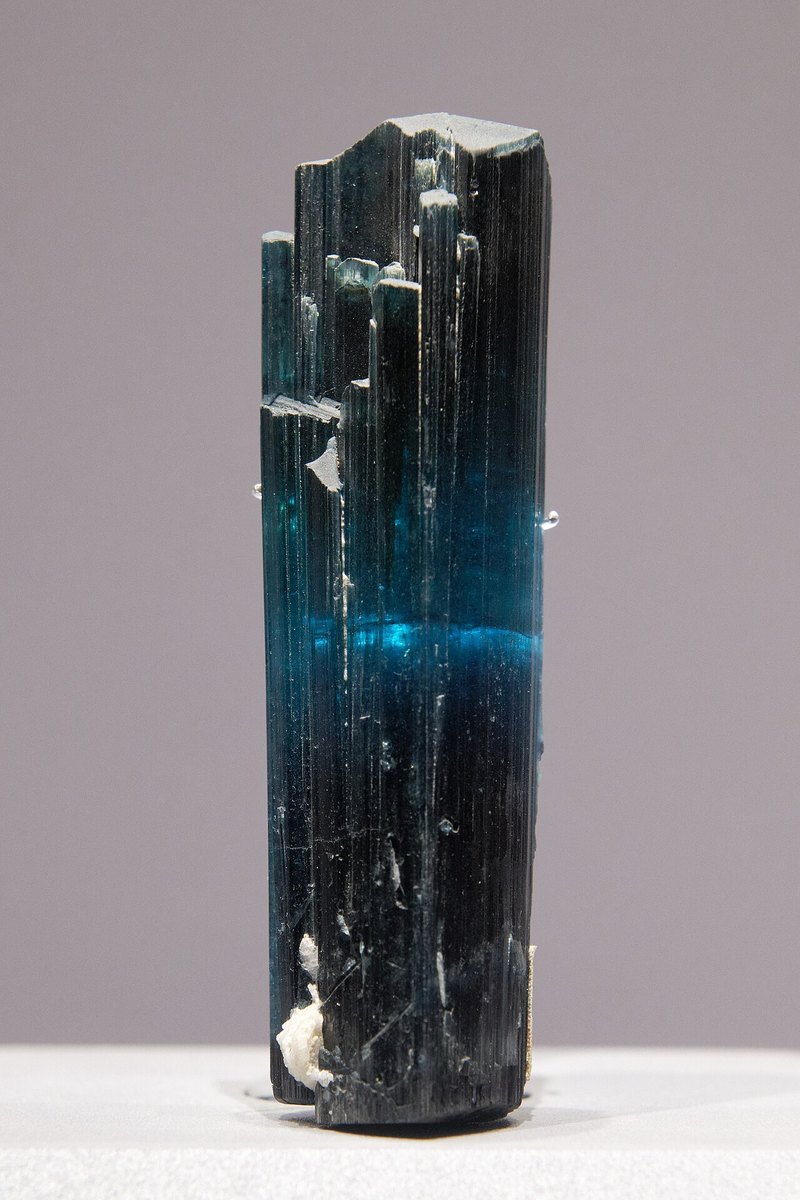
Indicolite
The deep blue variety of tourmaline, indicolite carries throat chakra calm in a stone hard enough for daily-wear engagement rings.
- The name indicolite comes from indigo, the deep blue dye plant whose color the stone resembles.
- Tourmaline shows pleochroism, displaying different colors from different crystal angles; gemcutters orient indicolite carefully to maximize the visible blue through the table.
- The broader tourmaline family takes its name from the Sinhalese word turamali, meaning mixed gems, because of its variety of colors.
- Indicolite is significantly rarer than pink or green tourmaline because the iron pegmatite conditions required for blue color are less common.
- Egyptian legend held that tourmaline traveled along a rainbow from the center of the earth, picking up all the colors along the way.
- Practitioners working with throat chakra communication and third eye intuition
- Engagement ring shoppers seeking a hard, daily-wear blue alternative to sapphire
- Collectors interested in unusual tourmaline color varieties with documented origin
- Pisces and Libra readers drawn to deep teal-blue water-element stones
- Buyers wanting affordable alternatives to paraíba tourmaline pricing
- Buyers under $200 per carat (consider blue topaz or aquamarine)
- Anyone wanting paraíba's neon glow without paraíba prices (consider lab-grown)
- Practitioners seeking grounding root chakra energy (try smoky quartz or hematite)
What Is Indicolite?
Indicolite is the trade name for the blue variety of tourmaline, a complex group of borosilicate minerals that includes some of the most colorful gemstones in the world. It rates 7 - 7.5 on the Mohs hardness scale.
The name derives from indigo, the deep blue dye plant, and the variety covers shades from light sky blue through deep teal to almost-black indigo blue.
The IMA tourmaline group includes multiple species; most indicolite belongs to the elbaite species, which has IMA symbol Elb. Color comes from iron impurities in the crystal structure.
Tourmaline crystals form long prismatic rods in granite pegmatites, where boron-rich late-stage fluids crystallize at relatively low temperatures. Indicolite specifically requires iron-bearing pegmatite environments and is significantly rarer than the more common pink and green tourmaline varieties.
Brazil's Minas Gerais state is the historical primary source, with significant production also from Afghanistan, Pakistan, Madagascar, and the United States.
Indicolite has a Mohs hardness of 7 to 7.5, which makes it durable enough for daily-wear jewelry including engagement rings. The stone shows pleochroism, displaying different blue tones from different crystal angles, which gemcutters orient carefully to display the deepest color through the table.
Heat treatment is common in commercial indicolite to lighten over-saturated stones into more marketable color ranges, and reputable sellers disclose the treatment. Indicolite is sometimes confused with the much rarer and more expensive paraíba tourmaline, which shows distinctive neon blue-green color from copper rather than indicolite's iron-based blue.
How Indicolite Compares
| Property | Indicolite | Paraíba Tourmaline | Aquamarine |
|---|---|---|---|
| Hardness | 7 - 7.5 | 7 - 7.5 | 7.5 - 8 |
| Price / carat | $$ Mid-range | $$$$ Luxury | $$ Mid-range |
| Color cause | Iron | Copper | Iron |
| Best For | Engagement, throat work | Investment, high jewelry | Daily wear, calm |
Meaning and Symbolism
Indicolite carries the broader tourmaline family's deep history while developing its own identity in modern crystal practice as the throat chakra blue tourmaline. Tourmaline has been used as a gemstone for centuries, with the broader family carrying strong associations across many cultures.
The Egyptians had a legend that tourmaline traveled along a rainbow on its way to earth from the center of the planet, picking up all the colors along the way; this story explained why tourmaline crystals can show so many different colors, sometimes within a single specimen.
Indicolite specifically gained recognition as a distinct trade variety in the late 1800s after Brazilian deposits in Minas Gerais began producing significant quantities of fine blue tourmaline.
The variety remained relatively obscure until the 1950s and 1960s, when expanded mining and gemological literature established it as a recognized collector category alongside the more common pink and green tourmaline varieties. Modern crystal practitioners adopted indicolite as the throat chakra tourmaline.
In modern crystal practice, indicolite is traditionally associated with the throat and third eye chakras together. Practitioners believe the deep blue color supports both clear communication and intuitive perception, especially for readers whose work involves expressing complex insights in language others can understand.
Many find indicolite useful as a personal talisman for teachers, writers, therapists, and anyone whose role requires the kind of patient, considered speech that bridges deep thought and accessible expression.
Historical Timeline
Healing Tradition
Emotional
Practitioners believe indicolite is a stone of clear communication, considered self-expression, and the integration of intellectual insight with emotional honesty. In crystal healing tradition, it is said to support readers whose work requires articulating complex ideas in accessible language, which makes it a popular recommendation for teachers, writers, therapists, and counselors.
Many find indicolite useful during periods of intensive communication work or major creative writing projects.
The stone has long been used in modern crystal practice to support readers managing the kind of communication-related anxiety that comes from public speaking, important conversations, or major creative output.
Practitioners often pair indicolite with rose quartz when communication involves heart-centered material, or with clear quartz for amplified focus on a specific message.
Indicolite is sometimes recommended for readers cultivating mediation skills, with the stone treated as a literal reminder that words have weight and deserve careful crafting before delivery.
Spiritual
Indicolite is traditionally associated with the throat and third eye chakras together in modern crystal practice. Practitioners believe its deep blue color bridges intuitive perception and clear verbal expression, supporting the integration of insight with accessible communication. It has long been recommended for spiritual teachers and writers in the contemporary tradition.
Many find indicolite useful in meditation focused on the wisdom traditions of speech, especially work that explores how language can serve truth without becoming weapon. The stone pairs well with aquamarine for amplified throat work and with lapis lazuli as a deep-blue companion for ancient wisdom traditions.
Practitioners sometimes use indicolite in ceremonies marking major commitments to verbal teaching, writing projects, or spoken vows that have particular weight in the speaker's life path.
Physical
Practitioners believe indicolite supports what they describe as the body's throat and respiratory system, which the throat chakra is associated with in crystal healing tradition. In folklore, the stone is sometimes used for vocal strain, hoarseness, and the kind of tension that builds during periods of suppressed expression.
It is also traditionally associated with the immune system and lymphatic flow in modern crystal healing practice.
Many find indicolite useful as a daily-wear pendant during periods of intensive vocal or verbal work. The stone is hard enough for continuous wear, which is one of its advantages over softer blue stones for ongoing physical-association work.
Indicolite is not a substitute for medical care, and practitioners are careful to frame its role as supportive rather than curative. The stone is sometimes worn as a pendant near the throat during seasonal cold and flu periods for symbolic immune support.
Zodiac, Birthstone and Gifts
Indicolite is most often associated with Libra in modern crystal astrology because of its connection to balanced, considered communication. Practitioners believe the stone supports Libra's natural diplomatic instincts and helps the sign articulate complex ideas without sacrificing harmony or accessibility.
It has long been suggested as a personal talisman for Libras working in mediation, law, counseling, or partnership-heavy fields.
Pisces is the secondary association because of indicolite's deep blue water-element character and traditional connection to intuitive perception. Astrologers sometimes recommend the stone for Pisces readers seeking to express subtle intuitive insights in language others can understand, especially in creative, healing, or teaching work.
Care and Cleansing
Indicolite tolerates most common cleansing methods, which makes it relatively easy to maintain. Running tap water for under a minute is safe for both loose and set stones, as is a brief rinse in lukewarm soapy water with a soft brush to remove skin oils.
The stone is durable enough for ultrasonic cleaning unless visible fractures are present, though many jewelers prefer gentler methods for valuable stones.
Sunlight cleansing is safe for indicolite since the iron-based blue color is stable. Moonlight, smoke from sage or palo santo, and sound cleansing with a singing bowl are all considered safe and well-aligned with the stone's gentle communication energy.
Salt cleansing should be brief and dry only, since saltwater can corrode metal settings over time. Many practitioners recharge indicolite by resting it on a clear quartz cluster overnight between uses.
- DO rinse indicolite jewelry in lukewarm soapy water and dry with a soft cloth.
- DO NOT use ultrasonic cleaners on stones with visible fractures or fillings.
- DO store indicolite separately from softer gems like opal and pearl to avoid scratching them.
- DO ask whether the stone is heated or unheated; both are accepted but should be disclosed.
- DO request a reputable independent gemological lab certificate for stones above one carat.
- DO NOT confuse indicolite with the much more expensive paraíba tourmaline; lab confirmation distinguishes them.
- Note: tourmaline is pyroelectric and develops static charge with temperature changes, attracting dust to settings.
Real vs Fake
Genuine indicolite shows the tourmaline family's characteristic refractive index of 1.624 to 1.644, specific gravity of 3.06 to 3.20, and pleochroism that displays different blue tones from different crystal angles. Under magnification you may see typical inclusions such as fine fluid fingerprints, growth tubes, or natural needle inclusions characteristic of pegmatite-formed material.
Heat treatment is common and accepted; reputable sellers disclose treatment status.
Common substitutes and confused stones include blue topaz (different refractive index and density), aquamarine (lower density, different optical properties), blue zircon (much higher refractive index and density), and synthetic indicolite (rare in the trade). A reputable independent gemological lab can distinguish these species using refractive index, density, and spectroscopy.
Paraíba tourmaline is a separate, much more expensive variety colored by copper rather than iron, and stones marketed as paraíba should be specifically lab-confirmed for the copper content.
At home, look for the tourmaline family's characteristic pleochroism (visible by rotating the stone under good light), the cool feel of true silicate, and natural inclusions visible under a 10x loupe.
Watch for stones marketed as indicolite at suspiciously low prices, since these are often heated blue topaz or other substitutes priced as the rarer species.
Reputable sellers always include current lab paperwork from a major gemological laboratory and disclose any heat treatment, the country of origin, and confirm whether the stone is iron-based indicolite or copper-based paraíba.
Indicolite Jewelry & Gifts
Indicolite pricing depends on color saturation, clarity, size, and origin. Light blue commercial stones in calibrated sizes run $200 to $600 per carat, mid-grade stones with good color and clarity reach $600 to $1,500 per carat, and top-grade saturated teal-blue stones above two carats can exceed $2,500 per carat.
Exceptional clean stones above five carats with documented Brazilian origin can reach $5,000 per carat or more at auction.
Heat treatment is common, accepted, and should be disclosed; it does not warrant a discount if disclosed appropriately. Watch for stones marketed as paraíba tourmaline at indicolite prices; the two are distinct varieties and require lab testing to distinguish reliably.
For engagement rings or heirloom pieces, request a reputable lab report from an independent gemological lab confirming the stone is natural tourmaline, identifying treatments, and confirming whether it is indicolite or paraíba.
fine clean indicolite from Brazilian Minas Gerais remains the benchmark, with Madagascan and African material offering competitive value at the lower end of the price range.
Where to Buy Indicolite
Affiliate disclosure: Some links below earn us a small commission at no extra cost to you. See our affiliate disclosure page.
Handmade, raw, and tumbled pieces from independent sellers worldwide.
Shop Indicolite on Etsy →Accessories, tools, and specimen sets with fast Prime delivery.
Shop Indicolite on Amazon →Certified loose gemstones graded and photographed for online buyers.
Shop Indicolite on GemSelect →Pairs Well With



Where Indicolite Is Found


