
Kyanite
Growing in elongated blades of streaked blue, kyanite is the throat-chakra stone famous for needing no cleansing.
- Kyanite has anisotropic hardness: about 4.5 along the blade and 7 across, earning it the old name disthene (two-strength).
- Kyanite is one of the few stones traditionally described in crystal healing tradition as not requiring cleansing.
- Willis Mountain in Virginia is one of the among the largest known industrial kyanite mines, producing material primarily for steel-making.
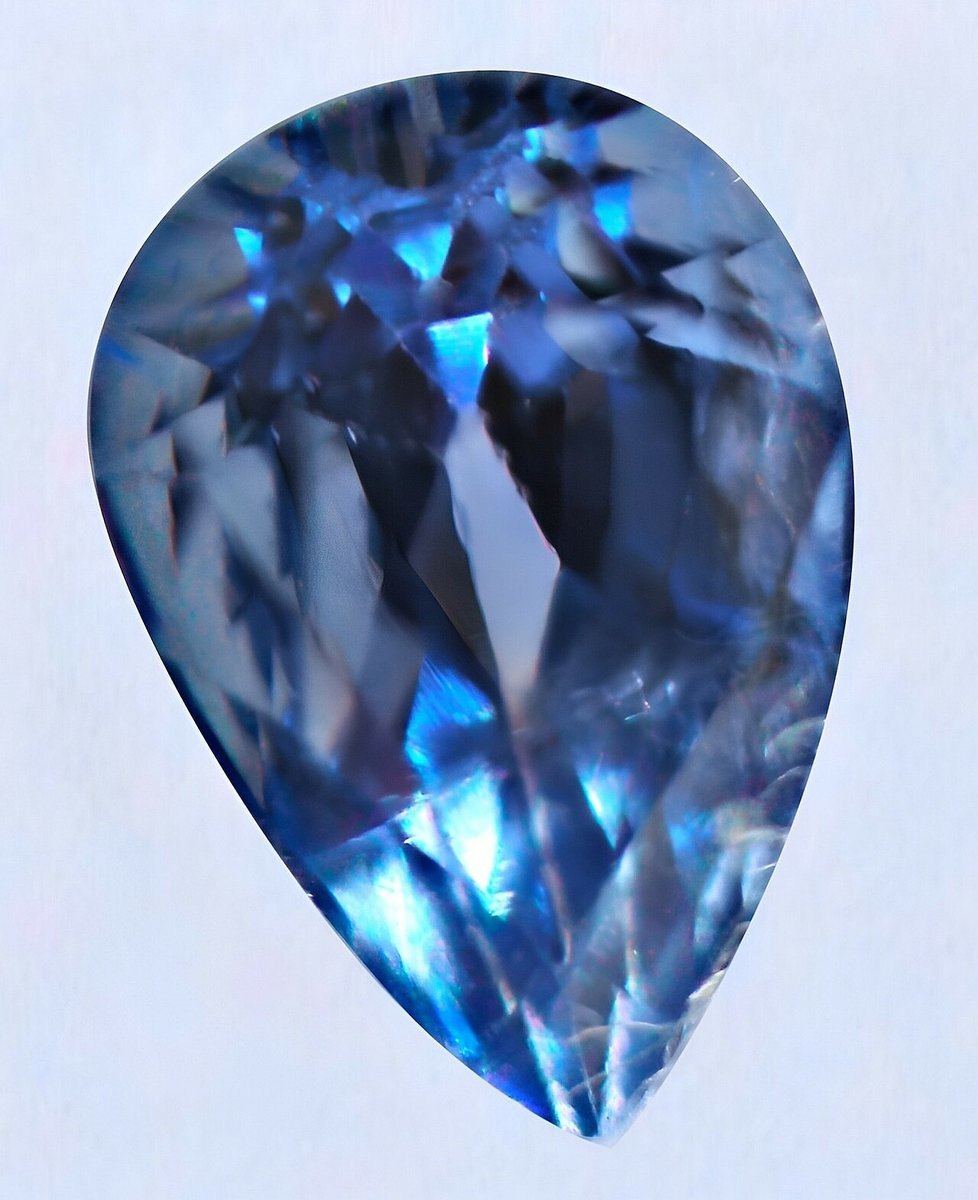
- Electric-blue Nepalese kyanite from the Kali Gandaki valley resembles sapphire at a fraction of the price.
- Kyanite forms with andalusite and sillimanite; all three share the same chemical formula but have different crystal structures.
- Practitioners working with throat and third eye alignment
- Readers drawn to streaked blade-like crystal habits
- Buyers seeking an unusual blue collector gem
- Gift givers shopping for a meaningful meditation stone
- Crystal workers who value low-maintenance low-cleansing materials
- Daily-wear ring buyers (kyanite is anisotropic and cleavage-sensitive)
- Those wanting uniform color (try blue sapphire)
- Beginners who prefer simple identification (kyanite variable hardness is confusing)
What Is Kyanite?
Kyanite is an aluminum silicate mineral famous among mineralogists for its anisotropic hardness: the stone is significantly harder across its long axis than along it. It rates 4.5 along - 7 across on the Mohs hardness scale.
Hardness along the blade is about 4.5 on the Mohs scale, while across the blade it reaches 7. This dramatic variability is why kyanite is also historically known as disthene, from the Greek for two-strength.
The name kyanite comes from Greek kyanos, meaning dark blue, because the most common gem color is a deep streaked sapphire-blue.
The stone forms in elongated crystal blades in metamorphic rocks such as schist and gneiss. The blades show parallel color banding along their length, with cores often more saturated than edges. Green, white, gray, and black kyanite also occur, though blue is the commercial favorite.
The most important deposits are in Nepal (particularly the Kali Gandaki valley, producing deep electric blue), Brazil (Minas Gerais), the United States (especially Virginia and North Carolina), India, Tanzania, Russia, and Switzerland.
Kyanite has important industrial uses well beyond gemology. Its refractory properties (resistance to extreme heat) make it valuable in steel-making and ceramic production, and most mined kyanite goes to industry rather than jewelry.
In Western crystal healing tradition, kyanite is one of the few stones described as self-cleansing: practitioners believe it does not accumulate negative energy and therefore does not require the regular cleansing other stones need.
How Kyanite Compares
| Property | Kyanite | Blue Sapphire | Tanzanite |
|---|---|---|---|
| Hardness | 4.5 - 7 (anisotropic) | 9 | 6 - 6.5 |
| Price / carat | $ Budget | $$$ Premium | $$$ Premium |
| Rarity | Uncommon | Rare (fine color) | Rare |
| Best For | Pendants, collectors | Engagement, heirloom | Special occasion |
Meaning and Symbolism
Kyanite has a shorter gem history than most classical stones because the streaked blade-like habit made it unappealing to early lapidaries who preferred uniform-colored faceted gems. The mineral itself was described by German mineralogist Abraham Werner in 1789, but it did not enter the jewelry trade in significant quantities until the 1990s.
The 1990s Nepali discoveries of deep electric-blue kyanite brought the gem into commercial gem-cutting supply.
Industrial applications of kyanite have been important since the 1920s, when the mineral's refractory properties made it valuable for steel-making, ceramics, and thermal insulation. The United States is one of the among the largest known kyanite producers, with Willis Mountain in Virginia supplying most domestic industrial demand.
Gem-grade material is a tiny fraction of total kyanite production.
In modern crystal healing tradition, kyanite is known as a stone that does not accumulate negative energy and therefore does not require cleansing. This unusual claim is widely shared across Western metaphysical traditions and makes kyanite popular among practitioners who dislike routine cleansing rituals.
Practitioners associate kyanite with the throat and third eye chakras and with what they call alignment of the energy centers, making it a common choice for meditation and energy-balancing work. It pairs naturally with amethyst for combined vision and clarity work and with clear quartz for amplified throat-chakra practice.
Historical Timeline
Healing Tradition
Emotional
Practitioners believe kyanite supports emotional balance and clear composed communication. In crystal healing tradition, it is often recommended for people working on aligning their inner sense of truth with their outward expression, especially in professional or public-facing roles.
Many readers wear kyanite pendants during periods of significant personal transformation and describe a sense of steadier composure during speech and presentations. Practitioners pair kyanite with rose quartz when the emotional work involves relationships, or with amethyst when racing thoughts need quieting alongside clear expression.
Because its reputation is alignment-oriented and self-cleansing, kyanite is often described as a low-maintenance practical stone for daily wear during intensive life seasons. Readers sometimes describe kyanite as particularly useful during life-coaching or therapy work where integration of multiple realms (emotional, mental, spiritual) is the focus.
Spiritual
Kyanite is traditionally associated with the throat and third eye chakras and is often called the alignment stone in modern Western metaphysical tradition. Practitioners describe it as a stone that supports integration of the seven chakras during meditation.
In modern crystal healing tradition, kyanite is uniquely described as self-cleansing, meaning it does not accumulate negative energy and does not require routine cleansing rituals.
Many readers keep a kyanite blade on a meditation altar or wear a small pendant during spiritual practice. Practitioners working on chakra alignment sometimes use kyanite blades laid along the body (one for each chakra) during healing sessions.
It pairs readily with selenite (another self-cleansing stone) and with clear quartz for amplified meditation practice. Because of its unusual energy profile, kyanite is often recommended for sensitive readers who find other stones intrusive.
Physical
Practitioners believe kyanite supports what they describe as throat-area balance, mental focus, and general nervous-system regulation. Folk tradition has not developed around kyanite to the same depth as older gem traditions because of its recent commercial history, but modern crystal healing associates it with relief from vocal strain and from tension-related headache.
In modern crystal healing practice, kyanite is most often placed on the throat or held in the non-dominant hand during alignment meditation.
Many readers keep a tumbled kyanite on a desk during long work sessions or on the bedside during sleep. It is not a substitute for medical care, and practitioners frame its role as supportive alongside proper treatment.
Because kyanite is slightly soft and has variable hardness depending on the direction of wear, pendants and earrings are practical while rings require more careful protective settings.
Zodiac, Birthstone and Gifts
Kyanite is traditionally associated with Taurus, Libra, and Aries in Western astrology. Practitioners describe kyanite as an ally for Taurus's pursuit of grounded expression, for Libra's diplomatic speech, and for Aries's direct communication style.
Although kyanite is not on the formal US birthstone list, it is often given as a meaningful gift for anyone in teaching, public speaking, or leadership roles regardless of birth month.
Its reputation as a self-cleansing stone also makes it a popular gift for crystal enthusiasts who prefer low-maintenance additions to their collection.
Care and Cleansing
Kyanite is uniquely described in modern Western crystal healing tradition as a stone that does not require cleansing. Practitioners report that kyanite does not accumulate negative energy and therefore does not benefit from the regular smoke, moonlight, or salt cleansing that other stones receive.
Many readers rely on this reputation and never formally cleanse their kyanite pieces.
That said, physical cleaning of kyanite jewelry can be done safely. A brief rinse under lukewarm water with a soft cloth removes surface dust. Soapy water should be used only briefly because kyanite is slightly soft and has variable hardness depending on direction. Avoid prolonged soaking, saltwater, ultrasonic cleaners, and steam cleaners.
For readers who do practice ritual cleansing regardless of the self-cleansing tradition, smoke cleansing with sage, palo santo, or cedar is safe, as is brief moonlight exposure. Many practitioners place kyanite on a selenite plate when other stones are being cleansed, more out of habit than necessity.
Kyanite is often recommended specifically because of its low-maintenance reputation in crystal collections.
- DO handle kyanite jewelry carefully because hardness varies by direction.
- DO NOT use ultrasonic or steam cleaners on kyanite.
- DO store kyanite separately from harder stones to prevent scratches.
- DO remove kyanite rings before manual work to protect from impact.
- DO rinse briefly with lukewarm water and soft cloth for dust removal.
- DO NOT worry about energetic cleansing; kyanite is traditionally self-cleansing.
- Note: kyanite has perfect cleavage along the blade; avoid sharp impacts.
Real vs Fake
Genuine kyanite shows elongated blade-like crystal habit (in rough form), parallel color banding, and distinctive pleochroism that shifts between deeper blue and paler lavender as the stone is rotated. The specific gravity around 3.6 is noticeably heavy for its size.
Common imitations and confusions include blue glass (cold, lightweight, often gas bubbles), synthetic spinel (no parallel banding, uniform color), synthetic sapphire sold as kyanite, and natural blue sapphire mislabeled.
The anisotropic hardness of kyanite can be tested: a steel knife scratches kyanite easily along the length of the blade but not as readily across it.
A refractometer test gives kyanite's distinctive range of 1.710 to 1.734, which is higher than quartz and lower than corundum. Basic gemological tests quickly separate kyanite from most imitations.
For any significant purchase, ask about origin (Nepal, Brazil, USA, India) and whether the stone has been oil-treated or surface-coated. Oil treatment to improve transparency is occasionally performed and should be disclosed.
A laboratory report is not usually necessary for kyanite purchases under $1,000 per carat, but origin documentation can add value for Nepali electric-blue material.
Kyanite Jewelry & Gifts
Kyanite prices range from $20 per carat for small, pale, or heavily included stones to over $300 per carat for top Nepali electric-blue material with clean transparency and strong color saturation.
Standard 1-2 carat faceted kyanite typically runs $40 to $100 per carat. Larger stones with deep saturated blue reach $150 to $250 per carat. Natural blade-form kyanite specimens (unfaceted) for collectors and metaphysical use cost $10 to $60 per piece depending on size and color.
The biggest buying variables are color saturation, clarity, and origin. Nepali electric-blue material commands a significant premium over Brazilian, American, and Indian production. Green kyanite is rarer and sometimes commands collector-level prices.
Treatments in kyanite are minimal. Occasional oil enhancement to improve transparency is sometimes performed and should be disclosed. Fracture filling is rare because the mineral's cleavage makes filling unstable.
When buying, look at color under daylight and incandescent light to assess pleochroism, check for eye-clean clarity under a 10x loupe, and prefer cuts (emerald, rectangular, oval) that align the cutting axis with the strongest color direction. For collector use, natural blade forms often display more beautifully than faceted cuts.
Where to Buy Kyanite
Affiliate disclosure: Some links below earn us a small commission at no extra cost to you. See our affiliate disclosure page.
Handmade, raw, and tumbled pieces from independent sellers worldwide.
Shop Kyanite on Etsy →Accessories, tools, and specimen sets with fast Prime delivery.
Shop Kyanite on Amazon →Certified loose gemstones graded and photographed for online buyers.
Shop Kyanite on GemSelect →Pairs Well With




Where Kyanite Is Found


