
Garnet
From Bohemian almandine to Tanzanian tsavorite, garnet is the family of gems that spans fiery red through electric green.
- Garnet is a group of silicate minerals, not a single species; the family includes more than a dozen named varieties.
- Tsavorite garnet was named after Tsavo National Park in Kenya, where the first significant deposits were found.
- Demantoid garnet has higher dispersion than diamond, producing more fire per carat despite being softer.
- Color-change garnets shift dramatically between daylight and incandescent light, similar to alexandrite but from a different cause.
- The garnet industry is one of the few major gem trades where treatment of any kind is rare, and most commercial garnet is untreated.
- January birthstone seekers wanting affordable classic red
- Practitioners working with root chakra vitality and sacral creativity
- Collectors drawn to the many garnet species (tsavorite, demantoid, rhodolite, spessartine)
- Buyers seeking durable daily-wear rings in colors beyond red
- Readers wanting a stone traditionally linked with passion and commitment
- Those needing maximum toughness (try sapphire or ruby)
- Shoppers who only want cool tones (try aquamarine or amethyst)
- Buyers seeking the deepest pigeon-blood red (try ruby)
What Is Garnet?
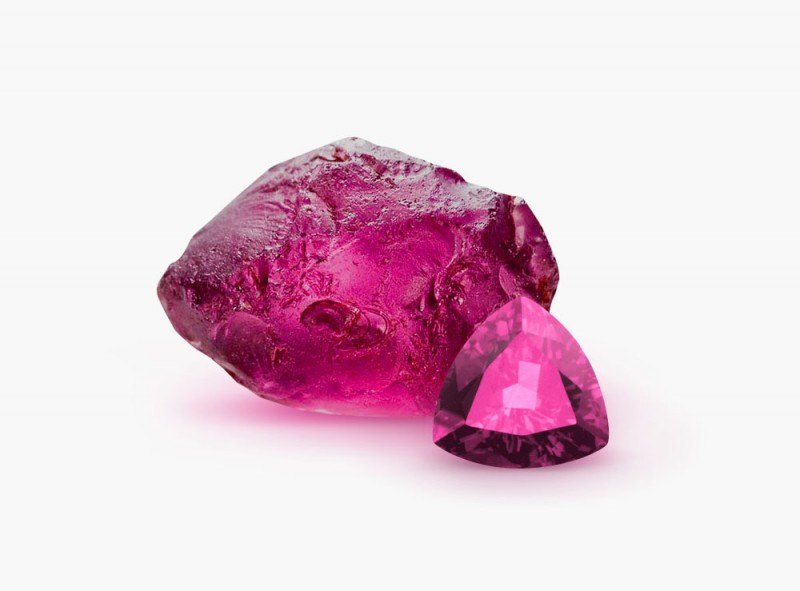
Garnet is a family of silicate minerals rather than a single species. The family includes pyrope (magnesium-aluminum, typically red), almandine (iron-aluminum, red to red-purple), spessartine (manganese-aluminum, orange), grossular (calcium-aluminum, the tsavorite variety is vivid green, hessonite is brown-orange), andradite (calcium-iron, the demantoid variety is brilliant green), and uvarovite (calcium-chromium, bright green).
Most commercial garnets are mixtures of two or more end-members.
The name garnet comes from the Latin granatus, meaning pomegranate-seed, a reference to the typical round red garnet crystals that resemble pomegranate kernels. At Mohs 6.5 to 7.5, depending on species, garnet is durable enough for daily wear in most jewelry settings.
Garnet forms in metamorphic schists, gneisses, and contact aureoles, and is also widely found in detrital river gravels.
Garnet has one of the widest color ranges of any gem family. Rhodolite (pyrope-almandine mix) is raspberry-pink-red; tsavorite grossular is vivid emerald-green; demantoid is yellowish-green with remarkable dispersion; spessartine orange is known as mandarin garnet when saturated; malaya and color-change garnets display complex behavior under different light sources.
Garnet is almost never treated; heating, irradiation, and other enhancements common in other gem families are rare, which makes garnet particularly appealing to buyers who prefer untreated stones.
How Garnet Compares
| Property | Garnet (Pyrope) | Tsavorite Garnet | Ruby |
|---|---|---|---|
| Hardness | 7 - 7.5 | 7 - 7.5 | 9 |
| Price / carat | $ Budget | $$$ Premium | $$$ Premium |
| Rarity | Common | Rare | Rare (fine color) |
| Best For | Everyday red jewelry | Affordable green alternative to emerald | Heirloom investment |
Meaning and Symbolism
Garnet has been worn as jewelry for more than five thousand years. Egyptian, Sumerian, and Greek artifacts contain carved garnet seals and beads, and the stone was sometimes called carbuncle in medieval Europe, a term also applied to other red gems.
Bohemian garnet from the Czech lands was the fashionable red stone of late medieval and early modern Europe, and by the eighteenth century Bohemian garnet rose-cut clusters were a staple of European jewelry.
In Greek myth, Hades gave Persephone a pomegranate to ensure her return to the underworld, a story many later read as an allegory for garnet and the binding quality of the stone. Medieval warriors wore garnet as a protection amulet, believing the stone ensured safe return from battle.
Tsavorite and demantoid (both green garnets) came to Western markets much later: demantoid from the Russian Urals in 1868, and tsavorite from Kenya and Tanzania in 1967, when it was discovered and named Tsavorite by Campbell R. Bridges.
In crystal healing tradition, the red garnets are associated with passion, courage, and life-force energy at the root and sacral chakras. Tsavorite and demantoid carry green-garnet heart-chakra associations. Practitioners often describe garnet as a stone of commitment, one that is said to deepen existing bonds rather than create new ones.
Many readers give garnet as an anniversary or long-friendship gift because of this traditional association with faithful, sustained relationships.
Historical Timeline
Healing Tradition
Emotional
Practitioners believe garnet is a stone of warm, committed passion, traditionally associated with deep loyalty and sustained vitality. In crystal healing tradition, it is said to support readers navigating long commitments, including marriages, long-term friendships, and multi-year projects, with the stone framed as strengthening existing bonds rather than opening new ones.
Many wear red garnet during periods that require steady stamina and reassurance of purpose. Crystal workers often pair garnet with rose quartz for softer heart-centered commitment or with black tourmaline when emotional loyalty needs protection.
Tsavorite and green garnets are described as stones of compassionate growth rather than passion, and are often chosen for readers working on patient heart-opening. Unlike ruby, which is associated with assertive action, garnet is traditionally described as a slower, deeper warmth.
Spiritual
In crystal healing tradition, garnets are linked to the root, sacral, and heart chakras depending on color. Practitioners often describe red garnets as stones of incarnated purpose, said to help readers ground spiritual intention into embodied daily life.
Many keep a small garnet on a desk altar during long projects or in a bedside bowl during committed partnership work. The stone has long been used in amulets of safe return, a folk association that carries into modern crystal work as traveler's support.
Garnet pairs readily with clear quartz for amplification and with smoky quartz for deeper earth grounding. Green garnets partner especially well with emerald and rose quartz in heart-focused grids, and crystal workers sometimes describe the effect as a greener, slower-growing counterpart to emerald's brighter presence.
Physical
Practitioners believe garnet supports what they describe as circulation, stamina, and steady life-force energy, associations drawn from the stone's deep red color and its long folk link to blood and vitality.
Crystal healing tradition associates garnet with overall endurance during demanding periods, and many readers wear garnet jewelry during long physical projects or recovery from exhaustion. The stone is also traditionally linked with reproductive and sacral-area comfort, with green garnets sometimes preferred for patient healing work.
Garnet is not a substitute for medical care, and practitioners frame its role as accompanying rather than curing. Crystal workers sometimes suggest garnet for people in caregiving or physically demanding roles, describing the stone as a steady support for sustaining effort.
Zodiac, Birthstone and Gifts
Garnet is the modern US birthstone for January, shared by late Capricorns and early Aquarians. Astrologers traditionally associate garnet with Mars and Pluto, a combination many find echoes the January temperament of determined steady work paired with deep passion.
For Capricorn, practitioners suggest garnet as a stone of long-term commitment, supporting the sign's natural preference for sustained effort. For Aquarius, the stone is said to warm the sign's sometimes airy temperament with grounded purpose. Leo is a secondary association through the red color and fire-element link.
In Vedic tradition, hessonite garnet (gomed) is prescribed for those seeking to work with the planetary node Rahu, typically set in silver and worn on the middle finger.
Care and Cleansing
Garnet tolerates most cleaning methods. Warm soapy water with a soft brush is safe, and brief rinses in tap water cause no damage. Ultrasonic and steam cleaners are generally safe for clean garnets in sturdy settings, but should be avoided on heavily included stones such as some demantoids with horsetail inclusions.
Moonlight, smoke with palo santo or sage, and sound cleansing with a singing bowl are all safe and traditional for garnet. Dry salt cleansing is fine; saltwater soaks should be avoided because of metal setting corrosion.
Garnet is not considered fragile to natural cleansing methods, which makes it one of the easier fine gems to maintain.
Direct sunlight is safe for most garnet species because the color comes from transition-metal substitution in a stable crystal lattice rather than irradiation. Brief morning sun charging is traditional and poses no risk.
The one exception is some color-change garnets, where extremely prolonged UV may slightly shift the color-change character, although this is uncommon in normal use.
- DO clean garnet in warm soapy water with a soft brush for routine maintenance.
- DO NOT use ultrasonic cleaners on demantoid garnet with delicate horsetail inclusions.
- DO remove garnet rings during heavy housework to prevent chips at the girdle.
- DO NOT store garnet loose with harder stones such as sapphire or diamond.
- DO request species and origin disclosure for premium garnets (tsavorite, demantoid, color-change, mandarin).
- DO favor protective settings for small demantoid stones because of their slightly brittle nature.
- Note: garnet is almost never treated; disclosure of any enhancement is uncommon but should still be on documentation when present.
Real vs Fake
A genuine garnet shows good transparency with a refractive index that returns strong light even in simple cuts. Natural inclusions include needle-like rutile, small mineral crystals, and in the case of demantoid the famous horsetail inclusions that are diagnostic for Russian Ural material.
Color distribution is typically even, without the banding common in imitations.
Common imitations include red glass, red synthetic spinel, and red cubic zirconia. Glass often shows curved gas bubbles and swirl marks under magnification, and glass cannot scratch quartz.
Synthetic spinel and synthetic garnet (rare, but produced as YAG and GGG laser material) can mimic natural garnet color but have different optical signatures under a refractometer.
Practical at-home checks include looking for natural inclusions under a 10x loupe, testing hardness against glass, and checking specific gravity because garnet is notably denser than glass or quartz. A polariscope reveals the doubly refractive glass and singly refractive true garnet difference.
For valuable garnets, especially tsavorite, demantoid, and mandarin spessartine, a report from a gemological laboratory confirms species and origin.
Garnet Jewelry & Gifts
Garnet pricing depends heavily on species. Commercial almandine and pyrope red garnets run $10 to $100 per carat in small sizes. Rhodolite sits at $50 to $300 per carat for good color. Spessartine (mandarin) and hessonite range $100 to $500 per carat, with top mandarin reaching $1,500 per carat.
Tsavorite, the premium green garnet, runs $500 to $3,000 per carat for fine color, with top stones above two carats exceeding $5,000 per carat. Demantoid from Russian Urals with visible horsetails reaches $2,000 to $8,000 per carat for fine color and documented origin.
Garnet treatment is rare across the family, which is one of its main trade advantages. Almost all garnets on the market are untreated. Focus on color saturation, cut quality, and for rarer species origin documentation.
For tsavorite, demantoid, mandarin spessartine, or color-change material, request a gemological laboratory report confirming species and ideally country of origin. Clean clean faceted garnets above five carats in common species remain very affordable compared to sapphire or ruby of similar size.
Where to Buy Garnet
Affiliate disclosure: Some links below earn us a small commission at no extra cost to you. See our affiliate disclosure page.
Handmade, raw, and tumbled pieces from independent sellers worldwide.
Shop Garnet on Etsy →Accessories, tools, and specimen sets with fast Prime delivery.
Shop Garnet on Amazon →Certified loose gemstones graded and photographed for online buyers.
Shop Garnet on GemSelect →Pairs Well With



Where Garnet Is Found


