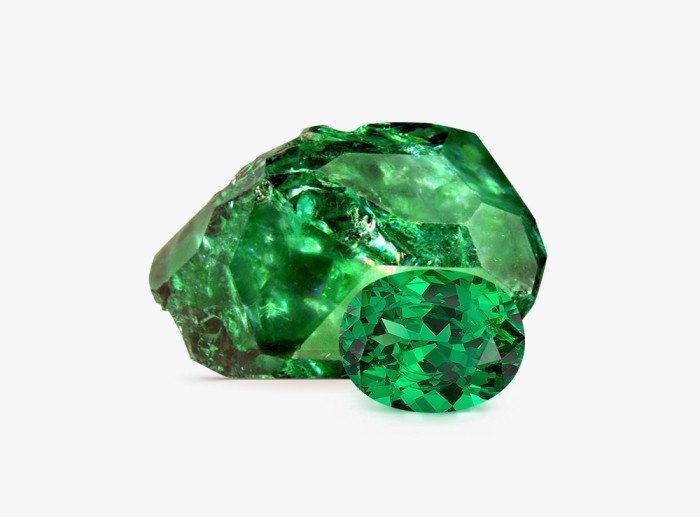
Tsavorite
Born in Tanzanian and Kenyan schists, tsavorite is the vivid green grossular garnet that rivals emerald for color brilliance.
- Tsavorite was named after Kenya's Tsavo East National Park, near its discovery site.
- Tsavorite was introduced to Western markets in 1974, giving it its commercial identity.
- Tsavorite's refractive index exceeds emerald's, producing stronger brilliance in cut stones.
- Almost all tsavorite is sold without heat treatment or oiling, unlike most colored stones.
- Most faceted tsavorite stones are under three carats; larger clean stones are particularly rare.
- Engagement ring shoppers seeking a durable alternative to emerald without oil treatments
- Collectors of East African gems with limited commercial supply
- Readers who prefer green stones and want heirloom-worthy durability
- Crystal workers with heart chakra practice preferring saturated natural color
- Gift buyers for significant milestones where a truly distinctive green gem is wanted
- Budget-conscious buyers (try peridot or green tourmaline)
- Shoppers wanting large stones (most tsavorite stays under three carats)
- Readers seeking ancient folklore (tsavorite was discovered only in the 1960s)
What Is Tsavorite?
Tsavorite is a vivid green variety of grossular garnet, colored by trace vanadium and chromium. It was discovered in 1967 by British geologist Campbell Bridges along the Kenya-Tanzania border, and formally introduced to the market as tsavorite in the 1970s through American luxury jewelers who immediately recognized its rarity
The name honors the nearby Tsavo East National Park in Kenya.
At Mohs 7 to 7.5, tsavorite has the same hardness as other garnets and is durable enough for daily-wear rings in protective settings. Its refractive index of 1.734 to 1.759 is notably higher than emerald's 1.577 to 1.583, giving faceted tsavorite stronger brilliance and fire.
The stone is typically eye-clean at commercial grades, unlike emerald which frequently requires oil treatment to mask inclusions.
Tsavorite forms in specific metamorphic environments where calcium and aluminum are available alongside trace vanadium or chromium. The deposits are concentrated in East Africa, primarily in southeastern Kenya, northeastern Tanzania (Merelani and Lemshuko), and scattered locations in Madagascar and Pakistan.
Tsavorite is never heat-treated or oiled because the natural color and clarity need no enhancement, making it one of the few gems sold essentially untreated as a standard. This natural-state marketing advantage distinguishes tsavorite from most colored stone trade.
How Tsavorite Compares
| Property | Tsavorite | Emerald | Demantoid Garnet |
|---|---|---|---|
| Hardness | 7 - 7.5 | 7.5 - 8 | 6.5 - 7 |
| Price / carat | $$$ Premium | $$$ Premium | $$$ Premium |
| Rarity | Rare | Moderate | Very Rare |
| Best For | Untreated natural jewelry | Classic prestige pieces | Collector investment |
Meaning and Symbolism
Tsavorite has no ancient folklore because the stone was only discovered in the 1960s. Its meaning has been built in modern crystal healing tradition, drawing on its vivid green color, its East African origin, and its connection to the broader garnet family.
In modern crystal practice, tsavorite is associated with prosperity, growth, and heart-centered wealth, alongside its saturated color placement in the heart chakra.
Tsavorite's marketing history is distinctive. the stone was introduced to Western markets in the 1970s, giving it the commercial name honoring Tsavo National Park.
This luxury-jeweler connection tied tsavorite to a specific luxury jewelry identity from the start, and the stone remains a signature among American luxury retailers. Its East African origin has also made tsavorite a subject of ethical sourcing discussions in contemporary trade.
In crystal healing tradition, tsavorite is associated with heart-centered success, the pursuit of meaningful work rather than mere accumulation. Practitioners often recommend tsavorite for entrepreneurs and creative professionals who want their financial success to align with personal values.
Its durability and natural untreated status make tsavorite a symbolic choice for readers who value authenticity in both their jewelry and their professional lives. Modern tradition also links tsavorite with renewal after long rebuilding periods.
Historical Timeline
Healing Tradition
Emotional
Practitioners believe tsavorite is a stone of heart-centered success, traditionally associated with aligning professional ambition with personal values. In crystal healing tradition, it is said to support readers pursuing meaningful work, building their own businesses, or seeking career paths that nourish both financial stability and emotional fulfillment.
Many readers wear tsavorite during launches, negotiations, or significant creative projects. Practitioners often pair tsavorite with citrine for abundance work and with clear quartz for amplified intention setting. Crystal workers frequently describe tsavorite as a warm, active stone rather than a purely calming one, which suits readers in active growth phases.
The stone's association with authenticity and natural untreated status also makes it a symbolic choice for readers doing work around integrity, honest self-expression, or aligning outer actions with inner truth. The pairing with rose quartz is common when ambition needs to meet tenderness.
Spiritual
In crystal healing tradition, tsavorite is linked specifically with the heart chakra, placing it alongside emerald and green aventurine in heart-centered work. Practitioners often describe tsavorite as a stone of flowering prosperity, linking its growth-green color to both emotional expansion and material abundance.
Many readers use tsavorite as a focal anchor during intention work around new ventures or creative flowering.
Because tsavorite is a relatively recent discovery without ancient folklore, its spiritual associations are modern rather than traditional. Crystal workers have built its reputation through its 1974 Western market introduction, its East African origin, and its untreated natural status.
Tsavorite pairs readily with jade in prosperity grids, with rose quartz in heart-centered layouts, and with clear quartz for amplification. Some practitioners also use tsavorite in grids honoring African ancestral lineage, acknowledging the East African origin with intentional respect.
Physical
Practitioners believe tsavorite is traditionally associated with heart-muscle health, circulation, and what they describe as sustained physical energy during demanding work periods. Folklore and modern crystal writers link the stone with recovery from cardiovascular stress and steady stamina through long professional seasons, framed as supportive accompaniment rather than medical intervention.
Many readers wear tsavorite rings or pendants during periods of intensive physical or mental work. The stone is not a substitute for healthcare and practitioners are consistent in describing its role as accompanying rather than treating.
Some crystal workers also suggest tsavorite for people working through body-mind patterns related to career stress, often paired with black tourmaline for grounded protection. Because tsavorite is Mohs 7 to 7.5 and chemically stable, it is tolerated in direct gem elixirs and other direct-contact practices.
Zodiac, Birthstone and Gifts
Tsavorite is sometimes offered as a January alternative alongside traditional almandine garnet, and astrologers often pair it with Taurus for Venus rulership and material growth, Capricorn for disciplined ambition, and Aquarius for unconventional paths.
For Taurus readers, tsavorite is often recommended as a prosperity pendant for long-term financial growth. Capricorn readers navigating career ambition tend to find tsavorite resonant as a goal-setting anchor. Aquarius readers pursuing unconventional professional paths appreciate the stone's modern, natural untreated status. Practitioners pair tsavorite with citrine in prosperity kits.
Care and Cleansing
Tsavorite is one of the easier fine gems to maintain. Warm soapy water and a soft brush handle daily body oils and dust without risk, and the stone tolerates ultrasonic cleaning in unfractured form. Its chemically stable composition means no reaction with most household cleaners.
Fractured or heavily included stones should avoid ultrasonic and steam methods. Salt water should be avoided on set pieces because of metal mounting concerns.
Moonlight, sound cleansing with a singing bowl, and smoke cleansing with palo santo or sage are all traditional and safe. Dry salt cleansing for a few hours is acceptable. Many practitioners rest tsavorite on selenite plates overnight as a preferred energetic cleansing method. Ultraviolet fluorescence is weak or absent in tsavorite.
Sunlight does not fade tsavorite, so brief sun bathing is safe and sometimes described as a recharging practice by crystal workers. Long-term storage in direct sunlight causes no damage.
Annual jeweler inspection of prong settings is recommended for set pieces, along with routine cleaning in warm soapy water to maintain brilliance over time.
- DO clean tsavorite in warm soapy water with a soft brush regularly.
- DO use ultrasonic cleaners on unfractured natural tsavorite safely.
- DO NOT use ultrasonic or steam cleaners on heavily included or fractured stones.
- DO have prong settings inspected annually by a qualified jeweler.
- DO store tsavorite separately in a soft pouch away from harder stones.
- DO remove tsavorite rings before heavy sports or housework to avoid chipping.
- Note: almost all tsavorite is untreated; oiling or heating would be highly unusual.
Real vs Fake
Genuine tsavorite shows a characteristic vivid green color from vanadium and chromium, with refractive index 1.734 to 1.759 and specific gravity 3.57 to 3.73 confirming identification in gemological testing. Under a 10x loupe, natural tsavorite typically shows small crystal inclusions or liquid fingerprints, and the stone is singly refractive like other garnets.
Common imitations and confusions include emerald, green tourmaline, demantoid garnet, peridot, and glass. Emerald is doubly refractive and typically oil-treated. Green tourmaline shows stronger pleochroism. Demantoid has higher dispersion and different inclusion patterns (horsetail fibers).
Synthetic tsavorite has been produced in laboratories but is not commercially significant because natural material remains available at collectible prices. For any significant purchase, a lab certificate from a recognized gemological laboratory is standard and should specify origin (Tanzania, Kenya, Madagascar, or Pakistan), confirm natural identity, and state absence of treatments.
Reputable sellers provide this documentation by default.
Tsavorite Jewelry & Gifts
Tsavorite is priced as a premium natural gem. Small stones under one carat typically cost $500 to $1,200 per carat.
One to two carat clean stones run $1,500 to $3,500 per carat, and larger clean vivid-color stones above two carats reach $3,500 to $7,000 per carat or more for top-quality East African material.
Stones above five carats are particularly rare and command significant premiums. The top benchmark is Kenyan material with saturated medium-dark green hue.
Treatment is essentially absent in tsavorite, which is a major trade advantage. Unlike emerald, tsavorite is not oiled or resin-filled, and the natural color requires no heating. For jewelry, focus on vivid color saturation first, eye-clean clarity second, and well-cut proportions for maximum brilliance.
Ask reputable sellers for origin documentation and a lab certificate confirming natural untreated status. Ethical sourcing discussions are common in tsavorite trade given East African origins.
Where to Buy Tsavorite
Affiliate disclosure: Some links below earn us a small commission at no extra cost to you. See our affiliate disclosure page.
Handmade, raw, and tumbled pieces from independent sellers worldwide.
Shop Tsavorite on Etsy →Accessories, tools, and specimen sets with fast Prime delivery.
Shop Tsavorite on Amazon →Certified loose gemstones graded and photographed for online buyers.
Shop Tsavorite on GemSelect →Pairs Well With



Where Tsavorite Is Found


