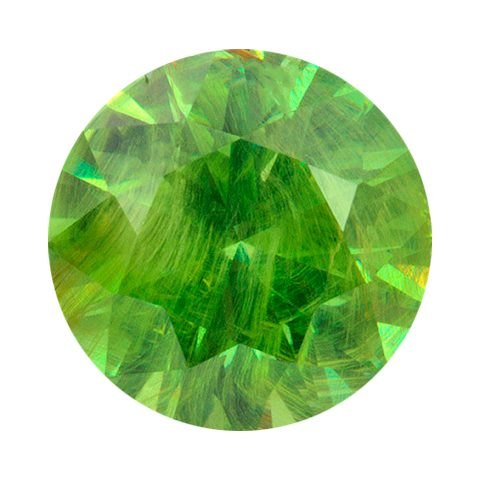
Demantoid
The most prized garnet variety, demantoid is a vivid green andradite with diamond-surpassing dispersion and rare horsetail inclusions.
- The name demantoid comes from the Dutch word demant (diamond), reflecting the stone's exceptional dispersion that exceeds that of diamond.
- Russian Ural demantoid is famous for distinctive horsetail inclusions, threadlike chrysotile fibers that look like sweeping horse tails under magnification.
- Carl Fabergé incorporated demantoid into many of his famous Imperial Easter eggs commissioned by the Romanov family.
- Demantoid has a dispersion (fire) value of 0.057, higher than diamond's 0.044, which produces remarkable rainbow flashes under proper lighting.
- Namibia's Green Dragon mine, opened in the 1990s, expanded global supply of demantoid dramatically and made the variety more accessible to mainstream fine jewelry.
- Collectors interested in rare garnet varieties with documented provenance
- Pendant and earring shoppers wanting fancy green stones with diamond-like fire
- Investors building a portfolio of rare colored stones with established markets
- Practitioners working with heart chakra abundance and prosperity
- January birthstone seekers wanting the rarest and most prestigious garnet
- Buyers under $1,000 per carat (consider tsavorite garnet or chrome diopside)
- Daily-wear ring buyers; demantoid is softer than sapphire and benefits from protective settings
- Anyone wanting large stones; clean demantoid above 2 carats is rare and disproportionately expensive
What Is Demantoid?
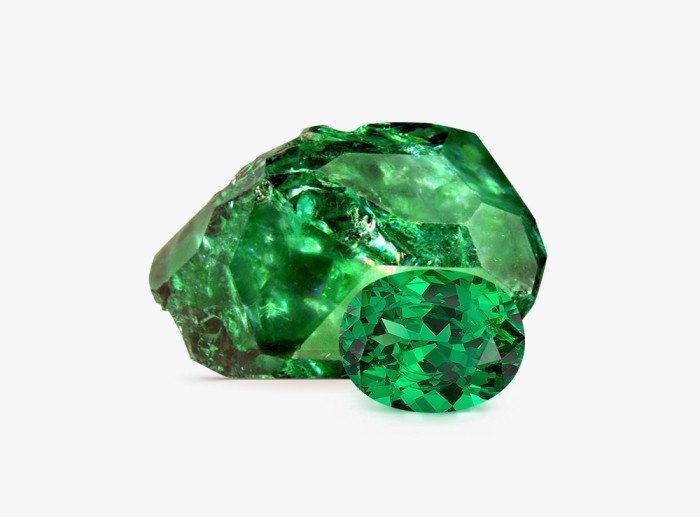
Demantoid is the most valuable variety of garnet, a vivid green to yellow-green form of the species andradite. The name comes from the Dutch word demant (diamond), reflecting the stone's exceptional dispersion that exceeds that of diamond and produces remarkable rainbow fire under proper lighting.
The IMA symbol for andradite is Adr, and demantoid is the chromium- and iron-bearing variety that shows the diagnostic green color.
Demantoid was first discovered in Russia's Ural Mountains in the 1850s, with the Bobrovka River and Sysert River deposits producing material that defined the variety for nearly a century.
Russian Ural demantoid is famous for distinctive horsetail inclusions, fine threadlike chrysotile fibers radiating from a central inclusion that look like sweeping horse tails under magnification. These inclusions are diagnostic of Ural origin and are considered desirable rather than detracting from value.
Namibia's Green Dragon and other deposits opened in the 1990s and dramatically expanded global supply of demantoid, with Namibian stones generally lacking the horsetail inclusions but offering excellent color and clarity at more accessible prices than Ural material. Madagascar and Italy contribute smaller quantities to the international trade.
Demantoid has a Mohs hardness of 6.5 to 7, which makes it durable enough for most jewelry but more vulnerable than sapphire or diamond for daily-wear ring use. Most cut stones are small (typically under two carats), and clean larger stones command exceptional premiums.
How Demantoid Compares
| Property | Demantoid | Tsavorite Garnet | Emerald |
|---|---|---|---|
| Hardness | 6.5 - 7 | 7 - 7.5 | 7.5 - 8 |
| Price / carat | $$$ Premium | $$$ Premium | $$$ Premium |
| Dispersion | 0.057 (exceeds diamond) | 0.028 | 0.014 |
| Best For | Collectors, fine jewelry | Daily wear, mid-tier | Heirloom, investment |
Meaning and Symbolism
Demantoid carries a uniquely Russian historical character, having been discovered and championed by the Russian gem trade in the late nineteenth century.
The variety became a favorite of the Russian Imperial court and the famous jewelry house of Carl Fabergé, who incorporated demantoid into many of his renowned Imperial Easter eggs and other pieces commissioned by the Romanov family.
Russian demantoid was largely unknown outside Eastern Europe until the late twentieth century, which contributed to its mystique among Western collectors when it became more widely available.
The stone gained renewed Western attention in the 1990s after the discovery of significant Namibian deposits expanded global supply. Demantoid is now recognized as one of the most desirable colored gems in the international trade, with Russian Ural material commanding the highest premiums for its historical provenance and characteristic horsetail inclusions.
The variety is sometimes called the king of garnets in collector circles for its combination of rarity, color, and exceptional optical properties.
In modern crystal practice, demantoid is traditionally associated with the heart chakra and with prosperity, abundance, and the kind of bright optimism that supports financial and creative growth. Practitioners believe the stone amplifies the broader garnet family's traditional associations with vitality, adding a specifically green prosperity dimension related to wealth and abundance.
Many find demantoid useful as a milestone stone for major financial achievements or business launches, with the gem's combination of rarity and visual fire making it a natural choice for celebration jewelry.
Historical Timeline
Healing Tradition
Emotional
Practitioners believe demantoid is a stone of bright optimism, prosperity-oriented confidence, and the kind of joyful abundance that supports financial and creative growth. In crystal healing tradition, it is said to amplify the broader garnet family's traditional vitality with a specifically prosperity-focused green energy.
Many find demantoid useful during major business launches, financial milestones, or any period that calls for confident expansion rather than careful conservation.
The stone has long been associated in modern tradition with the principle of attraction in heart-centered work, said to support readers magnetizing opportunities aligned with their authentic gifts. Practitioners often pair demantoid with citrine for amplified prosperity work, with clear quartz for focused intention setting, or with rose quartz for heart-centered amplification.
Demantoid is sometimes recommended for readers cultivating confidence in financial decision-making, with the stone treated as a personal milestone talisman.
Spiritual
Demantoid is traditionally associated with the heart chakra in modern crystal practice. Practitioners believe its vivid green color resonates with the heart's natural openness to abundance and the kind of prosperity that comes from generous engagement with life rather than scarcity-based hoarding.
It has long been considered a stone of celebration in Western jewelry traditions because of its rarity and historical Imperial Russian provenance.
Many find demantoid useful in meditation focused on financial purpose, especially work that involves aligning material success with deeper values and ethical commitments. The stone pairs well with clear quartz for amplified focus and with citrine for solar plexus prosperity activation.
Practitioners sometimes use demantoid in ceremonies marking major financial achievements or business milestones, treating the stone as a literal Imperial talisman for prosperity work conducted with integrity.
Physical
Practitioners believe demantoid supports what they describe as the body's heart and circulatory system through its garnet-family lineage. In folklore the broader garnet family has long been associated with blood, the heart as a physical organ, and overall physical vigor.
It is sometimes recommended for readers managing the physical effects of stress related to financial pressure or major business demands.
Many find demantoid useful as a milestone-occasion stone rather than a continuous-wear talisman, given the stone's rarity and value. Demantoid is durable enough for daily-wear pendants and protective ring settings, and the gem's exceptional fire makes it a popular center stone for celebration jewelry.
Demantoid is not a substitute for medical care, and practitioners are careful to frame its role as supportive rather than curative. For readers who want similar green heart-centered energy at more accessible price points, tsavorite garnet and chrome diopside are practical alternatives.
Zodiac, Birthstone and Gifts
Demantoid is most often associated with Capricorn in modern crystal astrology because of its connection to material achievement and prosperity built through long-term effort. Practitioners believe the stone supports Capricorn readers in celebrating financial milestones with bright optimism rather than the sign's tendency toward conservative caution.
It has long been recommended as a milestone gift for Capricorn entrepreneurs and executives reaching major career achievements.
Aquarius is the secondary association because of demantoid's distinctive rarity and historical Imperial Russian provenance, which appeals to Aquarian readers drawn to unconventional yet historically grounded personal style. Astrologers sometimes suggest the stone for Aquarian innovators reaching milestones in technology or social enterprise.
Care and Cleansing
Demantoid tolerates most common cleansing methods, which makes it relatively easy to maintain. Running tap water for under a minute is safe for both loose and set stones, as is a brief rinse in lukewarm soapy water with a soft brush to remove skin oils.
Avoid prolonged hot water exposure and ultrasonic cleaners on stones with significant inclusions or fillings, since rapid temperature change and vibration can stress the gem.
Sunlight cleansing is safe for demantoid since the green color is stable. Moonlight, smoke from sage or palo santo, and sound cleansing with a singing bowl are all considered safe and well-aligned with the stone's heart-centered energy.
Salt cleansing should be brief and dry only, since saltwater can corrode metal settings. Many practitioners recharge demantoid by resting it on a clear quartz cluster overnight between special-occasion uses.
- DO rinse demantoid jewelry in lukewarm soapy water and dry with a soft cloth.
- DO NOT use ultrasonic cleaners on stones with prominent horsetail inclusions or visible fractures.
- DO use bezel or halo settings rather than exposed prongs for daily-wear demantoid rings.
- DO ask whether the stone is Russian Ural or Namibian; both are accepted but command different prices.
- DO request a reputable independent gemological lab certificate for stones above one carat.
- DO insure demantoid jewelry separately given the per-carat value at fine grades.
- Note: horsetail inclusions in Ural demantoid are diagnostic and desirable, not flaws.
Real vs Fake
Genuine demantoid shows the andradite garnet's characteristic refractive index of 1.880 to 1.890 and specific gravity of 3.81 to 3.87, both significantly higher than most other green gemstones. The exceptional dispersion (0.057) produces rainbow fire that exceeds even diamond, which is a diagnostic visual feature.
Russian Ural stones often show distinctive horsetail inclusions of fine chrysotile fibers radiating from a central inclusion; these are diagnostic of Ural origin and are desirable rather than detracting from value.
Common substitutes and confused stones include tsavorite garnet (similar color but different refractive index and density, lower fire), chrome diopside (much softer, different optical properties), peridot (different refractive index, slightly lower density), and synthetic green YAG or cubic zirconia (similar appearance but different physical properties).
A reputable independent gemological lab can distinguish these species using refractive index, density, and spectroscopy.
At home, look for the andradite garnet's exceptional fire (more rainbow flash than other green stones), the cool feel of true silicate, and natural inclusions visible under magnification. Watch for stones marketed as Russian demantoid at suspiciously low prices, since most Ural-origin stones command significant premiums and require lab confirmation.
Reputable sellers always include current lab paperwork from a major gemological laboratory for any stone above one carat, disclose the country of origin (Russia, Namibia, Madagascar, or Italy), and confirm whether the stone is heat-treated.
Demantoid Jewelry & Gifts
Demantoid pricing depends heavily on color, clarity, size, and origin. Small commercial stones in calibrated sizes run $1,000 to $3,000 per carat, mid-grade Namibian stones with good color reach $3,000 to $8,000 per carat, and fine Ural Russian material with characteristic horsetail inclusions commands $5,000 to $15,000 per carat.
Exceptional clean stones above two carats with documented Ural origin can exceed $20,000 per carat at auction, and historic Imperial Russian-era pieces in antique settings reach significantly higher prices in collector markets.
Heat treatment is sometimes used to improve color in Namibian material; the treatment is accepted and should be disclosed. Russian Ural demantoid is typically untreated. Reputable sellers always include current lab paperwork from a major gemological laboratory for any stone above one carat.
For collectors, Russian Ural demantoid with documented horsetail inclusions represents the premium end of the market. Namibian material continues to supply most fine jewelry demand, while Ural stones command rising premiums as Russian production remains small.
Where to Buy Demantoid
Affiliate disclosure: Some links below earn us a small commission at no extra cost to you. See our affiliate disclosure page.
Handmade, raw, and tumbled pieces from independent sellers worldwide.
Shop Demantoid on Etsy →Accessories, tools, and specimen sets with fast Prime delivery.
Shop Demantoid on Amazon →Certified loose gemstones graded and photographed for online buyers.
Shop Demantoid on GemSelect →Pairs Well With



Where Demantoid Is Found


