
Pyrope
Named for the Greek word for fire, pyrope is the bright magnesium-rich garnet practitioners associate with vitality and direct action.
- Pyrope means fiery-eyed in Greek, a name applied by 19th-century mineralogists for the stone's bright glow.
- Chrome pyrope from South Africa shows brighter, more vivid red than ordinary pyrope thanks to chromium impurities.
- Pyrope is a classic indicator mineral for diamond exploration; geologists track it back to kimberlite pipes.
- Bohemian garnet jewelry of the 18th and 19th centuries used thousands of small rose-cut pyropes per piece.
- Anthill garnet pyrope from Arizona is collected from harvester-ant mounds where the insects eject the stones.
- January birthstone seekers wanting a bright, fiery red rather than dark almandine
- Daily-wear ring buyers looking for a durable affordable red stone
- Antique jewelry fans drawn to Bohemian rose-cut garnet pieces
- Practitioners working with root and heart chakras for embodied vitality
- Collectors building a garnet-species reference suite
- Buyers who want a dark velvety burgundy red (try almandine)
- Shoppers seeking pinkish-purple red (try rhodolite)
- Those needing large clean stones over five carats (try spessartine)
What Is Pyrope?
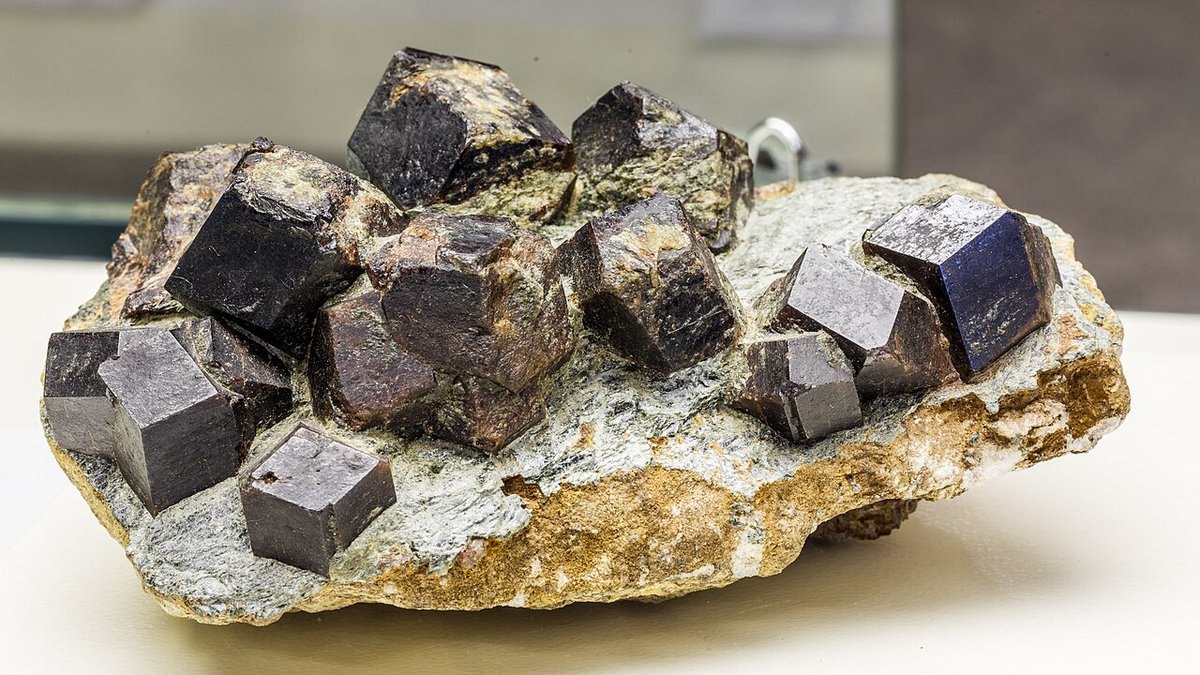
Pyrope is the magnesium aluminum end-member of the garnet group, with the chemical formula Mg3Al2(SiO4)3. The name comes from the Greek pyropos, meaning fiery-eyed, a reference to the bright reddish glow of fine specimens. It rates 7 - 7.5 on the Mohs hardness scale.
Pyrope forms in deep-source ultramafic rocks like peridotite and serpentinite, often as a companion mineral to diamond, and is widely used by geologists as an indicator mineral when prospecting for diamond pipes.
Color in pure pyrope is a bright, slightly orange-tinted red. Most red garnets in the trade are blends of pyrope with almandine (more iron, deeper color) or with spessartine (more manganese, orange tones), and the relative ratios produce the wide range of reds, browns, and oranges seen in commercial garnet jewelry.
Pyrope-rich garnets carry a livelier, more saturated red than almandine-dominated material.
The most famous source historically is Bohemia, in what is now the Czech Republic, where pyrope was mined from the 16th century onward and used in dense rose-cut cluster jewelry. South African pyrope, recovered as a byproduct of diamond mining, gives modern jewelers their richest material.
Chrome pyrope from Arizona's anthill garnets and the Kimberley diamond fields shows a particularly bright color due to small amounts of chromium that lift the saturation.
How Pyrope Compares
| Property | Pyrope | Almandine | Ruby |
|---|---|---|---|
| Hardness | 7 - 7.5 | 7 - 7.5 | 9 |
| Price / carat | $$ Mid-range | $ Budget | $$$ Premium |
| Color | Bright red, fiery | Deep red, slightly violet | Pure red, pigeon blood ideal |
| Best For | Vivid jewelry, daily wear | Antique style, budget | Heirloom, investment |
Meaning and Symbolism
Pyrope's name itself signals its symbolic territory. The Greek pyropos, meaning fiery-eyed, was used by ancient writers to describe the bright reddish glow of certain stones, and the name was formally applied to magnesium garnet in 1803 by German mineralogist Abraham Werner.
Across cultures, red garnet has been associated with the blood of life, the fire of warriors, and the heart's vital force.
Bohemian pyrope holds a special place in European jewelry history. Mined from the volcanic rocks of the Czech mountains starting in the 16th century, the stones were cut into small rose-cut clusters and set in dense gold-and-silver mountings.
Bohemian garnet jewelry was the everyday luxury of the 17th, 18th, and 19th centuries, and the style still defines what many people picture when they hear the word garnet.
In modern crystal healing tradition, pyrope is associated with passion, vitality, and the courage to act on what the heart knows. Practitioners believe it supports both the root and heart chakras, bridging physical embodiment and emotional commitment.
Many find pyrope well-suited to readers ready to take direct action: starting projects, ending stagnant situations, or stepping into leadership roles. Pyrope is the traditional birthstone for January and a recurring gift for second-anniversary celebrations. Modern crystal writers often describe it as the more outgoing twin of almandine.
Historical Timeline
Healing Tradition
Emotional
Practitioners believe pyrope supports passionate, embodied emotional engagement. In crystal healing tradition, it is said to lift sluggish moods, restore enthusiasm during burnout, and encourage decisive action when the user has been stuck in deliberation.
Many find pyrope useful at the start of new projects, after a long period of recovery, or during career transitions that require visible confidence. Unlike the deeper, more meditative almandine, pyrope is traditionally framed as outgoing, fiery, and suited to forward motion.
Because pyrope sits in the bright fiery range, practitioners sometimes pair it with cooling stones like blue lace agate when emotional fire risks tipping into irritability. It is rarely described as a stone for processing grief or quiet sorrow; for those, practitioners reach for rose quartz or smoky quartz instead.
Spiritual
In crystal healing tradition, pyrope is one of the bridge stones between the root and heart chakras. Practitioners believe its bright red energy carries embodied vitality up from the base into the chest, supporting passionate commitment that is grounded in the body rather than abstract feeling.
Medieval Christian writers associated red garnet with the blood of Christ; older Mediterranean traditions linked it to courage and the safe return of warriors.
Many practitioners use pyrope during meditation focused on courage, leadership, or the willingness to step into visible roles. The stone is traditionally associated with Mars and the Sun, emphasizing direct action and the radiant self-expression those planets represent.
Pyrope is frequently chosen as a daily-carry companion during periods of bold change, particularly when the user wants to act from heart rather than from fear.
Physical
Practitioners believe pyrope's bright magnesium-rich red energy supports what traditions describe as circulation, body warmth, and physical stamina. Folklore from medieval Europe linked all red garnets to the blood, and pyrope's livelier color earned it specific associations with vitality and courage in physical effort.
Pyrope is not a substitute for medical care, and crystal traditions frame it as supportive rather than curative.
Many readers wear pyrope rings or pendants during athletic training, cold seasons, or recovery periods that require sustained energy. Practitioners sometimes pair pyrope with carnelian for fuller sacral chakra warmth and with hematite for grounded physical work.
In contemporary gem therapy, pyrope is sometimes recommended for readers in cold climates seeking a warm-energy companion.
Zodiac, Birthstone and Gifts
Pyrope is a January birthstone, making it a classic stone for late Capricorn and early Aquarius birthdays. Astrologers traditionally associate pyrope with Mars and the Sun, the planets of action and radiant self-expression, which is why many find it especially resonant for fiery Aries and Leo.
Capricorn readers often respond to pyrope's combination of root grounding and visible action, supporting ambitious long-term projects. Water signs sometimes find pure pyrope too bright; pairing it with a calming stone like moonstone can soften the fire. Earth signs typically prefer the deeper, more grounded almandine for everyday wear.
Care and Cleansing
Pyrope is one of the easiest stones to cleanse because it is chemically stable and physically tough. Lukewarm soapy water with a soft brush removes grime and skin oils, and a brief rinse under running tap water is also fine.
Ultrasonic cleaners are generally safe for clean pyrope without significant fractures, though check for inclusions before using one.
Sunlight, moonlight, and dry smoke cleansing (sage, palo santo, cedar) are all considered safe and traditional methods. Many practitioners specifically favor sunlight for pyrope given its fire-element associations and bright color.
Recharging on a clear quartz cluster overnight or on a small dish of dry herbs (rosemary, basil) is a common practice between bold-action cycles.
- DO clean pyrope in lukewarm soapy water with a soft brush; rinse and dry with a soft cloth.
- DO NOT use ultrasonic cleaners on stones with visible fractures or fillings.
- DO store pyrope separately from softer stones like opal and pearls to avoid scratching them.
- DO NOT subject pyrope to sudden temperature changes; thermal shock can cause stress fractures.
- DO request disclosure of any treatments, though pyrope is rarely treated commercially.
- DO remove rings during heavy physical work to protect prongs and settings.
- Note: open-back settings show off pyrope's bright color and let light through more dramatically.
Real vs Fake
Genuine pyrope almost always shows tiny natural inclusions under 10x magnification, though the stone is generally cleaner than almandine. Typical inclusions include small crystal fragments and occasional fluid pockets.
Pyrope is singly refractive (cubic), so under a polarizing filter it shows no doubling. A stone sold as pyrope that does show doubling is something else, often spinel or treated tourmaline.
Real pyrope has a refractive index between 1.71 and 1.74 and a specific gravity around 3.62 to 3.87, lighter than almandine but heavier than glass or plastic substitutes.
A simple density check using identical-volume comparison rules out cheap fakes quickly. Glass imitations show bubbles or swirl marks under magnification; real pyrope does not.
At home, you can scratch glass easily with pyrope and check magnetic response (pyrope responds less to magnets than iron-rich almandine, but a strong neodymium magnet often shows visible attraction). Synthetic garnet exists primarily as YAG, used in lasers and as a budget diamond simulant, and is rarely sold as natural pyrope.
For higher-priced chrome pyrope (Cape ruby) above two carats, request a lab report from GIA, Mindat, and USGS to confirm both natural origin and the chromium content responsible for the brighter color. Misrepresentation as ruby is occasionally encountered in low-end markets.
Pyrope Jewelry & Gifts
Pyrope sits in an affordable price range with meaningful variation by quality. Small commercial-grade pyrope under one carat runs $20 to $80 per carat. Cleaner stones in the one- to three-carat range with bright color run $80 to $200 per carat.
Premium pyrope above three carats with vivid, slightly orange-toned red and excellent transparency reaches $200 to $400 per carat.
Chrome pyrope (Cape ruby) from South Africa carries a small premium for its brighter saturation; clean stones above two carats can reach $300 to $500 per carat.
Rare color-change pyrope from Madagascar (shifting from red to purplish in different light) commands higher collector prices, often $500 to $1,500 per carat for fine examples.
Pyrope is generally untreated. Heat treatment is uncommon and the stone reaches the market in its natural state. Always ask about disclosure, though most reputable dealers sell untreated pyrope. For Bohemian-style antique jewelry, condition of the setting and provenance often drive value as much as the individual stones.
Where to Buy Pyrope
Affiliate disclosure: Some links below earn us a small commission at no extra cost to you. See our affiliate disclosure page.
Handmade, raw, and tumbled pieces from independent sellers worldwide.
Shop Pyrope on Etsy →Accessories, tools, and specimen sets with fast Prime delivery.
Shop Pyrope on Amazon →Certified loose gemstones graded and photographed for online buyers.
Shop Pyrope on GemSelect →Pairs Well With



Where Pyrope Is Found


