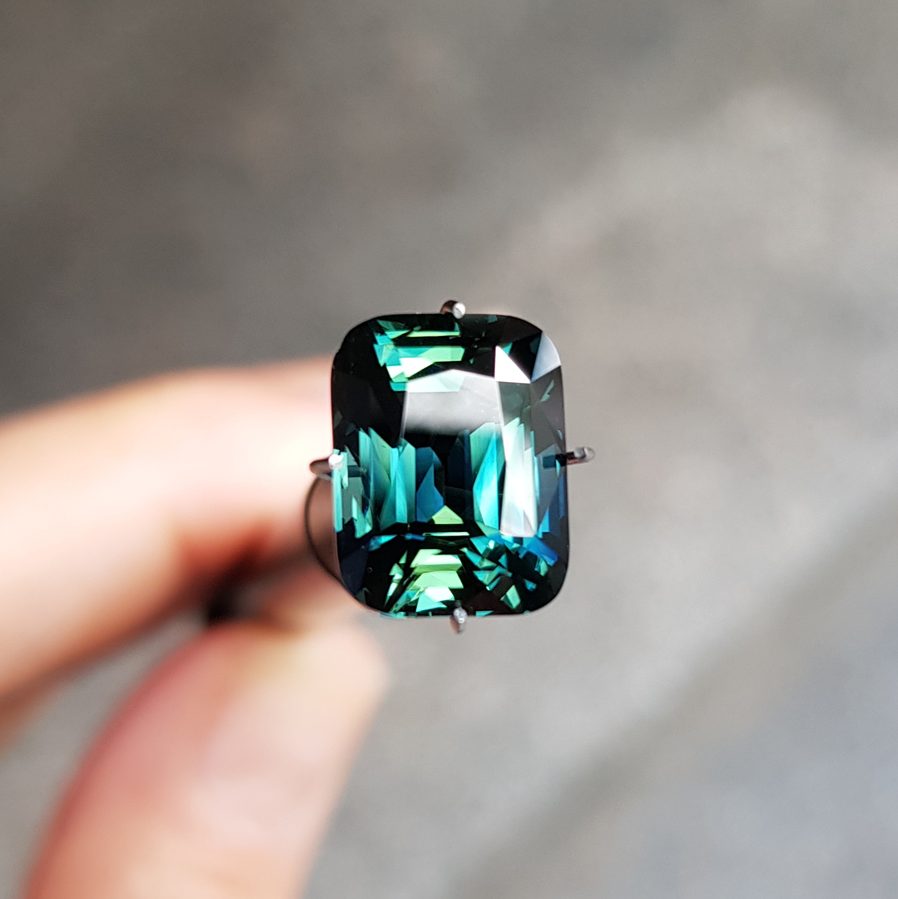
Parti Sapphire
Born in Australian gem fields with simultaneous blue, green, and yellow color zones.
- The word parti comes from the French parti-colored, meaning divided by two or more colors - a heraldic term for shields divided into colored sections.
- Australian basalt-hosted sapphire fields include Anakie in Queensland and the New England region of New South Wales - active gem fossicking areas for enthusiasts.
- Parti sapphires are cut by skilled lapidaries who study the rough crystal orientation to maximize the visual separation or blending of color zones.
- Teal sapphire - the blue-green variety - is technically a subset of the parti family where the colors mix rather than zone distinctly.
- No two parti sapphires have identical color distribution - each stone is geologically unique, which drives their appeal for collectors and custom jewelry.
- Jewelry lovers who want a completely one-of-a-kind gemstone where no other person will have the same stone
- Collectors building a variety of sapphire colors who want the most unusual option
- Buyers who love teal, peacock, and multicolor aesthetics for unconventional engagement rings
- September birthstone shoppers who want something completely different from standard blue sapphire
- Spiritual practitioners working with multiple chakras simultaneously through one multi-hued stone
- Buyers who want a clean single-color stone - the whole point of parti is color zoning
- Anyone needing a perfectly predictable color for matching sets - each parti sapphire is unique
- Budget-first shoppers - unusual parti specimens with striking color distribution command premiums
What Is Parti Sapphire?
Parti sapphire is a corundum (Al2O3) variety showing distinct zones of 2 or more colors visible in a single faceted stone. The word parti derives from the French parti-colored, meaning divided by color. It rates 9 on the Mohs hardness scale.
Most parti sapphires come from Australian gem fields in Queensland and New South Wales, where the local volcanic basalt deposits produce sapphire with unusually complex growth zoning.
The color zones - typically combinations of blue, green, yellow, and teal - form during the crystal's growth as trace element concentrations shift layer by layer.
The colors in parti sapphire result from varying combinations of iron and titanium within the corundum lattice. Blue zones contain higher titanium with optimal iron interaction; yellow zones are iron-dominant; teal and green zones appear in the transition regions.
Australian basalt-hosted sapphire is particularly prone to this complex growth history because the volcanic environment delivers trace elements in fluctuating pulses during crystal formation.
Parti sapphire has been known to miners and cutters for decades, but its rise to collector and designer prominence is largely a 21st-century phenomenon driven by social media and the custom jewelry market.
Cutters who understand parti material orient the stone so that the color zones interact maximally across the face - some displaying blue at the table and yellow at the culet, others showing a gradient from teal to gold across the length. Each stone is a unique intersection of geology and artistry.
Parti Sapphire vs Teal Sapphire vs Blue Sapphire
| Property | Parti Sapphire | Teal Sapphire | Blue Sapphire |
|---|---|---|---|
| Color | 2+ zones: blue, green, yellow | Single blue-green teal | Single blue |
| Hardness | 9 | 9 | 9 |
| Price / carat | $$ Mid-range | $$$ Premium | $$ Mid-range |
| Uniqueness | Each stone unique | Common type, variable | Standardized by color grade |
| Best For | Custom, collector, unconventional ring | Modern jewelry, teal aesthetic | Traditional fine jewelry |
Meaning and Symbolism
Sapphire carries the accumulated symbolism of 3,000 years across multiple civilizations: wisdom, truth, loyalty, heaven, and the protection of the divine. Parti sapphire adds a uniquely modern dimension to this ancient inheritance - it is explicitly the sapphire of complexity, multiplicity, and the beauty of contradiction.
Where a single-color sapphire represents singular focus and clarity, parti sapphire embodies the richness of holding multiple truths simultaneously.
Practitioners who work with parti sapphire in crystal healing describe its multi-color nature as an amplifier of nuance - a stone for people who resist binary thinking and embrace the full spectrum of experience.
Is said to support the integration of seemingly opposite qualities: stability and growth, analysis and intuition, logic and creativity. Many find it particularly resonant during periods of creative breakthrough or when navigating decisions that require holding multiple perspectives at once.
The Australian origin of most parti sapphire connects it to one of the world's oldest living cultures and the Aboriginal tradition of deep relationship with land and stone. While parti sapphire is not specifically identified in Aboriginal ceremonial traditions, the land that yields it carries profound Indigenous significance.
Many contemporary buyers appreciate this connection to ancient, unbroken geological and cultural time - a dimension that purely commercial origins lack.
Historical Timeline
Healing Tradition
Emotional
Practitioners believe parti sapphire supports emotional complexity - the capacity to hold contradictory feelings simultaneously without needing to resolve them immediately. Many who work with multi-color stones find them particularly helpful during transitions when old and new identities overlap and conflict.
Is said to encourage self-acceptance across the full range of one's personality, not just the parts that feel acceptable or coherent. Crystal wellness practitioners describe parti sapphire as a companion for people learning to stop editing themselves - to let all the colors show.
Spiritual
In crystal healing tradition, parti sapphire is associated with all the colors it displays - blue for Throat chakra truth, green for Heart chakra compassion, and yellow for Solar Plexus personal power.
Practitioners believe this multi-chakra activation makes it a particularly potent stone for holistic spiritual practice that addresses multiple energetic centers simultaneously. Is said to support the development of integrated spiritual identity - the quality of being fully oneself across all life domains rather than compartmentalizing spiritual practice from daily reality.
Physical
While no gemstone replaces medical care, the multiple color zones of parti sapphire are said by some practitioners to support different body systems simultaneously - blue for the nervous and communicative systems, green for the heart and circulatory, yellow for the digestive and metabolic.
This is a metaphorical rather than clinical understanding, rooted in color therapy traditions. Many find that the visual complexity of parti sapphire during meditation creates a unique contemplative experience that supports mental clarity and the release of rigid thinking patterns.
Zodiac, Birthstone and Gifts
Parti sapphire resonates most strongly with the Air signs, whose multi-dimensional intellectual and relational natures mirror the stone's multi-color character. Gemini (May 21 - June 20), the sign of duality and multiplicity, has an almost literal correspondence with parti sapphire's two or more simultaneous colors.
Libra (September 23 - October 22) connects through the stone's capacity to hold multiple perspectives in balance - a core Libran quality.
Aquarius (January 20 - February 18), the innovative humanitarian sign, resonates with parti sapphire's unconventional beauty and its challenge to the gemstone convention that single color equals highest value. Many astrology practitioners choose parti sapphire for Aquarius precisely because the stone itself defies traditional gem hierarchy.
As a September birthstone, parti sapphire also serves Virgo birthdays in its traditional sapphire capacity.
Care and Cleansing
Parti sapphire is one of the most durable gemstones and requires minimal care in cleansing. All standard methods are safe: running water, brief sunlight, moonlight, selenite plate, and sound. Mohs 9 corundum is chemically stable and color-stable, with no UV sensitivity or water absorption concerns.
Mild soap and warm water with a soft brush is the most effective physical cleaning method for set jewelry. Ultrasonic cleaning is safe for unfractured specimens without clarity-reaching inclusions.
For energetic cleansing after intense ritual or healing work, many practitioners favor full moonlight on a windowsill, allowing both the physical brilliance and the energetic field of the stone to reset under lunar light.
- DO store separately from other sapphires and diamonds to prevent contact scratching on surface.
- DO work with a custom jeweler who understands stone orientation for parti sapphire - the wrong orientation wastes the color effect.
- DO NOT use ultrasonic cleaners if the stone has significant clarity features; consult a gemologist first.
- DO inspect prong settings periodically - the stone's hardness means it holds its surface but prongs still wear.
- DO photograph your parti sapphire in multiple lighting conditions - the color shift is part of the stone's appeal and should be documented.
- DO request origin documentation if buying as a collector investment - Australian origin adds provenance value.
Real vs Fake
Parti sapphire authentication focuses on confirming genuine corundum (Al2O3) rather than glass, synthetic, or simulant material. At Mohs 9, parti sapphire scratches any common simulant except diamond. Glass and synthetic spinel show softer hardness readings and different refractive indices.
A refractometer reading of 1.762 to 1.770 with strong double refraction confirms corundum chemistry.
Synthetic corundum is the most chemically similar simulant. Lab-created sapphire can be produced in multicolor patterns but typically shows curved growth striations (Verneuil) or chevron zoning (hydrothermal) rather than the natural angular zoning of genuine Australian parti sapphire.
Under magnification at 10x to 40x, natural parti sapphire shows natural inclusions and angular color zone boundaries consistent with geological growth.
For collector-grade parti sapphire, a gemological laboratories or equivalent report confirming natural origin and Australian provenance is valuable documentation. Synthetic multicolor corundum is not common in the market but exists; for significant purchases, laboratory confirmation is the most reliable protection.
The biggest market risk is misrepresentation of Australian origin using material from other origins with similar color zoning.
Parti Sapphire Jewelry & Gifts
Parti sapphire prices range from $200 to $3,000 or more per carat depending on color distribution, saturation, clarity, and cut. The most desirable stones show distinct, saturated color zones that are visible and well-separated - a 50/50 blue-green split or a strong teal-to-gold gradient commands premium pricing.
Poorly distributed or muddy color transitions significantly reduce value.
Heat treatment is common in commercial Australian sapphire, though some parti sapphire is sold unheated. Unheated Australian parti sapphire with strong color and good clarity commands a premium. Always ask the dealer about heat treatment and request documentation.
The custom jewelry market is the primary venue for the finest parti sapphire; specialty Australian gem dealers are the most reliable sources for origin-documented material.
Where to Buy Parti Sapphire
Affiliate disclosure: Some links below earn us a small commission at no extra cost to you. See our affiliate disclosure page.
Handmade, raw, and tumbled pieces from independent sellers worldwide.
Shop Parti Sapphire on Etsy →Accessories, tools, and specimen sets with fast Prime delivery.
Shop Parti Sapphire on Amazon →Certified loose gemstones graded and photographed for online buyers.
Shop Parti Sapphire on GemSelect →Pairs Well With


Where Parti Sapphire Is Found
