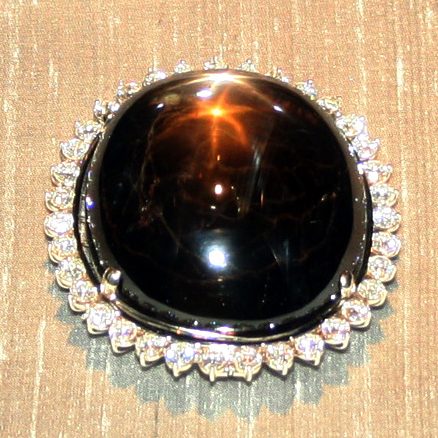
Sapphire Star
A 6-rayed star of light glides across the sapphire's surface - an optical phenomenon called asterism, formed by microscopic silk inclusions inside the stone
- The Star of India (563 carats) shows a rare double star - visible from both sides of the stone - because silk runs through its entire body, not just near the surface.
- A star sapphire's asterism is only visible under a single concentrated light source - diffuse or fluorescent light makes the star disappear entirely.
- Corundum's trigonal (hexagonal) crystal structure means silk forms at exactly 60° angles, which is why star sapphires reliably show 6 rays, not 4 or 8.
- Occasionally, star sapphires display 12 rays instead of 6 - this happens when 2 different types of inclusions produce 2 overlapping star patterns.
- The term "asterism" comes from the Greek word for star (*aster*) and is found in several other gemstones including star ruby, star diopside, and star rose quartz.
- Collectors seeking a dramatic, optically rare phenomenon stone with centuries of royal history
- September birthstone shoppers wanting something more distinctive than a standard faceted sapphire
- Spiritual practitioners drawn to the 6-ray star as a sacred geometry symbol and protective talisman
- Fine jewelry buyers looking for a durable, eye-catching cabochon centerpiece
- Anyone drawn to stones that carry provable authenticity - the asterism cannot be faked in low-quality synthetic alternatives
- Buyers expecting the sparkle of a faceted stone - star sapphires are cut as cabochons and show a gliding star, not a brilliant fire; consider a faceted blue sapphire for scintillation
- Budget buyers - authentic star sapphires start at $50+ per carat for commercial grade; lab-created versions offer the look at lower cost
- Those wanting transparent clarity - the silk inclusions causing the star make the stone translucent, not transparent
What Is Sapphire Star?
A star sapphire is a corundum (Al₂O₃) gemstone that displays *asterism* - a 6-rayed star of reflected light that glides across the cabochon surface when a single light source moves. The star forms because of densely packed, microscopically thin rutile needles (called "silk") arranged in 3 intersecting directions at 60° angles, matching corundum's hexagonal crystal symmetry. Each direction reflects a band of light; the 3 bands combine to produce the 6-ray star.
Star sapphires occur in the full color range of corundum - blue, black, gray, pink, orange, and yellow - but blue star sapphires are by far the most prized and widely traded. The largest historic blue star sapphire, the "Star of India" at 563 carats, is displayed at the American Museum of Natural History in New York. Sri Lanka (formerly Ceylon) remains the premier source of fine blue star sapphires, with Burma (Myanmar) and Thailand also producing significant material.
For asterism to be visible, the silk must be abundant and well-oriented, and the stone must be cut as a dome-shaped cabochon with the c-axis perpendicular to the table. Correct orientation is critical - even a slight error shifts or distorts the star. The best stars are sharp, centered, and display all 6 rays of approximately equal length and brightness. Sapphire's Mohs hardness of 9 makes star sapphires among the most durable of all phenomenon stones.
How Star Sapphire Compares
| Property | Star Sapphire | Star Ruby | Black Star Sapphire |
|---|---|---|---|
| Hardness | 9 | 9 | 9 |
| Price / carat | $$ Mid-range | $$ Mid-range | $ Budget |
| Star Type | 6-ray blue | 6-ray red | 6-ray / 12-ray black |
| Rarity | Rare | Very Rare | Common |
Meaning and Symbolism
Star sapphires have been venerated across cultures for thousands of years, with the 6-ray star interpreted as a symbol of divine protection, fate, and sacred knowledge. In ancient Persia and medieval Europe, the three crossing lines of the star were associated with Faith, Hope, and Destiny - a tripartite symbolism that made star sapphires among the most powerful protective amulets known.
The ancient Sinhalese called certain star sapphires *padparadscha* variants and associated them with divine protection in battle and travel. In medieval European courts, the star sapphire was considered a 'stone of destiny' - worn to attract favorable fortune and shield the bearer from envy and deceit. Rulers and high clergy favored them. The stone was also associated with prophecy, as the moving star seemed to shift in response to the wearer's thoughts.
In contemporary crystal healing tradition, star sapphire carries the full sapphire repertoire - wisdom, clarity, integrity, and spiritual insight - amplified by the star's symbolism of guidance and purpose. Practitioners believe the 6-ray star acts as a spiritual compass, helping the wearer align with their highest truth. Many find star sapphire supportive in meditation practices focused on developing discernment, clarity of purpose, and intuitive leadership.
Historical Timeline
Healing Tradition
Emotional
Practitioners believe star sapphire supports emotional clarity, helping the wearer distinguish genuine intuition from fear-based reaction. Many find the stone encourages a settled, centered quality - a sense of standing in one's own truth without needing to defend it. In crystal healing tradition, sapphire is said to clear confusion and indecision, supporting people navigating significant life crossroads. The star's symbolism of guidance resonates strongly with those at transitions - career changes, relationship decisions, or shifts in spiritual direction. Many practitioners use star sapphire specifically when a client needs to trust their own inner compass more than outside opinions.
Spiritual
Star sapphire is most often associated with the third eye and throat chakras in spiritual practice, where practitioners believe it deepens access to inner wisdom and supports clear, truthful communication. The 6-ray star is seen as a sacred geometry symbol in multiple traditions - a mandala of balance and wholeness. Many crystal teachers use star sapphire in meditation for connecting with higher guidance, developing clairvoyant perception, or establishing spiritual integrity. Some practitioners associate it with the angelic realm and use it in invocation or protection work. In Buddhist and Hindu traditions, sapphire has long been associated with divine truth and the spiritual development of the mind.
Physical
In crystal healing tradition, star sapphire is said to support the eyes, ears, and neurological system, reflecting its third eye and mental clarity associations. Some practitioners place it on the throat for thyroid and communication-related concerns. Others associate it with blood and bone strength through its corundum (aluminum oxide) composition. These associations are not medically validated and should not be interpreted as medical claims. Star sapphire is never a replacement for licensed medical care. Any physical symptoms require professional evaluation and treatment by a qualified healthcare provider.
Zodiac, Birthstone and Gifts
Star sapphire is a traditional September birthstone and the gem of Virgo, connecting it to the themes of discernment, integrity, and service that define that sign. Virgo's analytical nature is said to be elevated by sapphire's reputation for mental clarity and truth-seeking - the star symbolizing the moment insight crystallizes into understanding. Taurus is connected through both Venus's rulership and the stone's deep historical association with enduring beauty and reliability. In Roman tradition, sapphire was sacred to Jupiter and Saturn - both governing higher principles and long-term structures. Many astrologers also note star sapphire as particularly supportive for Pisces, where the star's guiding function complements that sign's need for direction amid intuitive depth.
Care and Cleansing
Star sapphire is one of the most cleansing-friendly gemstones available. Its Mohs 9 hardness and chemical stability mean it tolerates water, moonlight, sunlight, and salt without risk of damage. Brief soaking in clean water followed by gentle drying is completely safe. Moonlight cleansing overnight on a windowsill is a traditional favorite for sapphire's lunar and Saturnine associations.
Sound cleansing with a singing bowl or tuning fork works well for any stone and is suitable for star sapphire. Smudging with sage, palo santo, or incense smoke is safe and effective. Placing star sapphire on a selenite slab overnight is widely used as a passive charging method. For a full energetic reset, some practitioners bury it briefly in dry soil and visualize the earth drawing out any accumulated energy before use in meditation.
- DO store star sapphire separately from other stones - at Mohs 9 it will scratch almost any other gemstone it contacts.
- DO NOT clean with steam cleaners if the stone has fractures or is fracture-filled - heat and pressure can damage treated stones.
- DO check the setting periodically if worn in a ring - the cabochon dome can pop free from prong settings with hard impact.
- DO clean with warm soapy water and a soft brush - safe and effective for untreated natural star sapphires.
- Note: Fracture-filled or beryllium-diffusion treated star sapphires require gentler care - ask your seller about treatment status before cleaning.
- DO NOT use abrasive polishing compounds - the polish on a star sapphire cabochon dome is critical to asterism display and must not be abraded.
Real vs Fake
Star sapphire authenticity has 2 distinct questions: is it genuine corundum, and is the star natural or artificially induced? Both matter for value. Synthetic star sapphires (most commonly Verneuil-process corundum with silk added) are widely sold and visually convincing. They display a perfect, sharp, bright star - almost too perfect. Natural star sapphires typically show some irregularity: a star that is slightly off-center, rays of unequal length, or gentle variations in the silk density.
Diffusion-treated star sapphires are another category - natural corundum treated with titanium at high temperature to create artificial silk near the surface. The star in a diffusion stone appears only within a very thin layer; tilting the stone dramatically shifts or breaks the star in a way that deep-silk natural material does not. A gemologist with a microscope can distinguish this quickly.
The most reliable test for natural versus synthetic: examine the stone under magnification for natural inclusions (fingerprints, needles, zoning), check the star's sharpness and centering, and request a certificate from a recognized gem lab. Refractive index (1.762-1.770) confirms corundum. Only a proper gem lab can distinguish natural from synthetic with certainty when the visual characteristics are ambiguous. Prices differ enormously - natural fine star sapphires cost 10-100x their synthetic equivalents.
Sapphire Star Jewelry & Gifts
Star sapphire quality is assessed on 5 criteria: star sharpness, star centering, body color, transparency, and size. The finest examples show a crisp, well-centered star with all 6 rays of equal intensity, a saturated royal blue or medium-blue body, strong translucence, and a well-proportioned dome. Commercial-grade star sapphires with a visible but soft star in a grayish-blue body start around $50-$200 per carat. Fine Sri Lankan material with an excellent centered star and vivid blue color reaches $1,000-$3,000 per carat.
Black star sapphires from Thailand and Australia offer asterism at dramatically lower prices - $10-$150 per carat for strong-star material. Gray star sapphires occupy the middle range. Pink and orange star sapphires are rare and expensive. Lab-created star sapphires with strong stars are available for $5-$30 per carat and are a cost-effective option for those who want the phenomenon without the investment.
Always ask whether the stone has been treated. Heat treatment is standard and acceptable in the sapphire trade. Fracture filling, beryllium diffusion, and surface titanium diffusion (for the star itself) are less desirable and must be disclosed. Request a certificate from a recognized gem lab for any star sapphire over $500 per carat. Sri Lankan origin with lab certification adds a provenance premium.
Where to Buy Sapphire Star
Affiliate disclosure: Some links below earn us a small commission at no extra cost to you. See our affiliate disclosure page.
Handmade, raw, and tumbled pieces from independent sellers worldwide.
Shop Sapphire Star on Etsy →Accessories, tools, and specimen sets with fast Prime delivery.
Shop Sapphire Star on Amazon →Certified loose gemstones graded and photographed for online buyers.
Shop Sapphire Star on GemSelect →Where Sapphire Star Is Found


