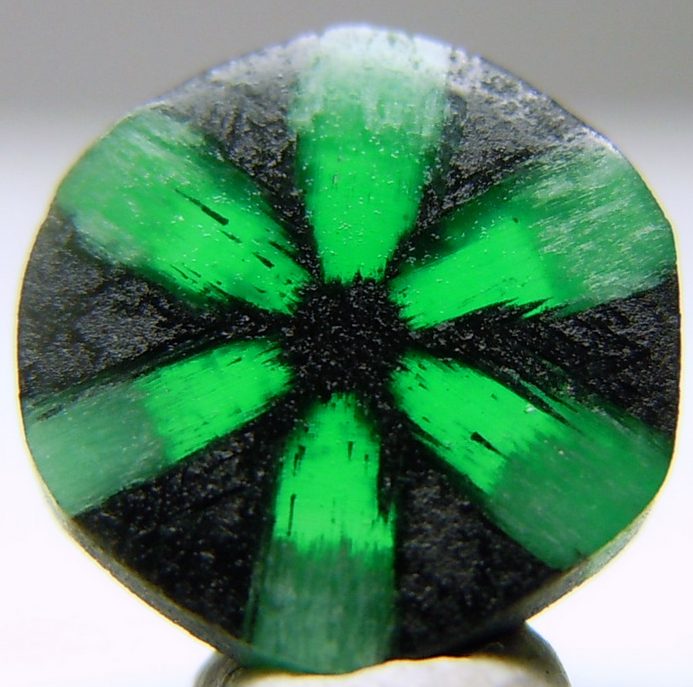
Trapiche Emerald
Trapiche emeralds grow a natural six-spoked wheel of dark carbon inclusions - a geometric pattern so precise it was once thought impossible.
- The trapiche wheel pattern is so precise and geometrically regular that early 19th century mineralogists initially suspected the specimens were manufactured rather than natural.
- True trapiche emeralds come almost exclusively from 2 Colombian mines - Muzo and Chivor - with rare examples from Brazil, Afghanistan, and a handful of other localities.
- The word 'trapiche' entered mineralogy from the Spanish word for the six-spoke crushing wheel used on Colombian sugar plantations, because the visual similarity is virtually perfect.
- Some trapiche emerald cross-sections show secondary color sectors between the six emerald sectors - creating 12 zones total with alternating shades of green and dark gray.
- The largest documented trapiche emerald cross-section on record measured over 6 cm across - large enough to carve into a significant cabochon while retaining the full wheel pattern.
- Serious collectors seeking one of nature's rarest geometric formations in a gemstone
- Those drawn to sacred geometry and the symbolism of the six-pointed star or mandala
- Emerald family collectors wanting a specimen that transcends conventional gem categories
- Mineral and crystal enthusiasts who value geological phenomena over faceted beauty
- Spiritual practitioners who work with geometrically significant patterns in healing
- Buyers wanting a traditional faceted emerald for fine jewelry - trapiche emeralds are primarily collector specimens
- Those on a tight budget - fine trapiche emeralds with clear spoke definition command significant premiums
- Anyone wanting a stone for ongoing physical contact or water cleansing - oil-treated inclusions require dry care
What Is Trapiche Emerald?
Trapiche emerald is a rare variety of *emerald* (chromium-bearing beryl, Be3Al2Si6O18) in which dark carbon-rich inclusions arrange themselves into a six-pointed spoke pattern radiating from the crystal's central axis to its six faces. It rates 7.5 - 8 on the Mohs hardness scale.
The word *trapiche* refers to the six-spoke wheel used to crush sugar cane in Colombian sugar mills - the visual resemblance to this wheel is exact. In cross-section, a trapiche emerald shows 6 green emerald sectors separated by alternating dark gray-black carbon inclusion zones, creating a natural mandala.
The spokes form when carbon-bearing organic material or graphite deposits in the crystal's interstitial zones between the six prism faces as the emerald grows, while the six prism faces themselves remain relatively clean emerald.
The mechanism requires specific growth conditions - particularly the presence of carbonaceous material in the hydrothermal fluid at the time of crystallization. These conditions are found primarily in Colombia's Muzo and Chivor mines and, more rarely, at a very small number of other world localities.
**Trapiche emeralds are cut in cross-section** rather than faceted conventionally - the geological phenomenon is only visible when the crystal is sliced perpendicular to the c-axis and polished, revealing the wheel-like pattern. Cabochon cross-sections are the standard commercial form.
Fine trapiche specimens show a clean, clearly defined six-spoke pattern in green emerald; inferior examples have irregular, indistinct spokes that reduce the visual impact of the phenomenon.
How Trapiche Emerald Compares
| Property | Trapiche Emerald | Colombian Emerald | Star Sapphire |
|---|---|---|---|
| Pattern | 6-pointed carbon spokes | None (plain green) | 6-rayed asterism from silk |
| Cut Form | Cross-section cabochon | Faceted | Cabochon |
| Price / piece | $$ Mid-range | $$ Mid-range | $$ Mid-range |
| Best For | Collectors, specimen display | Fine jewelry | Jewelry, collecting |
Meaning and Symbolism
The six-pointed star formation in trapiche emerald carries profound symbolic resonance across multiple traditions. In sacred geometry, the hexagram represents the union of opposing principles - earth and sky, masculine and feminine, matter and spirit - making the trapiche's natural six-spoke wheel a physical embodiment of cosmic integration.
The Star of David and the Seal of Solomon both employ this geometry.
Emerald itself carries some of the oldest spiritual associations in the gem world. Ancient Egyptians linked it to Thoth, god of wisdom and writing.
The Holy Grail of medieval legend was said by some accounts to be cut from a single emerald that fell from Lucifer's crown during his fall from heaven - a stone of divine knowledge. Colombian indigenous traditions regarded emerald deposits as sacred and the stones as gifts from the earth's interior.
**Trapiche emerald brings together** the heart chakra wisdom of emerald with the geometric perfection of a form that appears deliberately designed. Many practitioners experience the cross-section pattern as a natural mandala - an object for visual meditation on wholeness, balance, and the intelligence embedded in nature's own structures.
Historical Timeline
Healing Tradition
Emotional
Practitioners associate trapiche emerald with the integration of opposites within the heart - the capacity to hold love and grief, joy and sorrow, connection and solitude simultaneously without forcing resolution of the tension.
Its six-spoke pattern is seen as a symbol of emotional wholeness that includes all parts of experience rather than excluding the difficult ones. Many find it supportive in practices focused on acceptance of complexity in relationships and in oneself.
Crystal healing tradition describes it as deepening the heart chakra's quality of unconditional love - love that doesn't require things to be different from what they are.
Spiritual
In spiritual practice, trapiche emerald's sacred geometric pattern is used as a mandala object for meditation on divine order within natural form. Practitioners work with it to access states of integration where apparent opposites are recognized as complementary aspects of a unified whole.
Its heart chakra focus combined with the geometric intelligence of its formation makes it popular for meditations on cosmic design, the intelligence of nature, and the connection between mathematical beauty and spiritual truth.
Some esoteric traditions associate the hexagram with the merkaba - the geometric light body said to activate with deep spiritual development.
Physical
Crystal healing texts associate emerald with the heart, circulatory system, and the body's capacity for physical regeneration. Trapiche emerald carries these associations with the additional quality of the geometric pattern - said to support organized, structured healing rather than the more diffuse heart opening of plain emerald.
Practitioners sometimes use it in body layouts near the heart, particularly when working with patterns of physical tension that seem connected to long-held emotional armoring. These are metaphysical associations and do not constitute medical advice.
Zodiac, Birthstone and Gifts
Emerald is the May birthstone and Taurus's most direct zodiac connection. Trapiche emerald's sacred geometric pattern speaks to Taurus's appreciation for beauty that has depth and purpose - not ornamental but structurally meaningful. Venus rulership connects both to the stone's heart chakra green and to the mathematical elegance of the six-spoke wheel.
Cancer's deep emotional intelligence and its connection to the heart find resonance with trapiche emerald's integration of green emerald sectors with the dark spokes of accumulated experience. Virgo's Mercury rulership and attention to precise pattern align with the stone's natural geometric exactness.
All three signs benefit from the stone's traditional association with heart wisdom, wholeness, and the intelligence found in natural structure.
Care and Cleansing
Use water with caution for trapiche emerald - emeralds are commonly oiled or resin-treated to improve apparent clarity, and repeated water contact can gradually dissolve or cloud treatment materials.
Brief water contact is acceptable if treatment status is confirmed, but dry cleansing methods are safer as a default practice. **Confirm treatment status** with the vendor before any wet cleaning.
Sound cleansing with singing bowls is the safest and most appropriate method for trapiche emerald, requiring no physical contact with the stone surface and creating no risk to oil treatments. Moonlight on a dry surface is equally appropriate.
Smudging with sage in a well-ventilated space is a traditional alternative that poses no risk to the stone's surface treatment or color.
- DO NOT soak in water - emerald fracture fillings (oil, resin) are damaged by prolonged water exposure.
- DO NOT use ultrasonic cleaners - vibration can cause fractures to extend and can disrupt fracture fillings.
- DO keep the polished cross-section face clean using a dry soft cloth; avoid abrasive contact.
- DO NOT expose to strong solvents (acetone, alcohol) - these can dissolve fracture-filling oils or resins.
- DO store on a padded surface face-up to prevent scratches to the polished display surface.
- NOTE: The carbon spokes are a natural geological feature - they do not represent flaws or damage.
- DO confirm treatment status (oiled, resin-filled, untreated) before any cleaning procedure to avoid inadvertent damage.
Real vs Fake
Fake trapiche emeralds have been produced by various methods: assembling multiple green and dark sectors into a mosaic, etching false spokes on plain emerald cabochons, or using green glass with embedded dark materials.
Genuine trapiche specimens show spoke zones that are continuous mineral inclusions running through the depth of the stone, not surface applications. Examining the stone from the side reveals whether the spokes exist throughout the depth or are surface treatments.
Under magnification, genuine trapiche carbon spokes show the irregular, organic texture of natural mineral inclusions - varying widths, slight waviness, and integration with the surrounding beryl crystal structure. Manufactured fake spokes appear too regular, too uniform in width, or show sharp mechanical edges inconsistent with natural crystal growth.
The boundaries between the green emerald sectors and the dark spokes in genuine specimens show the gradual transition typical of mineral contact zones.
**Laboratory documentation** is the most reliable authentication for significant trapiche purchases. Gemological laboratories and Gübelin can confirm natural trapiche formation versus assembled or treated imitations. The Colombian origin should also be confirmed for specimens marketed at premium prices - most non-Colombian 'trapiche' material is significantly less distinctive in pattern definition.
Trapiche Emerald Jewelry & Gifts
Trapiche emerald quality is assessed by the clarity and regularity of the six-spoke pattern and the saturation of the green emerald sectors. The finest specimens show crisp, clearly defined dark spokes separating vivid green sectors with minimal cloudiness or irregular inclusion zones outside the spokes.
The cross-section should be polished to high clarity so the pattern is fully visible.
Colombian origin from Muzo or Chivor is the quality benchmark - request origin documentation for significant purchases. Non-Colombian trapiche material from Brazil or Afghanistan exists but is generally less dramatically patterned.
Prices range from $200 for small, moderately defined specimens to over $5,000 for large cabochons with exceptional pattern definition and good emerald color.
**Most trapiche emeralds are oiled** - this is standard in the emerald trade and should be disclosed. Untreated trapiche specimens are rarer and more valuable but require the same care instructions as untreated emerald generally. Purchase from dealers specializing in rare Colombian specimens who can provide documented provenance and treatment disclosure.
Where to Buy Trapiche Emerald
Affiliate disclosure: Some links below earn us a small commission at no extra cost to you. See our affiliate disclosure page.
Handmade, raw, and tumbled pieces from independent sellers worldwide.
Shop Trapiche Emerald on Etsy →Accessories, tools, and specimen sets with fast Prime delivery.
Shop Trapiche Emerald on Amazon →Certified loose gemstones graded and photographed for online buyers.
Shop Trapiche Emerald on GemSelect →Pairs Well With




Where Trapiche Emerald Is Found
