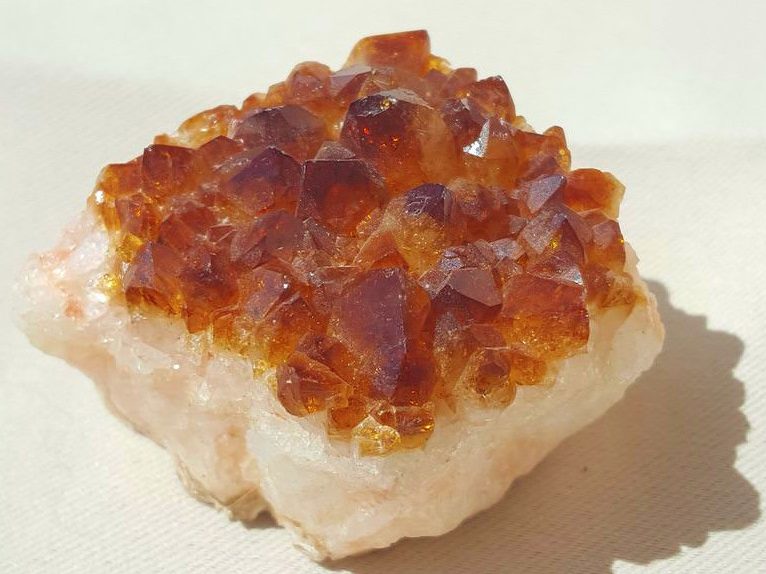
Yellow Quartz
Solar warmth crystallized - pale to golden yellow quartz for confidence, clarity, and bright new beginnings
- The boundary between "yellow quartz" and "citrine" is purely commercial and color-based - there is no mineralogical difference between a pale citrine and a saturated yellow quartz.
- Natural citrine is relatively rare; most yellow-orange quartz sold as citrine is amethyst or smoky quartz that has been heat-treated - a practice so widespread it is now considered industry standard.
- Ancient Romans called yellow quartz "topazion" after the island of Topazios (Red Sea), causing centuries of confusion between yellow quartz and the mineral topaz - two entirely different species.
- Yellow quartz from the Minas Gerais region of Brazil forms in some of the among the largest known individual crystal clusters, with museum pieces weighing hundreds of pounds.
- Some yellow quartz develops a two-toned appearance with a clear base and yellow termination tip, showing exactly where iron-rich hydrothermal fluids entered during the final growth stage.
- those working with confidence and personal power
- practitioners focused on solar plexus healing
- people seeking gentle warmth vs. intense citrine energy
- those drawn to pale golden aesthetics
- beginners exploring yellow crystals
- collectors seeking saturated orange-yellow gemstones
- buyers wanting identified citrine or heliodor
- those requiring rare or high-value specimens
What Is Yellow Quartz?
Yellow Quartz is a broad term for quartz crystals or masses with yellow coloration, most commonly due to trace amounts of iron impurities (Fe³⁺) within the silicon dioxide lattice. It rates 7 on the Mohs hardness scale.
It spans a range from very pale, almost clear yellow to warm golden tones, and is distinct from citrine primarily by convention and color intensity rather than strict mineralogical definition.
The distinction between yellow quartz and citrine is commercially fuzzy - citrine is technically a variety name for yellow-to-orange transparent quartz, while "yellow quartz" is sometimes used for paler, less saturated specimens or for massive (non-crystalline) yellow quartz material. Both are iron-colored quartz; the naming largely reflects trade custom and color intensity.
Natural yellow quartz forms in hydrothermal veins and pegmatites where the crystallization environment allows iron incorporation at the right oxidation state. The vast majority of commercially available yellow or citrine-colored quartz is heat-treated amethyst or smoky quartz - a fully disclosed and accepted trade practice.
Yellow Quartz vs. Similar Yellow Stones
| Property | Yellow Quartz | Citrine | Yellow Topaz |
|---|---|---|---|
| Hardness | 7 | 7 | 8 |
| Price/ct | $ Budget | $ Budget | $ Budget |
| Rarity | Common | Common-uncommon | Uncommon |
| Best For | Solar plexus, beginners | Abundance, confidence | Clarity, luxury |
Meaning and Symbolism
Yellow quartz carries the symbolism of sunlight, warmth, and clarity that solar-colored stones have represented across cultures throughout history. Its gentle golden hue is associated with optimism, intellectual clarity, and the kind of steady confidence that comes not from external validation but from inner alignment.
Practitioners connect yellow quartz to the solar plexus chakra, the energetic center traditionally associated with personal power, self-worth, and the ability to take decisive action in alignment with one's authentic self. The stone is said to work gently but persistently, slowly strengthening the solar plexus over time.
Unlike the more intense citrine, yellow quartz is often preferred by those who find citrine's energy too stimulating - its paler, softer tone is said to carry the same solar qualities in a more subdued, approachable way.
Many practitioners recommend it as a first solar plexus stone for those just beginning to explore personal empowerment work.
Historical Timeline
Healing Tradition
Emotional
Practitioners believe Yellow Quartz supports the building of genuine self-confidence and inner strength - not the performative kind that masks insecurity, but the quiet assurance that comes from knowing one's own worth. The stone is said to gently dissolve self-doubt, people-pleasing patterns, and the fear of taking up space.
Many crystal healers use it for clients working through lack of self-trust or difficulty making decisions, as the solar plexus energy it activates is traditionally associated with the will and personal authority.
Spiritual
In spiritual practice, yellow quartz is considered a bridge between earth-level personal power and higher spiritual alignment. Practitioners believe it supports the integration of ego and spirit - helping the individual self stop over-contracting in fear and expand into its natural, confident expression.
The stone is said to resonate with solar deities and the archetype of the inner sun across traditions. Some practitioners use it in morning meditations to set a tone of confidence, clarity, and engagement with the day.
Physical
Some crystal wellness practitioners associate Yellow Quartz with digestive health, metabolic support, and nervous system regulation through its traditional solar plexus connection. It is said to support the organs associated with digestion and assimilation in holistic frameworks. No scientific evidence supports these claims.
Always consult a qualified healthcare provider for any physical health concerns.
Zodiac, Birthstone and Gifts
Leo's solar nature and natural confidence resonate perfectly with yellow quartz's solar plexus energy - the stone is said to amplify Leo's warmth and generosity while calming any tendency toward ego inflation. Aries's fire energy and drive toward action align with yellow quartz's will-activating properties, supporting decisive forward movement.
Care and Cleansing
Yellow quartz responds well to sunlight cleansing - brief morning sun exposure (20-30 minutes) is said to recharge its solar energy. Unlike some color-sensitive stones, pale yellow quartz is generally more stable than amethyst or rose quartz in moderate sunlight, though prolonged daily exposure should still be avoided.
Sound cleansing with a singing bowl tuned to a solar frequency (practitioners often use F note, associated with solar plexus) is a resonant and effective method. Pass the stone through vibrations for 2-3 minutes while holding an intention for renewed confidence and clarity.
Briefly burying yellow quartz in a small bowl of brown rice (which is then discarded, not eaten) is a traditional cleansing method in some crystal communities. This is said to be especially effective for drawing out heavy energies accumulated during use in personal empowerment work.
- DO clean with warm water and mild soap, drying thoroughly after.
- DO NOT expose to prolonged direct sunlight as color may gradually fade over months.
- DO NOT use harsh chemical cleaners that could etch the polished surface.
- NOTE that most yellow quartz sold commercially is heat-treated amethyst or smoky quartz - this is standard practice and acceptable for personal use.
- DO NOT store with harder minerals like topaz or corundum that could scratch the 7 Mohs surface.
Real vs Fake
Natural yellow quartz (including natural citrine) is relatively rare - most yellow quartz sold is heat-treated amethyst or smoky quartz, which produces orange-yellow to pale yellow colors. This is fully legitimate and widely disclosed in the gem trade.
Heat-treated yellow quartz often has a slightly orange tint at the tips with a white or milky base - this is a natural artifact of the heating process on amethyst geodes. Natural yellow quartz tends toward purer, more evenly distributed yellow without the orange cast.
Glass fakes warm quickly in the hand and show no internal texture. Real quartz maintains cool temperature and shows natural inclusions, growth zones, or slight haziness under magnification.
Dyed yellow quartzite may be sold as yellow quartz at very low prices - look for color concentrated in crevices and surface features under magnification, or color bleeding when briefly soaked in water.
For buyers wanting confirmed natural yellow quartz rather than treated material, ask for locality and treatment disclosure documentation. Reputable dealers can and will provide this information.
Yellow Quartz Jewelry & Gifts
Yellow quartz is widely available across all price points. Tumbled pieces run $3-$12, small points and towers $8-$35, and large display clusters or geode pieces $30-$150. Heat-treated material dominates the market and is acceptable for personal use.
For naturally occurring yellow quartz, the key quality factors are color consistency (even distribution without heavy orange or milky zones), clarity, and crystal form. Natural yellow points showing clear crystal habit are more valuable than massive material.
If collecting for value, distinguish between heat-treated and natural yellow quartz. Natural citrine from specific Brazilian localities commands premium prices of $20-$100 per carat for gem-quality faceted stones - far above treated material.
For everyday use and decoration, heat-treated yellow quartz clusters and towers offer excellent value in the $15-$60 range. Brazilian geodes with yellow amethyst-turned-citrine coloring are among the most visually appealing and widely available options.
Avoid suspiciously vivid orange-yellow color at very low prices without treatment disclosure - this is almost certainly heat-treated material sold without transparency about its origin, which raises questions about the seller's reliability.
Where to Buy Yellow Quartz
Affiliate disclosure: Some links below earn us a small commission at no extra cost to you. See our affiliate disclosure page.
Handmade, raw, and tumbled pieces from independent sellers worldwide.
Shop Yellow Quartz on Etsy →Accessories, tools, and specimen sets with fast Prime delivery.
Shop Yellow Quartz on Amazon →Certified loose gemstones graded and photographed for online buyers.
Shop Yellow Quartz on GemSelect →Pairs Well With



Where Yellow Quartz Is Found


