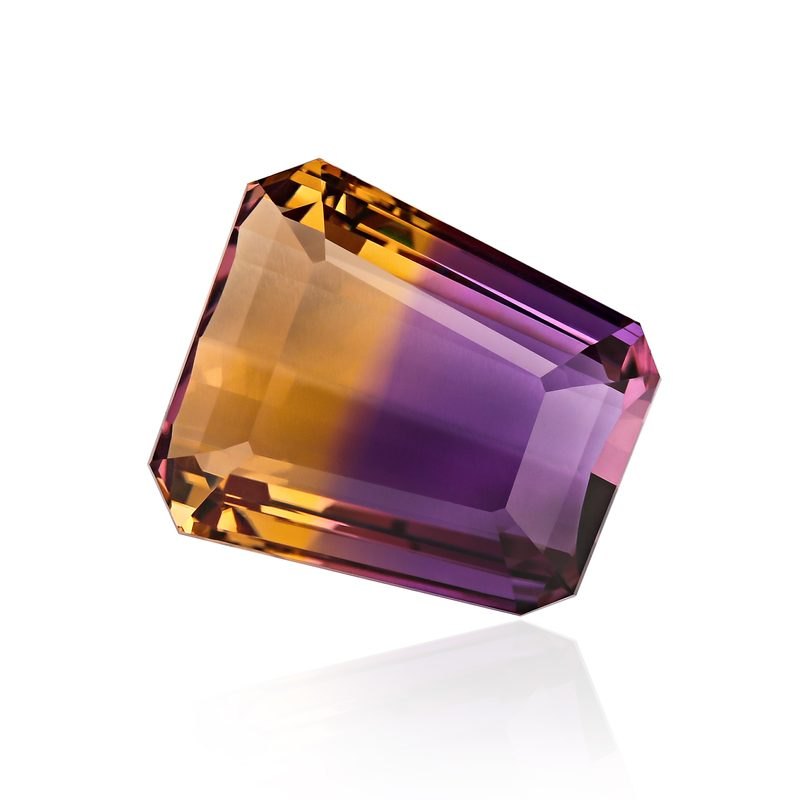
Ametrine
Half amethyst purple, half citrine gold within a single quartz crystal, mined almost exclusively in Bolivia's Anahí mine.
- Ametrine is sometimes called bolivianite after Bolivia, the country that produces nearly all commercial supply.
- The Anahí mine in eastern Bolivia is the only significant natural source of ametrine in the world.
- The bicolor effect requires natural iron impurities in two different oxidation states across a single crystal.
- Synthetic ametrine has been produced in Russia since the 1980s using hydrothermal growth methods.
- The among the largest known faceted ametrine, the Star of Estrela, weighs over 600 carats and is held in private collection.
- Practitioners working with both amethyst calm and citrine action in one stone
- Jewelry shoppers wanting a unique bicolor center stone with affordable durability
- Collectors interested in single-source gems with documented Bolivian provenance
- Libras drawn to balance, harmony, and the integration of opposite energies
- Meditation practitioners working on uniting third eye and solar plexus chakras
- Buyers wanting solid single-color stones (consider amethyst or citrine separately)
- Anyone seeking maximum saturation in either color zone (most ametrine is pastel)
- Practitioners wanting a recognized birthstone gift (use citrine for November)
What Is Ametrine?
Ametrine is a naturally bicolor quartz that combines amethyst purple and citrine yellow within a single crystal, separated by a sharp boundary. The trade name is sometimes spelled trystine or marketed as bolivianite, after the country that produces nearly all commercial supply. It rates 7 on the Mohs hardness scale.
Mineralogically the stone is the same silicon dioxide as both amethyst and citrine, with the color difference caused by varying iron oxidation states across the crystal.
The two color zones form because of differential temperature conditions during crystal growth. When iron impurities are present in two oxidation states (Fe3+ for purple and Fe2+ for yellow), and temperature crosses a critical threshold across the growing crystal, both colors develop in adjacent sectors.
The IMA symbol for the parent species is Qz, and ametrine is a trade variety rather than a separate mineral.
Ametrine was unknown to the gem trade until the 1970s, when material from the Anahí mine in eastern Bolivia began reaching markets through Spanish colonial-era folklore.
The mine sits in a remote area near the Brazilian border and is the only commercial source of natural ametrine in the world; a small amount of synthetic ametrine is produced in Russia.
Faceted ametrine is typically cut to display both colors prominently, often as long emerald cuts that show the amethyst-citrine boundary running diagonally across the stone. Total worldwide production remains modest, which keeps the gem affordable but uncommon.
How Ametrine Compares
| Property | Ametrine | Amethyst | Citrine |
|---|---|---|---|
| Hardness | 7 | 7 | 7 |
| Price / carat | $ Budget | $ Budget | $ Budget |
| Rarity | Uncommon | Common | Common |
| Best For | Bicolor jewelry, balance work | Calm, intuition | Manifestation, joy |
Meaning and Symbolism
Ametrine carries a romantic origin story tied to the Anahí mine in Bolivia. According to local tradition, the mine was given to Spanish conquistador Don Felipe in the 1600s as a dowry from a Princess Anahí of the Ayoreo people.
The princess was killed defending her tribe, and the bicolor stone is said to embody her dual loyalties to husband and people. The mine was lost to the Spanish for centuries before being rediscovered in the 1960s.
Practitioners adopted ametrine quickly after its modern reintroduction, and the stone is now traditionally associated with balance, integration, and the resolution of opposites. The amethyst zone connects to intuition, calm, and spiritual perception; the citrine zone connects to confidence, manifestation, and action.
Many find ametrine useful when they need both modes at once, such as during creative work that requires both vision and execution.
In modern crystal practice, ametrine is sometimes called the harmony stone or the duality stone. Practitioners believe it bridges the crown and solar plexus chakras, linking spiritual awareness to grounded personal power.
It has long been used in mediation and partnership work, with the bicolor symbolism extended to relationships, decision-making, and the integration of conflicting impulses within a single self.
Historical Timeline
Healing Tradition
Emotional
Practitioners believe ametrine is one of the few crystals that reliably supports two opposite emotional modes at once. In crystal healing tradition, it is said to combine amethyst's calming, intuitive influence with citrine's bright, action-oriented energy, which makes it useful when readers need both clarity and confidence.
Many find ametrine especially supportive during periods of decision-making, when both reflection and execution feel necessary.
The stone has long been used for inner conflict and ambivalence, with practitioners often recommending it to readers who feel pulled between two directions, two relationships, or two life paths. It is traditionally associated with the integration of opposites, which is why ametrine appears in mediation work and partnership meditations.
Practitioners often pair ametrine with clear quartz for amplified focus or with black tourmaline when grounding is needed alongside its high vibration.
Spiritual
Ametrine is traditionally associated with the crown and solar plexus chakras together, linking spiritual perception to grounded personal will. Practitioners believe this combination supports practical mysticism, the kind of spiritual work that translates directly into daily action.
It has long been considered useful for healers, teachers, and meditators who need both insight and stamina.
Many find ametrine valuable in meditation focused on integration, especially work that joins shadow material (amethyst) with light material (citrine) into a coherent whole. The stone pairs well with clear quartz in grids built around clarity and with rose quartz for relationship harmony work.
Practitioners sometimes use ametrine in ceremonies marking partnerships, business agreements, or major life decisions, treating the bicolor symbolism as a literal reminder that two energies can coexist within one form.
Physical
Practitioners believe ametrine supports what they describe as the body's energetic balance between activating and calming systems. In folklore the stone is associated with the digestive system (citrine influence) and with sleep and the nervous system (amethyst influence) at the same time.
Many find it useful as a single-stone alternative to carrying both amethyst and citrine separately.
The stone is sometimes worn as a pendant near the solar plexus or sternum to support both confidence and calm during long workdays. Ametrine is not a substitute for medical care, and practitioners are careful to frame its role as supportive rather than curative.
For readers who experience anxiety alongside fatigue, ametrine is sometimes recommended as a balancing daytime stone, with the amethyst zone facing the body for calm and the citrine zone facing outward for confident expression.
Zodiac, Birthstone and Gifts
Ametrine is most often associated with Libra, the air sign tied to balance, partnership, and the harmonization of opposites. Practitioners believe the stone's bicolor structure mirrors Libra's lifelong work of weighing two sides and finding the middle path.
It has long been recommended as a personal talisman for Libras navigating relationship decisions or career crossroads.
Gemini is the secondary association because of the duality theme. Astrologers sometimes suggest ametrine for Geminis seeking to integrate the sign's two famous halves into a single coherent expression. The stone is considered a versatile daytime working gem for both signs.
Care and Cleansing
Ametrine tolerates most common cleansing methods, which makes it relatively easy to maintain. Running tap water for a minute is safe for both loose and set stones, as is a brief rinse in lukewarm soapy water with a soft cloth to remove skin oils.
Avoid prolonged hot water exposure, since rapid temperature change can stress fissures in larger pieces.
Sunlight cleansing should be brief, since prolonged direct sun can fade the amethyst zone over months. Moonlight, smoke from sage or palo santo, and sound cleansing with a singing bowl are all considered safe and well-aligned with the stone's energy.
Salt cleansing should be brief and dry only, since prolonged saltwater contact can dull polish and corrode metal settings. Many practitioners recharge ametrine by resting it on a clear quartz cluster overnight or by placing it briefly in moonlight on a windowsill.
- DO rinse ametrine jewelry in lukewarm soapy water and dry with a soft cloth.
- DO NOT leave ametrine in direct sunlight for extended periods, since the amethyst zone can fade.
- DO store ametrine separately from softer gems like opal and pearl to avoid scratching them.
- DO NOT use ultrasonic cleaners on stones with visible inclusions or fractures.
- DO ask whether the stone is natural Bolivian or synthetic; both occur on the market.
- DO remove rings before heavy housework, gardening, or contact sports.
- Note: synthetic ametrine is gemologically similar but should be priced and disclosed accordingly.
Real vs Fake
Genuine ametrine shows a sharp, geometric boundary between the amethyst and citrine zones, often running parallel to a crystal face and sometimes showing additional color sectors visible under magnification.
Natural inclusions such as fluid bubbles or tiny crystal phantoms are common, and the boundary itself follows the crystal's natural growth geometry rather than appearing painted on.
Synthetic ametrine, mostly Russian hydrothermal material, can be very convincing and requires lab testing for reliable identification. Natural Bolivian stones often contain characteristic fluid inclusions and sometimes show a slight smoky tint between the two color zones, while synthetic stones tend to be unusually clean.
A reputable independent gemological lab can use spectroscopy and inclusion analysis to separate natural from synthetic; reputable dealers always provide origin documentation for stones over one carat.
Common imitations include doublet stones (two pieces of differently colored quartz glued together), heat-treated amethyst with painted or coated yellow zones, and dyed glass. Doublets show a visible glue line under magnification, and treated stones lack the natural fluid inclusions of genuine Bolivian material.
At home, look for the sharp natural boundary between colors, the trigonal symmetry of the crystal structure, and the cool, heavy feel of true quartz.
Watch for stones marketed as ametrine at suspiciously low prices, since these are often heat-treated amethyst with surface coating or simply assembled from amethyst and citrine fragments. Reputable sellers disclose origin (Bolivia for natural, Russia for synthetic) and any treatments.
Ametrine Jewelry & Gifts
Ametrine pricing depends on color saturation in both zones, the sharpness of the boundary, and the cut. Calibrated commercial stones in pendant and ring sizes typically run $8 to $40 per carat.
Mid-grade stones with strong color in both zones reach $40 to $100 per carat, and exceptional large stones above ten carats with vivid color and a clean diagonal boundary can exceed $200 per carat. Synthetic ametrine sells for a fraction of these prices and should be disclosed.
Most natural ametrine on the market comes from the Anahí mine in eastern Bolivia, and reputable sellers provide origin documentation. Watch for assembled or doublet stones at low prices and treated amethyst with painted citrine zones.
For jewelry, long emerald cuts that display both colors prominently are the standard and offer the best visual value. ametrine remains an under-collected gem relative to its rarity, which makes it an interesting value for buyers seeking distinctive bicolor stones.
Where to Buy Ametrine
Affiliate disclosure: Some links below earn us a small commission at no extra cost to you. See our affiliate disclosure page.
Handmade, raw, and tumbled pieces from independent sellers worldwide.
Shop Ametrine on Etsy →Accessories, tools, and specimen sets with fast Prime delivery.
Shop Ametrine on Amazon →Certified loose gemstones graded and photographed for online buyers.
Shop Ametrine on GemSelect →Pairs Well With




Where Ametrine Is Found


