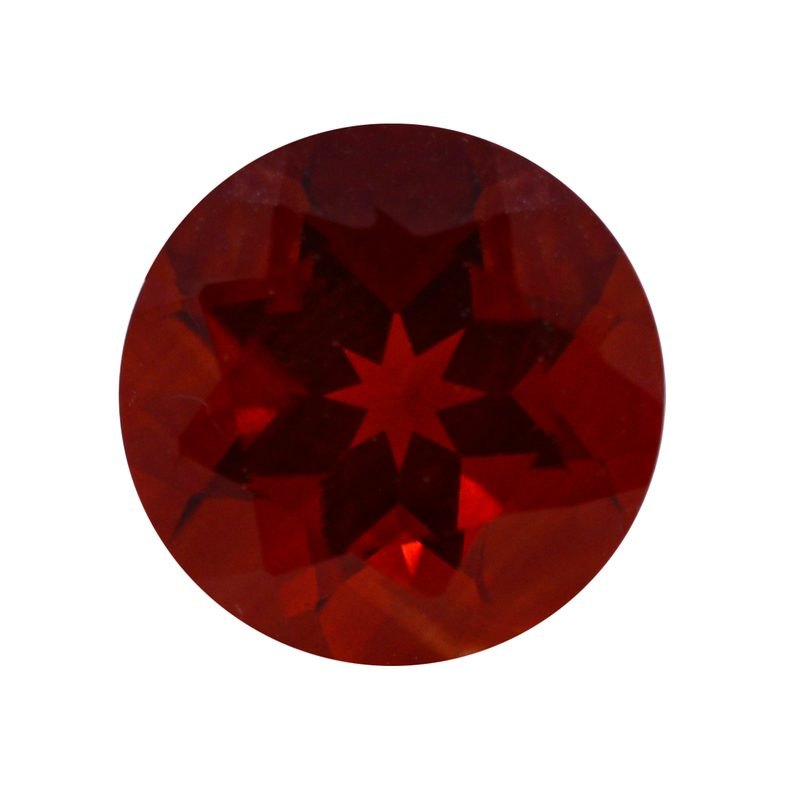
Andesine
A copper-bearing plagioclase feldspar, andesine glows in red and champagne tones and sits at the center of one of gemology's major trade.
- Andesine is named for the Andes Mountains, where it was first described in 1841.
- The copper content that gives red andesine its color is related to the copper in Oregon sunstone feldspar.
- Most red andesine on the market between 2002 and 2010 was later shown to be diffusion-treated rather than naturally colored.
- Andesine is part of the plagioclase feldspar series, which also includes oligoclase, labradorite, and anorthite.
- Champagne and yellow andesine exists alongside red, though red dominates commercial markets.
- Feldspar collectors building a full species portfolio
- Lapidary enthusiasts drawn to a cut-challenging stone
- Buyers attracted to red gems at lower price points than spinel or ruby
- Readers interested in gemology controversies and provenance discussions
- Practitioners working with sacral warmth balanced by heart softness
- Investment buyers expecting universal authenticity (diffusion-treated material is common)
- Shoppers who want saturated pure red without provenance risk (try red spinel)
- Readers who prefer widely recognized stones with clear traditions
What Is Andesine?
Andesine is a calcium-sodium plagioclase feldspar with the general formula (Na,Ca)(Si,Al)₄O₈, named after the Andes Mountains where it was first described in 1841. Gem-quality andesine with significant red or champagne color owes its hue to trace copper in the crystal lattice, similar to the copper coloring of Oregon sunstone.
The stone rose to commercial prominence in the early 2000s after red andesine from the Democratic Republic of Congo reached the gem market, with claimed Tibetan material arriving soon after.
The Tibetan andesine story became one of the major controversies in modern gemology. Between 2002 and 2010, large quantities of red andesine were marketed as Tibetan-origin material.
Laboratory investigations revealed that most or all of it was actually diffusion-treated Mongolian or Chinese feldspar with copper added by heat treatment rather than naturally present. Major gem laboratories now treat most red andesine as copper-diffused unless rigorously tested and documented. Natural red andesine from documented origins remains rare.
Andesine crystallizes in the triclinic system with Mohs hardness 6 to 6.5, refractive index 1.543 to 1.551, and specific gravity 2.65 to 2.69. The IMA treats andesine as a plagioclase feldspar series member between oligoclase and labradorite on the solid-solution continuum.
Colors range from colorless and champagne through yellow, orange, red, and green, with red being the most commercially prominent. Cleavage is good in two directions, which can make cutting moderately challenging.
How Andesine Compares
| Property | Andesine | Oregon Sunstone | Red Spinel |
|---|---|---|---|
| Hardness | 6 - 6.5 | 6 - 6.5 | 8 |
| Price / carat | $ Budget | $ Budget | $$ Mid-range |
| Rarity | Moderate (provenance disputed) | Moderate | Rare |
| Best For | Collector curiosity | Daily wear | Fine jewelry |
Meaning and Symbolism
Andesine has a short cultural history as a gem. Although described mineralogically in 1841 from specimens collected at the volcano Marmato in the Andes of Colombia, andesine was primarily of academic interest for most of its existence.
Commercial gem use began in the early 2000s when red copper-bearing andesine reached the international market, first from the Democratic Republic of Congo and then under the Tibetan andesine label that proved controversial.
Because gem-quality andesine is a recent entrant into the market, its metaphysical meaning is entirely modern and largely absent from older crystal literature. Contemporary crystal writers have assigned the stone associations with the root and heart chakras (for red material) and with solar-energy confidence (for champagne material).
Drawing parallels with sunstone and other copper-bearing feldspars.
Many practitioners who work with andesine describe it as a stone of warm, confident action rooted in honesty, framing the material as a reminder to face provenance questions openly.
The Tibetan andesine controversy has shaped the stone's modern story more than any tradition. Major gem laboratories including an independent gemological lab issued advisories in the late 2000s warning that most red andesine sold as Tibetan in origin was actually diffusion-treated material from elsewhere.
Reputable dealers now disclose treatments transparently, and buyers are advised to require laboratory documentation for any red andesine above modest value. This has given andesine a secondary reputation as a teaching stone about due diligence, transparency, and the importance of independent verification.
Historical Timeline
Healing Tradition
Emotional
Practitioners believe red andesine is a stone of warm, grounded confidence and steady emotional honesty. In crystal healing tradition, it is said to support a wearer who needs to act from integrity during difficult transitions, which ties into the stone's modern association with provenance transparency.
Many find red andesine a useful companion during career transitions, dating seasons requiring honesty about past hurts, or creative projects that ask for steady self-belief.
Andesine is often paired with rose quartz when the work involves heart softening alongside confidence, with smoky quartz when old shame needs grounding, and with clear quartz when amplifying intentions tied to honest self-expression. Practitioners tend to describe andesine as grounded and earthy rather than bright or dramatic, reflecting its feldspar lineage.
Spiritual
In crystal healing tradition, red andesine is said to bridge the root and heart chakras with warm steady energy, similar in temperament to red spinel but grounded specifically in the feldspar family.
Practitioners believe the stone supports readers whose spiritual path values honesty, careful discernment, and the slow work of aligning stated intentions with actual behavior.
Because andesine is a modern stone, it has no classical planetary assignment; contemporary practitioners often associate it with the Sun for its warm color and with Mars for its courage-adjacent qualities.
Carrying andesine during intention-setting rituals, morning meditation focused on integrity, or difficult honest conversations is a common contemporary practice among readers who work with the stone.
Physical
Practitioners believe red andesine supports what they describe as steady physical warmth and circulation, with folklore tying the copper content to similar copper-related associations seen in sunstone tradition.
Crystal healing tradition associates andesine with the lower torso, the solar plexus region, and overall vitality in gentle metaphorical ways rather than in targeted clinical senses. Many find wearing an andesine pendant or ring comforting during seasonal transitions, long work projects, or convalescent periods.
Andesine is not a substitute for medical care, and practitioners frame its role as supportive rather than curative. Readers with cardiovascular, circulatory, or chronic fatigue concerns are encouraged to rely on qualified medical guidance and treat crystal practice as one piece of a broader routine.
Zodiac, Birthstone and Gifts
Andesine has no traditional birthstone role and is adopted in contemporary astrology based on color and temperament. Many astrologers suggest red andesine for Leos drawn to warm, confident, fire-element stones, and for Ariens with an affinity for red and red-orange gems tied to initiative and courage.
Modern Western astrology associates andesine with the Sun and Mars for its warmth and copper-related color chemistry. Because andesine is a modern commercial stone with a contested provenance history, Vedic astrology (Jyotish) does not include it among classical gem prescriptions.
Contemporary practitioners use it on an intention basis rather than a chart-driven one.
Care and Cleansing
Andesine cleanses gently. Lukewarm soapy water and a soft brush handle daily maintenance for both natural and diffusion-treated stones, with a brief rinse under running water safe for loose pieces. Avoid ultrasonic and steam cleaners, especially for diffusion-treated material where the color layer is near the surface.
Saltwater soaks should be avoided because of the feldspar's slight reactivity and because dissolved salt can compromise any treatment.
Moonlight cleansing is traditionally recommended, and short sunlight exposure is considered safe since the color of natural andesine is stable, though diffusion-treated material may fade slightly over years of prolonged UV exposure. Smoke cleansing with palo santo or sage is common, as is sound cleansing with a singing bowl.
Dry salt placement is acceptable. Many practitioners recharge andesine overnight on a clear quartz cluster or selenite slab between uses.
- DO wipe andesine with a soft cloth and use lukewarm soapy water for deeper cleaning.
- DO NOT use ultrasonic or steam cleaners on diffusion-treated andesine.
- DO store andesine separately to protect the polished surface from harder stones.
- DO NOT soak andesine in saltwater, harsh cleaners, or acidic solutions.
- DO remove andesine jewelry before sports and heavy housework.
- DO ask for laboratory confirmation of treatment status before purchase.
- Note: most red andesine on the market is diffusion-treated; reputable dealers disclose this clearly.
Real vs Fake
Genuine andesine is a plagioclase feldspar regardless of color. The distinction most buyers care about is between natural-color andesine (where copper is naturally present in the crystal lattice) and diffusion-treated andesine (where copper has been added to the surface layer by heat and chemical diffusion).
Gem laboratory analysis is the only reliable way to distinguish the two; visual inspection and at-home testing cannot reliably make this call.
Under 10x magnification, natural-color red andesine often shows pleochroism (color shift with viewing angle) and uniform color distribution through the stone. Diffusion-treated andesine frequently shows color concentration near the surface, with thin clear rims visible at facet junctions where material was removed during cutting.
A reputable gem lab can confirm species (plagioclase feldspar, andesine composition) and natural versus diffusion-treated status using spectroscopy and chemical analysis.
Common misrepresentations include labeling diffusion-treated Chinese or Mongolian feldspar as natural Tibetan andesine (a category that major labs have treated with skepticism since 2008), selling synthetic copper-treated feldspar as natural, and marketing dyed quartz or glass as red andesine.
Refractive index of 1.543 to 1.551 and specific gravity of 2.65 to 2.69 distinguish andesine from quartz and glass, but not between natural and diffusion-treated feldspar. For any red andesine above $100 per carat, a laboratory report from an independent gemological lab, or similar is considered essential.
Andesine Jewelry & Gifts
Andesine pricing reflects the treatment history and provenance complexity of the variety. Small diffusion-treated red andesine stones in budget jewelry run $10 to $50 per carat. Mid-grade diffusion-treated stones with good color and size run $50 to $150 per carat.
Documented natural-color red andesine from Congolese deposits, rare and accompanied by reputable lab reports, runs $150 to $400 per carat for fine material, and exceptional stones can exceed $500 per carat in collector channels.
Because of the 2008 Tibetan andesine advisory, reputable dealers now disclose copper-diffusion treatment clearly on every piece. Buyers should require a laboratory report from an independent gemological lab, or similar for any andesine above $100 per carat, confirming both species (plagioclase feldspar) and treatment status (natural color versus diffusion-treated).
Congolese material is generally accepted as natural when properly documented, while Tibetan-labeled stones without lab documentation should be treated as diffusion-treated regardless of the seller's claims. Champagne and yellow andesine are less affected by the treatment controversy because they are primarily natural color.
Where to Buy Andesine
Affiliate disclosure: Some links below earn us a small commission at no extra cost to you. See our affiliate disclosure page.
Handmade, raw, and tumbled pieces from independent sellers worldwide.
Shop Andesine on Etsy →Accessories, tools, and specimen sets with fast Prime delivery.
Shop Andesine on Amazon →Certified loose gemstones graded and photographed for online buyers.
Shop Andesine on GemSelect →Pairs Well With




Where Andesine Is Found


