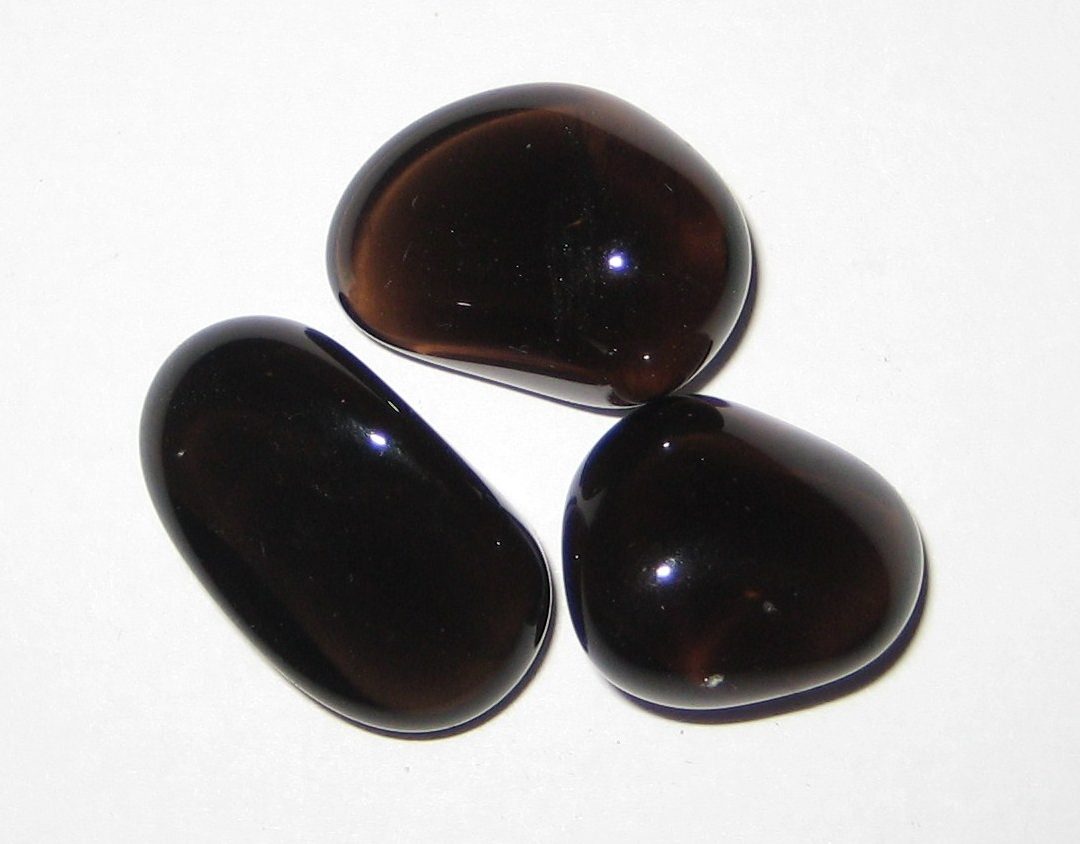
Apache Tears
Small black obsidian nodules that glow smoky brown when held to the light - deeply protective stones carried for grief, resilience.
- The geological term for the rounded obsidian nodules that include Apache Tears is 'marekanites' - named after the Mareka River area of Siberia where a similar type was first scientifically described.
- Apache Tears glow an unmistakable smoky-amber-brown when held to a bright light source - a unique optical quality that distinguishes them from other opaque black stones.
- The perlite matrix surrounding Apache Tears forms when obsidian absorbs groundwater over geological time, causing the glass to fracture along concentric patterns - a process called perlitization.
- Apache Tears are found in several locations beyond Arizona, including Nevada, Mexico, and parts of South America, but the Arizona material has the strongest cultural and metaphysical identity.
- Obsidian, including Apache Tears, was one of the most important technological materials in pre-Columbian North America - its conchoidal fracture pattern allows it to be knapped into blades sharper than surgical steel.
- Those processing grief, loss, or difficult endings
- Empaths seeking psychic protection and energetic shielding
- Scorpio and Capricorn resonance and shadow work
- Root chakra grounding and earthy protection
- Collectors drawn to the unique geology of volcanic glass
- Children without supervision - obsidian can have sharp edges if broken
- Those seeking faceted transparent stones for jewelry - try black tourmaline
- Buyers wanting rare investment material
What Is Apache Tears?
Apache Tears are rounded nodules of rhyolitic obsidian formed when volcanic lava cools rapidly and fragments scatter through the surrounding perlite matrix. Unlike polished obsidian slabs, these naturally tumbled nodules develop a distinctive smoky translucency - held to the light, they reveal deep brown-black interior glass that glows like a frozen ember.
The name comes from an Apache legend associated with the Superior, Arizona region, where a small group of Apache warriors reportedly died rather than surrender. The story holds that their family members' tears turned to stone where they fell, becoming the dark obsidian nodules found throughout the area's volcanic terrain.
Geologically, Apache Tears are classified as 'marekanites' - a specific variety of rounded perlitic obsidian nodule. The perlite matrix surrounding them results from the absorption of water by obsidian over geological time, creating a concentric fracture pattern. When the perlite weathers away, the harder obsidian core is freed as a rounded nodule.
How Apache Tears Compare
| Property | Apache Tears | Black Obsidian | Black Tourmaline |
|---|---|---|---|
| Hardness | 5-5.5 | 5-5.5 | 7-7.5 |
| Price/ct | $ Budget | $ Budget | $ Budget |
| Unique Feature | Natural nodule form, translucent | Mirror black, conchoidal fracture | Striated prisms, very durable |
| Best For | Grief healing, empath protection | Scrying, shadow work | EMF protection, shielding |
Meaning and Symbolism
Apache Tears are one of the most widely revered grief-healing stones in the crystal tradition. Practitioners believe the stones carry a specific medicine for loss - the capacity to hold grief without being overwhelmed by it, and to move through mourning with honesty and ultimately with acceptance.
The legend of their origin in a community's tears gives them particular resonance for anyone processing sorrow.
The stones are said to offer psychic protection for empaths - people who absorb the emotional states of others. Practitioners believe Apache Tears create a gentle energetic boundary that shields the bearer from taking on grief or pain that is not theirs while keeping them open to genuine compassionate connection.
Apache Tears are also associated with honest self-reflection - the willingness to see one's own shadow clearly, acknowledge one's role in past wounds, and do the internal work of genuine change.
Like the obsidian mirror used in scrying, they are said to reveal truth without softening it, but in a gentler, more gradual way than raw obsidian.
Historical Timeline
Healing Tradition
Emotional
Apache Tears are considered one of the most powerful grief healing stones in the crystal tradition, and practitioners recommend them specifically during bereavement, heartbreak, major losses, and the slow mourning of things that simply didn't turn out as hoped.
The stone is said to create a safe container for grief - holding the weight of sorrow without adding to it, allowing the bearer to feel what they feel without being swept away by it. Crystal workers often describe this as the stone teaching the difference between grieving and drowning in grief.
It is traditionally used in loss and trauma recovery contexts, carried during the weeks and months after a significant loss, placed on an altar for someone who has passed, or held during moments of acute sadness.
The stone is also said to support the process of forgiving oneself for what could not be controlled - the grief of regret and the mourning of what might have been.
Spiritual
In crystal healing traditions, Apache Tears are associated with root chakra grounding, psychic protection, and the honest confrontation of shadow material - the parts of the self that have been suppressed, denied, or not yet integrated.
Practitioners believe the stone creates a protective energetic field around the aura while simultaneously inviting the kind of clear-eyed self-honesty that genuine spiritual growth requires.
Unlike raw obsidian, which is said to reveal shadow material quickly and sometimes intensely, Apache Tears are described as a gentler teacher - drawing attention to what needs to be seen without overwhelming the psyche.
They are traditionally used by empaths as a shielding stone, worn or carried to maintain energetic boundaries in emotionally charged environments. Some practitioners use them in ancestral healing work, believing the stones carry the specific medicine of grief that has been transformed into strength.
Physical
Apache Tears are not a medical treatment and no health claims are made here. In wellness traditions, grounding volcanic stones like Apache Tears are associated with physical resilience and the capacity to endure difficult periods without losing vital force.
Some crystal wellness practitioners use them in relaxation layouts along the lower body, feet, and root chakra areas during stress-recovery sessions. The stone's earthy, grounding volcanic energy is said to support the nervous system during grief and trauma recovery, helping the physical body find rest when the mind is churning.
Always consult a qualified healthcare provider for any health concerns.
Zodiac, Birthstone and Gifts
Apache Tears are traditionally associated with Scorpio and Capricorn, both signs known for their relationship to shadow, depth, and resilience through difficulty. Scorpio's willingness to descend into the depths of human experience - including grief, loss.
The parts of life most people prefer to avoid - makes Apache Tears a natural resonator for this sign. Practitioners believe the stone supports Scorpio's transformative work by providing protection and grounding during the most intense inner excavations.
For Capricorn, Apache Tears are said to acknowledge this sign's tendency to carry grief silently and alone, gently inviting the mountain goat to put down some of the weight it insists on bearing without complaint.
Care and Cleansing
Apache Tears handle brief water rinsing safely - unlike some obsidian varieties, their naturally rounded form is stable. A short rinse under cool water followed by air drying or gentle pat-drying works well for regular cleansing.
Burying in clean earth overnight is the most traditional and resonant cleansing method for Apache Tears - returning a stone born of volcanic earth to contact with the soil is said to fully discharge absorbed grief energy and restore the stone to its natural protective clarity.
Smudging with white sage or cedar is effective for regular clearing, particularly if the stone has been working hard in a grief-processing context. Some practitioners pass Apache Tears through smoke while consciously releasing the grief or difficult emotion the stone has been holding.
- DO handle with care - obsidian is volcanic glass and can fracture with sharp conchoidal breaks if dropped on hard surfaces.
- DO NOT use with children without supervision - broken obsidian has extremely sharp edges.
- DO NOT store with harder gemstones like quartz or topaz that will scratch the surface.
- NOTE that Apache Tears work intensively with grief and shadow - take breaks from extended use if you feel emotionally depleted.
- DO NOT confuse with black tourmaline, black onyx, or jet - Apache Tears have a unique translucent quality when backlit that distinguishes them from all other black stones.
Real vs Fake
The most reliable authentication test for Apache Tears is the light test - hold the stone up to a bright light source and look through it. Genuine Apache Tears glow smoky brown-amber from within. Opaque black stones like black tourmaline, black onyx, or jet show no internal light transmission.
Genuine Apache Tears are naturally rounded - the perlite matrix in which they form acts as a geological tumbler over millions of years. Very perfectly spherical specimens may have been artificially rounded from raw obsidian, which is a different product from true natural nodules.
Weight and surface texture provide additional clues. Natural obsidian nodules have a glassy surface that is naturally smooth from the perlite environment. The specific gravity of approximately 2.4 gives them appropriate heft - lighter plastic beads fail this test.
Dyed glass and resin imitations cannot replicate the internal glowing translucency of genuine obsidian glass. Under strong magnification, genuine obsidian shows the characteristic bubble inclusions and flow patterns of rapidly cooled volcanic glass.
Apache Tears are inexpensive and widely available - outright counterfeiting is uncommon. The more typical issue is being sold a different black stone under the name. The light test resolves this immediately.
Apache Tears Jewelry & Gifts
Apache Tears are among the most affordable stones in the crystal market. Natural unpolished nodules sell for $1-$3 each in bulk. Quality polished or selected specimens run $3-$15. The main quality differentiators are size, the quality of natural rounding, and the richness of the internal smoky glow.
Look for specimens that show clear translucency when backlit - the stronger and more even the smoky amber glow, the higher the quality. Some nodules are nearly fully opaque; these are lower grade. Well-lit online listings from reputable vendors typically demonstrate this quality.
Arizona Apache Tears from the Superior area are the most historically significant. Nevada and Mexican material is also genuine Apache Tear obsidian. Material sold simply as 'obsidian nodules' without specific locality is still authentic volcanic glass but may not carry the cultural provenance of the Arizona material.
Polished Apache Tears that have been tumble-finished show a high gloss that enhances the internal glow effect. Natural unpolished specimens have a rough matte surface with the same internal optical quality. Both forms are authentic; preference depends on intended use.
For grief healing or empath protection purposes, selecting a stone that feels right in your hand is as important as any quality metric. Many crystal shops sell Apache Tears individually so you can hold them and choose the one that resonates.
Where to Buy Apache Tears
Affiliate disclosure: Some links below earn us a small commission at no extra cost to you. See our affiliate disclosure page.
Handmade, raw, and tumbled pieces from independent sellers worldwide.
Shop Apache Tears on Etsy →Accessories, tools, and specimen sets with fast Prime delivery.
Shop Apache Tears on Amazon →Certified loose gemstones graded and photographed for online buyers.
Shop Apache Tears on GemSelect →Pairs Well With


Where Apache Tears Is Found

