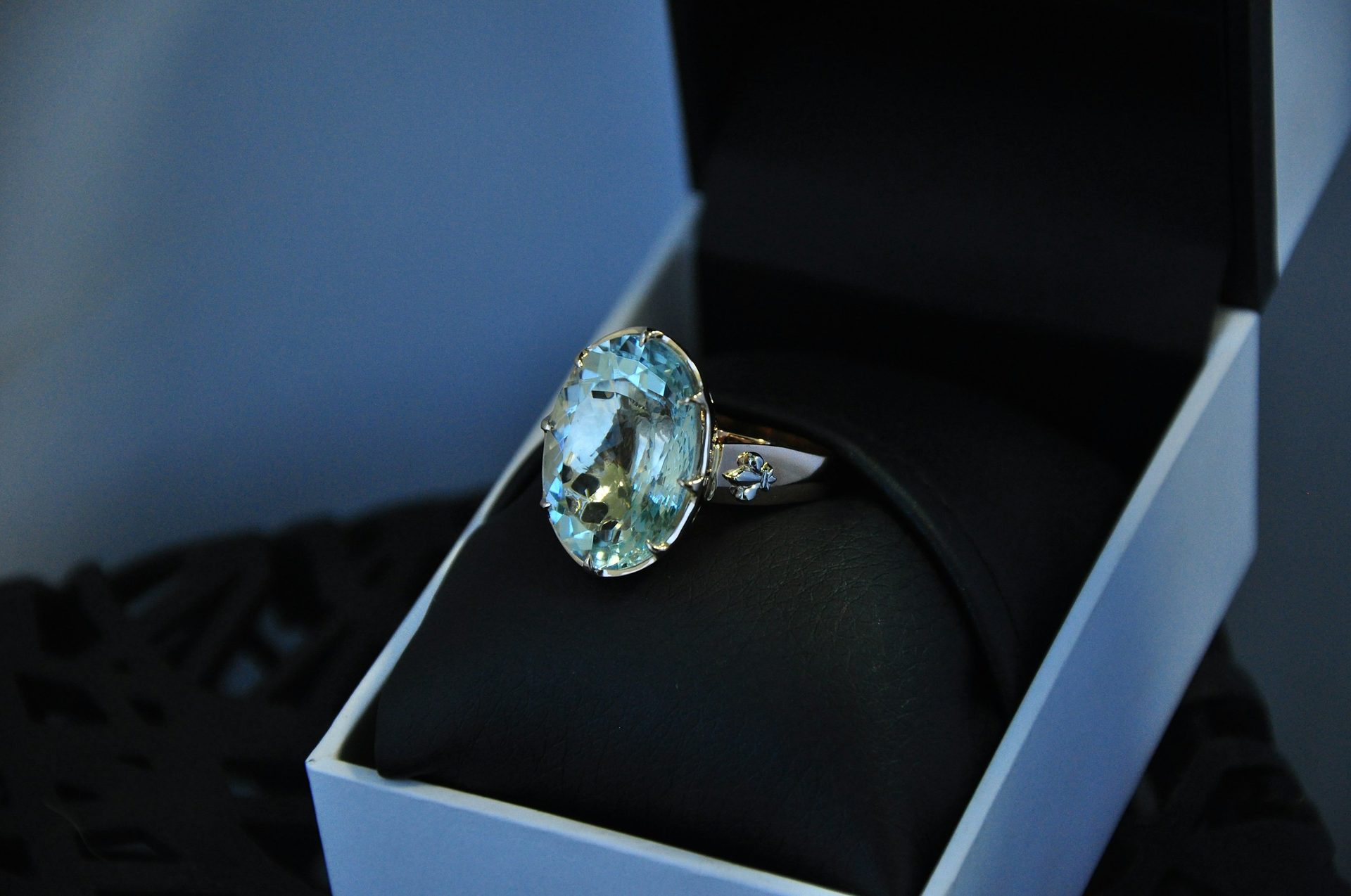
Aquamarine Cat’s Eye
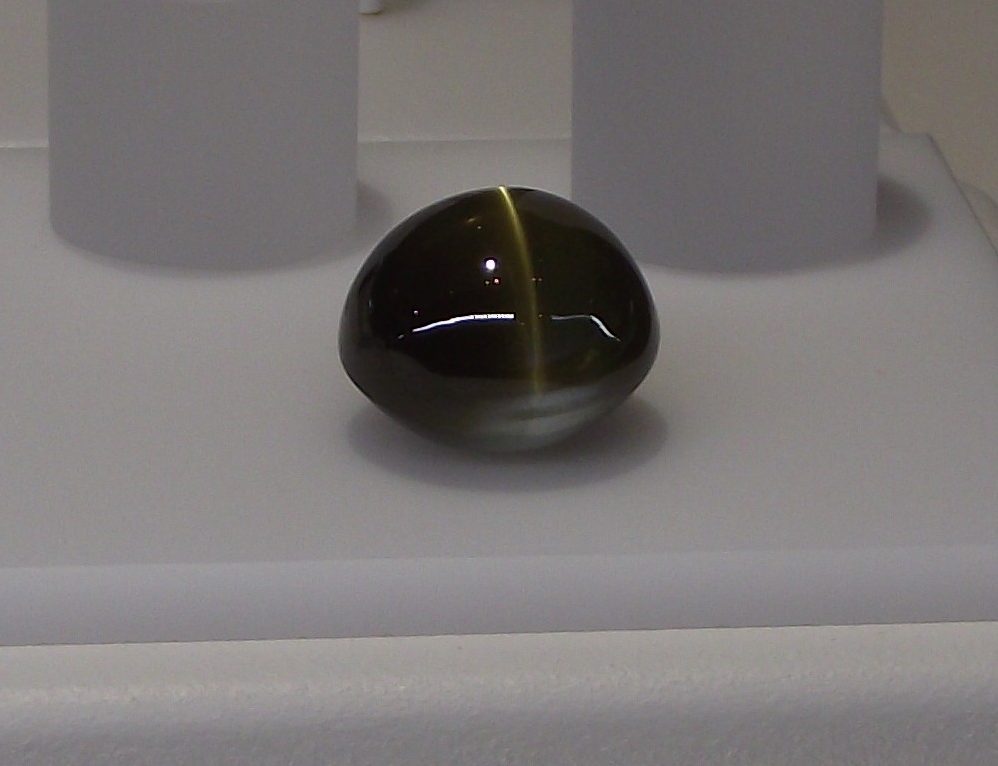
A rare natural phenomenon in beryl: parallel needle-like inclusions create a luminous rolling white ray across the sea-blue surface of.
- The cat's eye effect in gemstones is called chatoyancy - from the French chat (cat) and oeil (eye).
- For a cat's eye to appear in aquamarine, the stone must contain dense, parallel hollow tubes - an internal structure that makes faceting impossible without destroying the effect.
- The finest aquamarine cat's eye shows what collectors call the milk and honey effect - the half of the cabochon facing the light source appears milky white, while the other half shows the stone's blue-green body color.
- Aquamarine cat's eye is significantly rarer than cat's eye chrysoberyl - the latter is found in multiple deposits; the former requires a very specific and uncommon set of growth conditions.
- Brazil's Santa Maria and Minas Gerais aquamarine deposits are the primary sources of cat's eye material, though Madagascar also produces specimens.
- Collectors seeking a rare optical phenomenon in a beloved gem family
- Buyers who want an unusual conversation-starting cabochon piece unlike standard faceted aquamarine
- March birthstone shoppers wanting an exceptionally rare form of the classic birthstone
- Crystal practitioners drawn to aquamarine's water and communication energy in a particularly visually striking form
- Jewelry designers who work with cabochon stones and want a blue-green with genuine gemological rarity
- Buyers expecting the sparkling transparency of faceted aquamarine - cat's eye is cabochon-cut and translucent
- Anyone on a budget - genuine aquamarine cat's eye with strong chatoyancy is rare and commands significant premiums
- Shoppers wanting large sizes - well-defined cat's eye aquamarine over 5 carats is exceptionally rare
What Is Aquamarine Cat’s Eye?
Aquamarine cat's eye is a beryl variety (Be3Al2Si6O18) that displays chatoyancy - a shimmering, moving band of light across the stone's surface when cut as a cabochon. The phenomenon requires dense, parallel inclusions of hollow tubes or needle-like mineral fibers aligned within the crystal. It rates 7.5 - 8 on the Mohs hardness scale.
When light hits these parallel structures and reflects off a cabochon-cut dome, the reflected rays converge into a single bright line that appears to move as the stone or light source rotates, mimicking the slit pupil of a cat's eye.
Chatoyancy in aquamarine is produced by hollow growth tubes that form parallel to the crystal's c-axis during beryl's hexagonal growth. These tubes are typically microscopically thin but must be densely and consistently aligned to produce a sharp, well-defined cat's eye.
Most aquamarine is cut as faceted gems precisely because it lacks these inclusions; specimens with sufficient and correctly oriented tubes are rare, making aquamarine cat's eye a genuinely uncommon collector material.
The color of aquamarine cat's eye ranges from the characteristic pale blue-green of standard aquamarine to deeper blue-teal tones depending on iron content. The cat's eye effect itself appears as a white or silvery ray - called the eye - moving across the dome.
The finest examples show a sharp, bright, well-defined ray centered on the cabochon with strong contrast against the blue-green body color. Such specimens are among the most prized examples of the chatoyancy phenomenon in the beryl family.
Aquamarine Cat's Eye vs Chrysoberyl Cat's Eye vs Regular Aquamarine
| Property | Aquamarine Cat's Eye | Chrysoberyl Cat's Eye | Regular Aquamarine |
|---|---|---|---|
| Chatoyancy | Present - rare in beryl | Strong - the classic cat's eye | None |
| Hardness | 7.5 - 8 | 8.5 | 7.5 - 8 |
| Price / carat | $$ Mid-range | $$ Mid-range | $ Budget |
| Cut | Cabochon only | Cabochon only | Faceted |
| Best For | Collector, rare chatoyancy | Investment, strongest eye | Fine jewelry, standard use |
Meaning and Symbolism
Aquamarine carries an ancient tradition of maritime protection and the calming, clarifying power of the sea. Sailors wore it as an amulet against storms and drowning; Roman fishermen threw aquamarine into the sea to propitiate Neptune.
The cat's eye phenomenon adds a layer of mystical symbolism: the moving eye of light has long been associated in gem lore with the eye of a protective spirit - a watchful presence moving with the stone, seeing what the wearer cannot.
In multiple Asian gem traditions, cat's eye stones of any variety are considered powerfully protective and are believed to deflect the evil eye. The phenomenon of the moving ray is interpreted as the stone literally watching over its wearer.
Aquamarine cat's eye combines water-element protective energy with this watching quality, making it particularly revered in coastal and island cultures where both the sea's blessing and protection from its dangers are simultaneously desired.
In modern crystal healing tradition, aquamarine cat's eye is said to carry the same Throat and Third Eye chakra associations as regular aquamarine, with the additional insight-amplifying quality of the cat's eye phenomenon. Practitioners believe the moving ray represents the stone's capacity for shifting perspective - seeing situations from multiple angles simultaneously.
Is said to support the development of intuitive, multi-dimensional awareness that goes beyond linear analysis.
Historical Timeline
Healing Tradition
Emotional
Practitioners believe aquamarine cat's eye combines aquamarine's traditional Throat chakra energy with the heightened intuitive awareness associated with cat's eye stones across multiple healing traditions.
Many who work with this stone in crystal wellness find it particularly helpful for developing the capacity to see emotional situations from multiple perspectives simultaneously - a quality associated with the moving ray of the cat's eye.
Is said to support the release of fixed emotional viewpoints and create flexibility in how one understands difficult relationships or recurring patterns.
Spiritual
In crystal healing tradition, aquamarine cat's eye is associated with deep water-element intuition and the development of spiritual sight - the capacity to perceive subtle energies and truths that are not accessible to ordinary analytical awareness.
The moving eye of light is said by many practitioners to represent the Third Eye's capacity for fluid, non-linear perception. Is said to be particularly powerful during meditation focused on developing psychic sensitivity or the interpretation of dreams and symbolic experience.
Physical
While no gemstone replaces medical care, aquamarine is traditionally associated with the throat, lungs, and fluid systems of the body in crystal wellness practice. Practitioners place aquamarine at the throat during practices intended to support voice, communication, and thyroid-area wellness.
The cat's eye variety is said by some practitioners to add a specifically optical and neurological dimension - associated with healthy vision and the nervous system's sensory processing capacities. These are traditional associations and should be understood as spiritual practice rather than clinical treatment.
Zodiac, Birthstone and Gifts
Aquamarine is the March birthstone, connecting it most strongly to Pisces (February 19 - March 20). Pisces, the deeply intuitive water sign associated with the ocean's depth and mystery, resonates powerfully with aquamarine cat's eye's combination of water energy and mysterious moving light.
The cat's eye phenomenon - rational yet inexplicable in its beauty - mirrors Pisces's capacity to dwell simultaneously in mundane reality and profound spiritual perception.
Aquarius (January 20 - February 18) and Gemini (May 21 - June 20) are also linked to aquamarine through its associations with clear communication and mental clarity.
Both Air signs appreciate the stone's Throat and Third Eye chakra energy, and the cat's eye variety's unusual optical quality appeals to these signs' characteristic love of the intellectually curious and visually unusual.
Care and Cleansing
Aquamarine cat's eye is safe for most standard cleansing methods. Brief rinsing under cool water is effective and safe. Avoid prolonged UV exposure (extended sunlight) as aquamarine's iron-based color can fade over time with intense light exposure.
The cabochon surface should be dried immediately after water contact to prevent mineral deposits in the surface texture.
Sound cleansing with a singing bowl is particularly resonant for aquamarine cat's eye - the vibration corresponds to water-element energy and avoids any risk to the surface. Selenite plate overnight is an excellent hands-off alternative. Moonlight cleansing is traditional for water-element stones and fully safe for this material.
Avoid salt cleansing as salt can lodge in micro-surface features of cabochon stones.
- DO NOT facet or grind aquamarine cat's eye specimens - the chatoyancy is destroyed if the cabochon dome is removed.
- DO store separately from harder gems like sapphire and diamond that can scratch the Mohs 7.5-8 surface.
- DO NOT expose to prolonged direct sunlight - aquamarine color can fade with extended UV exposure.
- DO display under directional lighting to show the cat's eye; diffuse ambient light does not reveal chatoyancy well.
- DO NOT use ultrasonic cleaners - vibration can stress the parallel tube inclusions that create the eye effect.
- DO clean with a soft damp cloth only; avoid abrasive cleaners that scratch the polished dome surface.
Real vs Fake
Fake aquamarine cat's eye takes two forms: glass with embedded fibers to simulate chatoyancy, and genuine chrysoberyl or other cat's eye stones sold as aquamarine. Fiber-optic glass cat's eyes are immediately identifiable by their low hardness (Mohs 5-6), single uniform color without the characteristic aquamarine color range, and plastic-like luster.
The chatoyancy in genuine aquamarine is natural and internally structured; glass chatoyancy looks mechanical and shows embedded fiber rather than mineral inclusion texture.
Chrysoberyl cat's eye (cymophane) is often darker golden to yellowish rather than blue-green, and shows a denser, more precise eye than most aquamarine cat's eyes. The refractive indices differ measurably - aquamarine at 1.567 to 1.590 vs chrysoberyl at 1.746 to 1.763. A refractometer reading confirms which stone you have.
Under magnification, genuine aquamarine cat's eye shows the distinctive hollow tube inclusions of beryl growth.
Any seller offering aquamarine cat's eye at prices comparable to regular faceted aquamarine should be viewed skeptically - genuine chatoyant aquamarine with a sharp, well-defined eye is significantly rarer and more valuable than standard material. Request gemological documentation from a recognized laboratory for any significant purchase.
The combination of a gemological laboratories or equivalent identification report with a specimen demonstrating strong chatoyancy is the most reliable authentication.
Aquamarine Cat’s Eye Jewelry & Gifts
Aquamarine cat's eye prices range from $100 per carat for weak or poorly defined eye specimens to $1,000 or more per carat for sharp-eyed, well-saturated stones with strong contrast between eye and body color.
The quality of the eye - its sharpness, brightness, and how well it moves across the dome - is the primary value driver, more important than carat weight or body color grade alone.
When evaluating aquamarine cat's eye, view the stone under a single directional light source to assess the eye's sharpness and mobility. Look for a bright, white or silver ray that moves cleanly across the center of the dome.
The milk and honey effect (lighter and darker halves visible as you tilt the stone) indicates excellent quality. Body color should be as close to aquamarine's characteristic sea-blue as possible. Purchase from specialty gem dealers or estate auction sources with documented gemological evaluation.
Where to Buy Aquamarine Cat’s Eye
Affiliate disclosure: Some links below earn us a small commission at no extra cost to you. See our affiliate disclosure page.
Handmade, raw, and tumbled pieces from independent sellers worldwide.
Shop Aquamarine Cat’s Eye on Etsy →Accessories, tools, and specimen sets with fast Prime delivery.
Shop Aquamarine Cat’s Eye on Amazon →Certified loose gemstones graded and photographed for online buyers.
Shop Aquamarine Cat’s Eye on GemSelect →Pairs Well With


Where Aquamarine Cat’s Eye Is Found


