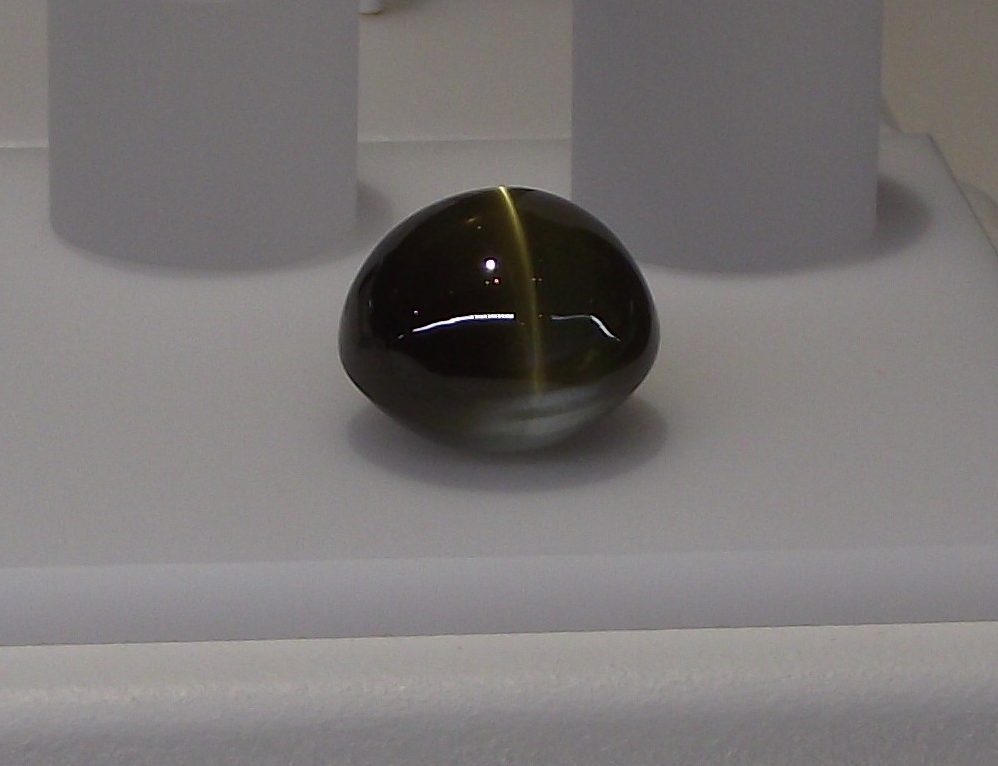
Chrysoberyl Cat’s Eye
Chrysoberyl cat's eye - also called cymophane - shows a single perfect beam of light sliding across a honey-gold dome.
- In gemology, 'cat's eye' used alone always means chrysoberyl cat's eye - all other chatoyant stones must name their mineral species first.
- The finest chrysoberyl cat's eyes show 'milk and honey' - one side of the dome is milky white, the other honey-gold - and the sides switch as light moves.
- A 45-carat chrysoberyl cat's eye sold to the Duke of Connaught in 1879 triggered the first major European cat's eye fashion craze.
- Chrysoberyl cat's eye measures 8.5 on Mohs - making it harder than almost everything in daily life except corundum and diamond.
- Sri Lanka's gem gravels (illam) have been producing chrysoberyl cat's eye for over 2,000 years and remain the primary global source today.
- Fine jewelry buyers wanting the most dramatic chatoyancy effect in the gemstone world
- Collectors seeking one of the hardest natural gemstones outside corundum and diamond
- Those born in June wanting an alternative to pearl or moonstone with more durability
- Practitioners working with intuition, protection, and seeing through deception
- Investment-minded gem buyers - fine cat's eyes appreciate in value over time
- Budget buyers - fine chrysoberyl cat's eye is premium-priced; tiger's eye provides chatoyancy affordably
- Those wanting a faceted gem - cat's eye effect requires a dome-shaped cabochon cut, not facets
- Buyers who prefer colored stones - the finest examples are greenish-yellow to honey, not saturated color
What Is Chrysoberyl Cat’s Eye?
Chrysoberyl cat's eye, historically called cymophane from the Greek for "wave" and "to appear," is the chatoyant variety of chrysoberyl (BeAl₂O₄). The chatoyancy - a single bright band of reflected light known as the "cat's eye" effect - is produced by parallel needle-like inclusions or hollow growth tubes oriented along the crystal's c-axis.
When the stone is cut as a cabochon and oriented correctly, incoming light reflects off these aligned inclusions and concentrates into the sharp streak that rolls across the dome like a feline pupil.
In the gemological trade, the term "cat's eye" used alone (without a qualifying mineral name) refers exclusively to chrysoberyl cat's eye - all other chatoyant stones must be qualified as "cat's eye tourmaline" or "cat's eye aquamarine," for example.
This convention reflects chrysoberyl cat's eye's status as the finest and most commercially significant chatoyant gem. The finest specimens show a phenomenon called "milk and honey" - one half of the stone appears milky white and the other honey-gold, switching sides as the light source moves.
Chrysoberyl cat's eye measures 8.5 on the Mohs scale - harder than all minerals except corundum (9) and diamond (10). This exceptional hardness makes it among the most durable gems for daily jewelry wear. Specific gravity of 3.70 to 3.84 is characteristic.
Colors range from yellowish-green to brownish-yellow, with honey-yellow and greenish-yellow being the most commercially desirable. Sri Lanka is the most celebrated source of fine material.
How Chrysoberyl Cat's Eye Compares
| Property | Chrysoberyl Cat's Eye | Tiger's Eye | Cat's Eye Tourmaline |
|---|---|---|---|
| Chatoyancy | Extremely sharp, bright | Good, but less precise | Variable, often good |
| Hardness | 8.5 | 7 | 7 - 7.5 |
| Price / carat | $$$ Premium | $ Budget | $$ Mid-range |
| Best For | Investment jewelry | Affordable chatoyancy | Collector gem |
Meaning and Symbolism
The cat's eye has been a talisman against the evil eye across South and Southeast Asian cultures for at least 2,000 years. In Sri Lanka and India, chrysoberyl cat's eye (vaidurya in Sanskrit) is one of the nine sacred gems of the Navaratna, worn to propitiate the planet Ketu and provide protection against unseen enemies and sudden misfortune.
Ancient texts describe cat's eye as a stone that reveals what is hidden and protects the wearer from deception - its very nature, a beam of light that penetrates its own body, embodying the capacity to see through to the truth of a matter.
European gemological literature from the 18th and 19th centuries consistently emphasizes chrysoberyl cat's eye as a stone of fortune and luck, particularly for those in professions requiring insight and judgment - lawyers, physicians, merchants.
The Victorian fascination with talismanic gems elevated cat's eye to high commercial fashion, and fine specimens moved between royal collections and wealthy private hands.
Practitioners believe the gem’s association with Ketu - the lunar south node in Vedic astrology - gives chrysoberyl cat’s eye a complex spiritual character: protective but also transformative, requiring the wearer to see clearly rather than comfortably.
Historical Timeline
Healing Tradition
Emotional
Practitioners believe chrysoberyl cat's eye strengthens the quality of inner seeing - the capacity to perceive situations, relationships, and personal patterns with accuracy rather than wishful thinking. Many find it supportive when circumstances require honesty about what is actually happening versus what one hopes is true.
In crystal healing tradition, the stone is said to protect against self-deception and the emotional distress that follows from it. Its Vedic association with Ketu gives it a transformative quality: the stone is said to encourage release of outdated attachments and the courage to see what genuinely serves and what no longer does.
Spiritual
In Vedic tradition, chrysoberyl cat's eye is the gem of Ketu - the lunar south node associated with past karma, moksha (liberation), and the dissolution of ego-attachment. Practitioners working within this framework use it to support spiritual progress by releasing karmic patterns rather than accumulating new ones.
More broadly, practitioners believe the cat's eye beam symbolizes focused spiritual attention: the capacity to direct awareness precisely at what matters. The stone is said to sharpen intuition and discernment, particularly in situations where appearances are misleading.
Physical
Crystal healing tradition associates chrysoberyl cat's eye with the eyes, nervous system, and the physical capacity for acute perception. Practitioners believe it supports those whose work demands sustained visual or perceptual precision.
Some energy workers use it near the solar plexus for personal power and discernment work, and near the crown for expanded spiritual awareness. As with all crystal practice, these uses are complementary to, not replacements for, qualified medical care.
Zodiac, Birthstone and Gifts
Chrysoberyl cat's eye carries particularly strong resonance with Capricorn through Saturn's rulership and the stone's association with hard-won perception and practical wisdom. Capricorn practitioners may find it sharpens their natural talent for seeing through surface appearances to underlying realities.
The protective qualities support the sign's tendency to build long-term without being derailed by external interference. Sagittarius connects through the expansive spiritual seeking that cat's eye's Ketu association supports - the sign's philosophical direction-finding benefits from the stone's discernment against self-deception.
In Vedic astrology, cat's eye is specifically recommended for those with strong Ketu placements in their chart.
Care and Cleansing
Chrysoberyl cat's eye is exceptionally durable and tolerates most cleansing methods safely. Brief water rinsing with a soft cloth is the standard jewelry cleaning method and is perfectly appropriate. Avoid prolonged soaking, which is unnecessary and risks loosening settings over time.
Mild dish soap in warm water with a soft brush safely removes accumulated skin oils from the dome surface.
For energetic cleansing, moonlight overnight is highly appropriate given the stone's lunar and intuitive associations. Sound cleansing with singing bowls or bells is also safe. Smudging is effective for raw specimens. Sunlight is safe for short periods.
Avoid ultrasonic cleaners for stones with significant inclusions - while chrysoberyl is hard, the silk needles that create the cat's eye can be affected by vibration in heavily included material.
- DO store separately from diamond (the only common mineral harder) to prevent scratching.
- DO clean with mild soap, warm water, and a soft brush - safe for the stone and setting.
- DO NOT use ultrasonic cleaners on heavily included specimens - the needle-silk inclusions can be affected.
- DO protect the setting, not just the stone - the dome can chip at the girdle if struck directly at a sharp angle.
- NOTE: The cat's eye effect diminishes under diffuse light - show the stone in a single-point light source for best display.
- DO have mounted stones professionally cleaned annually if worn regularly in rings.
- DO verify 'milk and honey' quality under single direct light source when purchasing - this phenomenon significantly affects value.
Real vs Fake
Chrysoberyl cat's eye is frequently imitated. The most important authenticity test is the sharpness and quality of the chatoyancy. Genuine chrysoberyl cat's eye shows the sharpest, most precisely defined cat's eye band in the gemstone world - a narrow, bright, well-defined line.
Imitations in glass, synthetic fiber-optic materials, or other minerals typically show a broader, fuzzier, or less bright chatoyant band.
The 'milk and honey' phenomenon is a premium quality indicator found in fine chrysoberyl cat's eye but difficult to replicate convincingly. Under a single moving light source, one half of the stone should appear distinctly lighter (milky/white) and the other half distinctly golden-honey yellow, reversing as the light angle changes.
Glass imitations and most other minerals do not show this bilateral color separation.
Professional gemological testing confirms chrysoberyl by refractive index (1.745-1.757), biaxial optic character, and specific gravity (3.70-3.84). Tiger's eye (quartz, RI ~1.54) and other chatoyant quartz imitations test significantly lower in RI and specific gravity.
For any significant purchase, request a gemological laboratories or equivalent laboratory report confirming the stone as natural chrysoberyl cat's eye.
Chrysoberyl Cat’s Eye Jewelry & Gifts
Chrysoberyl cat's eye is evaluated primarily on chatoyancy quality, color, and eye visibility. The four main quality factors are: sharpness of the eye (a narrow, bright, well-defined band commands the highest premium), eye placement (centered is most desirable), color (honey-yellow and greenish-yellow are most valued).
The presence of 'milk and honey.' Fine stones range from $500 to $5,000+ per carat.
Weights below 3 carats are most common commercially; stones above 10 carats with fine eye quality are genuinely rare and investment-grade. Indian and Sri Lankan material dominates the market. Always view the stone under a single moving point light source - chatoyancy is invisible under fluorescent or diffuse lighting.
Chrysoberyl cat's eye is not routinely treated. The chatoyancy is entirely natural and structural. Occasional oiling of surface micro-fractures has been noted in some material, but this is not standard practice. Request disclosure of any treatments from sellers. Laboratory certification is strongly recommended for stones above $500.
Where to Buy Chrysoberyl Cat’s Eye
Affiliate disclosure: Some links below earn us a small commission at no extra cost to you. See our affiliate disclosure page.
Handmade, raw, and tumbled pieces from independent sellers worldwide.
Shop Chrysoberyl Cat’s Eye on Etsy →Accessories, tools, and specimen sets with fast Prime delivery.
Shop Chrysoberyl Cat’s Eye on Amazon →Certified loose gemstones graded and photographed for online buyers.
Shop Chrysoberyl Cat’s Eye on GemSelect →Pairs Well With


Where Chrysoberyl Cat’s Eye Is Found


