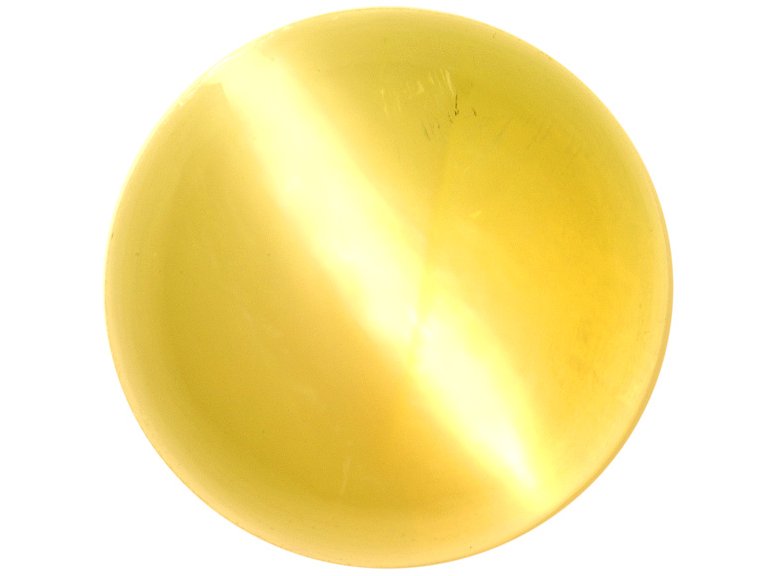
Cat’s Eye Chrysoberyl
The original cat's eye gem: a sharp silver band gliding across honey-gold chrysoberyl with legendary milk-and-honey perfection
- In the gem trade, 'cat's eye' without any qualifier always means chrysoberyl - every other chatoyant gem must be prefaced by its species name.
- The 'milk and honey effect' - where one half of the stone appears silvery white and the other golden honey under directional light - is the ultimate quality benchmark for cat's eye chrysoberyl.
- Prince Albert of Monaco gave a cat's eye chrysoberyl to Alice Heine in 1889; the subsequent fashion craze for cat's eye jewelry is documented in gemological history.
- Chrysoberyl is the third-hardest natural gem mineral after diamond (10) and corundum (9), making cat's eye chrysoberyl among the most durable chatoyant gems available.
- Sri Lanka's historical name for the stone is 'vaidurya,' derived from Sanskrit; this name also appears in Buddhist texts describing the gem-paved pathways of celestial realms.
- Serious gem collectors seeking a benchmark chatoyant stone
- Vedic astrology practitioners wearing cat's eye for Ketu
- Investors in rare natural gemstones
- Those who want the sharpest possible cat's eye effect
- Heirloom-quality jewelry with protective symbolism
- Budget gem buyers (choose cat's eye moonstone or tiger's eye instead)
- Those unfamiliar with chatoyant gems (start with tiger's eye)
- Anyone expecting the bright color play of alexandrite (a different optical effect)
What Is Cat’s Eye Chrysoberyl?
Cat's Eye Chrysoberyl - also called cymophane - is widely considered the gold standard of chatoyant gemstones. When the trade uses the unqualified term 'cat's eye,' it means chrysoberyl: the only gem species that earns the name without a qualifier. It rates 8.5 on the Mohs hardness scale.
Its sharp, mobile band of light across a honey-gold translucent body is the optical benchmark all other cat's eye gems are measured against.
The chatoyant effect results from densely packed parallel rutile needle inclusions oriented perpendicular to the optical axis. When cut as a cabochon with the dome's apex aligned with the needle direction, reflected light condenses into a single brilliant band.
The finest specimens show the 'milk and honey effect' - half the stone lights up golden yellow while the other half appears silvery white when viewed under a directional light.
Sri Lanka is the primary source of the finest cat's eye chrysoberyl, with India and Brazil as secondary sources. Chrysoberyl's 8.5 Mohs hardness makes cat's eye stones exceptionally durable compared to chatoyant gems in softer species.
How Cat's Eye Chrysoberyl Compares
| Property | Cat's Eye Chrysoberyl | Tiger's Eye | Cat's Eye Moonstone |
|---|---|---|---|
| Hardness | 8.5 | 7 | 6 - 6.5 |
| Price/ct | $$ Mid-range | $ Budget | $ Budget |
| Eye Sharpness | Sharpest possible | Good | Variable |
| Best For | Benchmark cat's eye collection | Affordable chatoyancy | Dual optical phenomena |
Meaning and Symbolism
Cat's Eye Chrysoberyl has one of the longest records of any gemstone as a protective talisman. Across South Asia, Southeast Asia, and the Middle East, the cat's eye stone has been regarded as a powerful shield against evil eye, misfortune, jealousy, and psychic attack for thousands of years.
In Vedic astrology, cat's eye chrysoberyl (lehsunia or vaidurya) is the prescribed stone for Ketu - the south lunar node associated with past-life karma, sudden events, spiritual liberation, and occult knowledge. Wearing it under Vedic gemologist prescription is said to harmonize Ketu's often disruptive influence and accelerate spiritual evolution.
Beyond Vedic tradition, practitioners broadly associate the stone with sharp perception, protection from deception, and the ability to see hidden truths - metaphysically aligned with the stone's literal function of catching every available point of light.
Historical Timeline
Healing Tradition
Emotional
Cat's eye chrysoberyl is traditionally associated with sharp emotional perception and the protection of one's emotional field from manipulation or negative influence. Practitioners believe it helps the bearer see through flattery, deception, and emotionally manipulative situations with unusual clarity.
It is said to support emotional resilience - the capacity to feel deeply without losing one's center or being overwhelmed by others' emotional projections. Crystal healers sometimes recommend it for highly empathic people who absorb others' emotions and struggle to distinguish their own feelings from those they have taken on.
Spiritual
Spiritually, cat's eye chrysoberyl is most powerfully associated with Vedic astrological practice, where it is prescribed to strengthen Ketu's positive qualities: spiritual insight, past-life wisdom, and liberation from material attachment. Practitioners believe it accelerates spiritual development by confronting the bearer with karmic patterns requiring resolution.
Some traditions describe it as a stone that 'catches the light of higher wisdom' - focusing spiritual perception in the same way it focuses physical light into a single brilliant band. It is said to be particularly powerful for those on contemplative or devotional spiritual paths.
Physical
In traditional Indian gemstone therapy (ratna chikitsa), cat's eye chrysoberyl is associated with the nervous system and is thought to support neurological health and mental clarity. Some practitioners suggest it for relief from anxiety and nervous tension, describing it as a stone that sharpens and calms the mind simultaneously.
Its association with Ketu in Vedic astrology also links it to digestive and gut-related health in traditional frameworks. These are traditional beliefs only; cat's eye chrysoberyl is not a medical intervention.
Zodiac, Birthstone and Gifts
In Vedic astrology, cat's eye chrysoberyl's association with Ketu makes it relevant across many birth charts regardless of sun sign - consult a Vedic astrologer for personalized guidance. In Western tradition, Capricorn's disciplined pragmatism and long-term thinking resonate with the stone's protective, focused qualities.
Aries benefits from the stone's traditionally courage-amplifying properties, while Taurus is thought to find its sensory appreciation of beauty deepened by chrysoberyl's extraordinary optical perfection.
Care and Cleansing
Cat's eye chrysoberyl's hardness of 8.5 makes it one of the most cleansing-friendly chatoyant gems: clean with lukewarm water and mild soap, scrub gently with a soft brush, and dry thoroughly.
Moonlight or sunlight exposure is appropriate given chrysoberyl's excellent physical stability; traditional Vedic practice often recommends lunar cleansing before setting or programming. Sound cleansing with a singing bowl or tuning fork is always a safe non-contact option, regardless of the stone's physical durability.
- DO clean regularly with mild soap and water - chrysoberyl's hardness (8.5) means it is resistant to everyday wear and most cleaning approaches.
- DO NOT use harsh chemical solvents or jewelry dip cleaners that may affect metalwork surrounding the stone.
- DO store away from diamond jewelry to prevent diamond from scratching the chrysoberyl over time (though rare given the hardness differential).
- NOTE that chatoyant inclusions (rutile needles) are permanent features of the stone - never attempt to 'clean' internal inclusions.
- DO NOT expose to ultrasonic cleaners if the stone shows visible fractures or surface cracks, as vibration may propagate them.
Real vs Fake
Genuine cat's eye chrysoberyl shows a sharp, bright, mobile single band of light across a translucent body - the eye moves smoothly and decisively as the stone is rotated under a point light source.
The 'milk and honey effect' - where one half glows golden and the other silver under directional light - is found in top-quality natural chrysoberyl and is essentially impossible to replicate convincingly in imitations.
Glass cat's eye imitations typically show too uniform or too perfect an eye without the natural slight irregularity of genuine needle inclusions; they also feel lighter in hand (lower SG of 2.5 vs chrysoberyl's 3.73).
Refractometer testing is definitive: chrysoberyl reads 1.745 to 1.763, which is dramatically higher than glass, quartz, or moonstone imitations. For significant purchases, request a report from gemological laboratories, AGL, or Gübelin confirming species as chrysoberyl and natural color/origin status.
Cat’s Eye Chrysoberyl Jewelry & Gifts
Cat's eye chrysoberyl is a premium gem market purchase; expect $50 to $200 per carat for good commercial quality, rising to $500 to $2000+ per carat for exceptional stones with the milk-and-honey effect.
The single most important quality factor is the eye: it must be sharp, bright, well-centered, and move clearly across the dome - a weak or off-center eye dramatically reduces value.
The 'milk and honey effect' where half the stone glows golden and half silver under a single light source is the benchmark of top quality and commands significant premiums.
Sri Lankan material dominates the finest end of the market; Indian chrysoberyl is available at slightly lower prices; Brazilian material tends toward lighter colors.
Request a laboratory report from gemological laboratories or AGL for any significant purchase - this confirms chrysoberyl species, natural color, and origin, providing both quality assurance and investment documentation.
Where to Buy Cat’s Eye Chrysoberyl
Affiliate disclosure: Some links below earn us a small commission at no extra cost to you. See our affiliate disclosure page.
Handmade, raw, and tumbled pieces from independent sellers worldwide.
Shop Cat’s Eye Chrysoberyl on Etsy →Accessories, tools, and specimen sets with fast Prime delivery.
Shop Cat’s Eye Chrysoberyl on Amazon →Certified loose gemstones graded and photographed for online buyers.
Shop Cat’s Eye Chrysoberyl on GemSelect →Pairs Well With




Where Cat’s Eye Chrysoberyl Is Found


