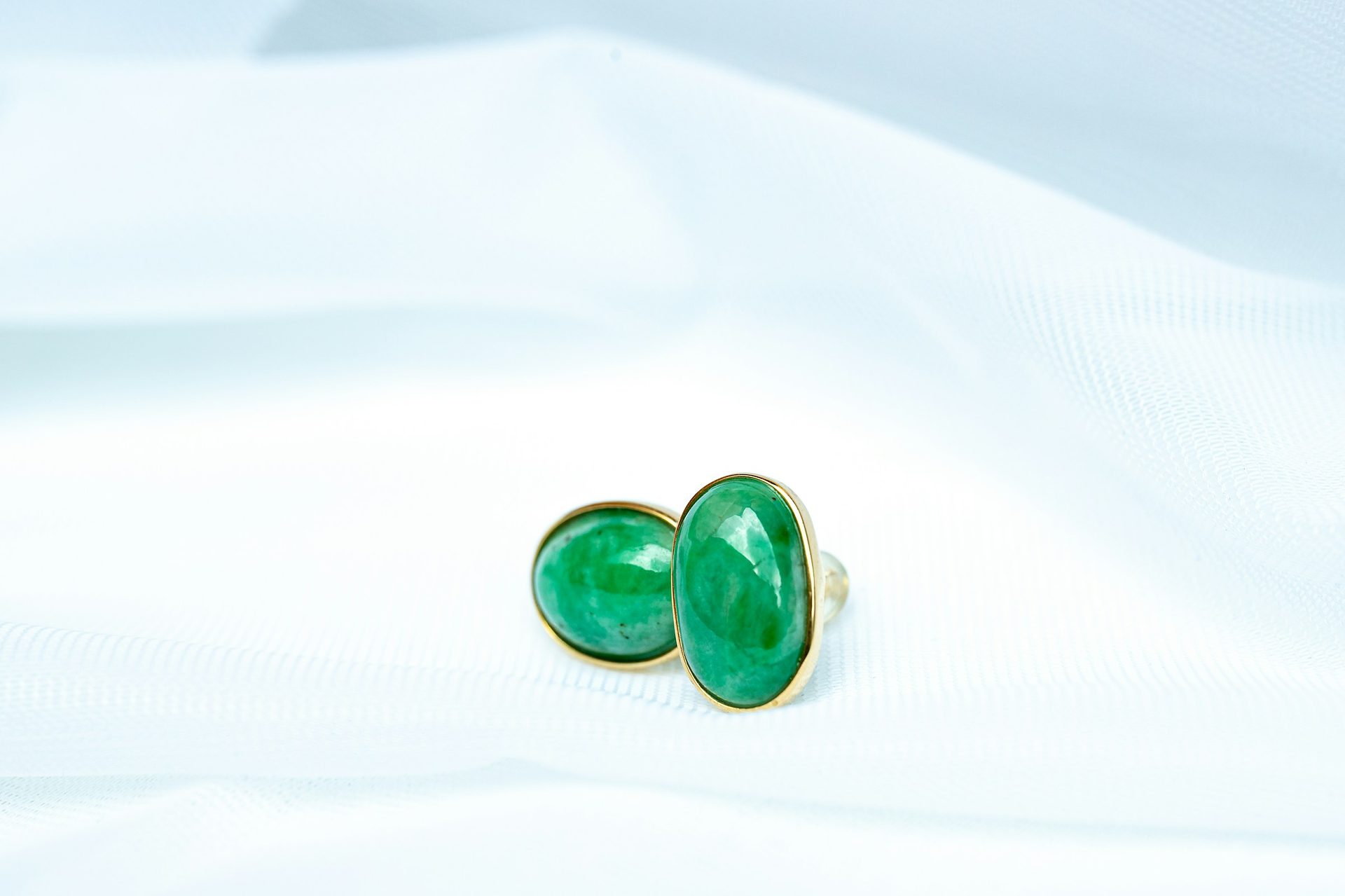
Cat’s Eye Emerald
Where emerald's vivid green meets the luminous sliding beam of chatoyancy - Cat's Eye Emerald combines 2 of nature's most coveted optical.
- The chatoyant band in Cat's Eye Emerald shifts position as the stone is rotated - this movement is what distinguishes true chatoyancy from a streak or surface marking.
- Chatoyancy requires a single light source to be visible - the effect disappears under diffuse overhead lighting, which surprises many first-time viewers.
- Fine chatoyant emeralds are so rare that major gem databases have very few documented examples; most appear only in private collections or specialized auctions.
- Emerald's green comes from chromium or vanadium - the same elements that color ruby red in corundum, demonstrating how trace chemistry determines gem identity.
- The finest Colombian emeralds are sometimes described as having a distinctive 'velvet' quality in their green - a soft luminosity not found in Brazilian or Zambian material.
- Serious gem collectors seeking an extreme rarity combining 2 prized phenomena in one stone
- Connoisseurs of optical effects in gemstones - chatoyancy plus emerald green is nearly unique
- Heart chakra practitioners wanting the most intensely rare green healing stone available
- Jewelry investors looking for a verifiable natural-phenomenon stone with auction-track value
- Those drawn to emerald but seeking something utterly different from a standard faceted stone
- Budget buyers - fine Cat's Eye Emerald is priced in premium territory
- Those wanting a standard faceted emerald look - chatoyant stones are always cut as cabochons
- Buyers expecting consistent availability - Cat's Eye Emerald is genuinely rare and rarely seen
What Is Cat’s Eye Emerald?
Cat's Eye Emerald is an emerald - chromium-bearing beryl with the formula Be3Al2Si6O18 - that displays chatoyancy, the optical phenomenon where a bright luminous band of light slides across the surface of a cabochon-cut stone when rotated under a single light source. It rates 7.5 - 8 on the Mohs hardness scale.
The effect resembles the vertical slit pupil of a cat's eye and is caused by parallel inclusions of fine needle-like crystals or hollow tubes aligned within the beryl structure.
For chatoyancy to appear in emerald, the stone must contain sufficient density of parallel fibrous inclusions oriented perpendicular to the stone's c-axis. These inclusions - most commonly actinolite needles or fluid-filled tubes parallel to the crystal's growth direction - reflect incident light into a narrow luminous band.
When the stone is cut as a dome-shaped cabochon with the correct orientation, this band becomes visible as a sharp, mobile line across the center of the gem.
The combination is extraordinarily rare because most emeralds with strong chatoyancy lack sufficient color saturation to qualify as fine emerald, and most fine emeralds lack the requisite inclusion density and orientation for chatoyancy. Specimens that achieve both simultaneously are among the rarest gems in the world.
Major sources include Colombia (the benchmark emerald source), Brazil, and Zambia. Most fine Cat's Eye Emeralds appear at specialized gem shows or auction rather than in standard retail channels.
How Cat's Eye Emerald Compares
| Property | Cat's Eye Emerald | Cat's Eye Chrysoberyl | Standard Emerald |
|---|---|---|---|
| Phenomenon | Chatoyancy + green | Chatoyancy (yellow-green) | Green color only |
| Hardness | 7.5 - 8 | 8.5 | 7.5 - 8 |
| Price / carat | $$$ Premium | $$ Mid-range | $$ Mid-range |
| Best For | Ultra-rare collector gem | Cat's eye jewelry | Fine jewelry, investment |
Meaning and Symbolism
Emerald has been one of the world's most prized gemstones since antiquity - worn by Cleopatra, mentioned in Sanskrit texts as among the most sacred stones, and designated by Pliny the Elder as second only to diamond in perfection.
The cat's eye optical effect adds an additional layer of mystique: chatoyant stones have been considered protective and magical across cultures from ancient Rome to medieval India, where the cat's eye effect was associated with warding off the evil eye.
In Vedic astrology tradition, cat's eye chrysoberyl (Lehsunia) is associated with the planet Ketu and is considered one of the nine navratna gemstones. Cat's Eye Emerald, combining emerald's Mercury correspondence with chatoyancy's protective energy, occupies an unusual and powerful position in these frameworks - serving both Mercury (emerald) and the anti-eye protection function of chatoyancy.
Some Vedic practitioners consider it exceptionally auspicious.
In contemporary crystal healing tradition, Cat's Eye Emerald is described as combining emerald's heart-centered wisdom and abundance-attracting properties with the focusing, protective intensity of the chatoyant beam.
Practitioners believe the sliding eye of light represents the all-seeing quality of the heart's wisdom - able to illuminate what is hidden and to see clearly even in difficult circumstances.
Historical Timeline
Healing Tradition
Emotional
In crystal healing tradition, Cat's Eye Emerald is said to combine emerald's renowned emotional healing - opening the heart to love, prosperity, and compassion - with chatoyancy's protective quality of revealing hidden truths.
Practitioners believe it helps those who have been deceived or self-deceived in emotional matters to see clearly without the bitterness that can follow such realizations. The sliding beam of light is metaphorically interpreted as the all-seeing quality of an open, clear heart that cannot be permanently fooled.
It is traditionally associated with emotional intelligence and discernment.
Spiritual
Practitioners describe Cat's Eye Emerald as a stone of spiritual illumination - the chatoyant beam representing the inner eye of wisdom that sees through surface appearances to essential truth.
In Vedic frameworks, the combination of Mercury (emerald's planet) and Ketu (cat's eye's association) creates a potent spiritual tool for insight, karmic clarity, and the purification of the intellect. Many contemporary crystal healers use it in work focused on seeing one's life path clearly, dissolving illusions, and aligning with genuine purpose.
Physical
From a crystal healing perspective, emerald is traditionally associated with the eyes, heart, and immune system. The cat's eye variety is said to add a focusing and clarifying quality to emerald's healing frequency. Practitioners believe it can support the body's own intelligence in identifying what needs attention.
As with all crystal practices, these are energetic traditions rather than medical claims. Cat's Eye Emerald should never replace qualified medical evaluation or treatment.
Zodiac, Birthstone and Gifts
Emerald is the traditional May birthstone, and Cat's Eye Emerald serves the two May signs: Taurus (April 20-May 20) and Gemini (May 21-June 20).
In Vedic astrology, emerald is Mercury's stone, making it particularly significant for Gemini - Mercury's ruled sign - where it is said to support intellectual clarity, communication, and adaptability. Cancer benefits from the nurturing, heart-centered frequency of emerald and the protective eye of chatoyancy.
The stone's combination of vision and heart resonates with Cancer's deep emotional intelligence and need for security.
Care and Cleansing
Cat's Eye Emerald benefits from gentle cleansing methods appropriate to its inclusions and typical fracture filling. Many emeralds on the market have been fracture-filled with oils or resins - a standard industry practice - and harsh cleaning can draw these fillers out over time.
Warm water with a very soft brush is the recommended physical cleaning method; avoid ultrasonic cleaners, steam cleaners, and chemical solutions.
Moonlight cleansing overnight is ideal as a non-contact energetic reset. Sound cleansing with a singing bowl is equally gentle and effective. Avoid salt water, which can enter surface-reaching fractures and be difficult to rinse from the stone's internal structure.
If the stone is known to be oil-treated (most Colombian emeralds are), periodic re-oiling by a professional jeweler is recommended to maintain its clarity appearance.
- DO NOT use ultrasonic or steam cleaners - heat and vibration can remove fracture-filling oils or resins from emerald.
- DO NOT use salt water - can penetrate fractures and degrade oil or resin fillings.
- DO clean only with warm water and a very soft brush.
- DO store in a padded box separately from harder gemstones.
- NOTE: Most emeralds are fracture-filled with cedar oil or synthetic resin; this is standard and disclosed practice, not a defect.
- DO re-oil periodically (every 1-2 years) through a jeweler if the stone develops a dry, less vibrant appearance.
Real vs Fake
Verifying genuine Cat's Eye Emerald requires confirming both the mineral species (beryl with chromium coloring) and the chatoyancy mechanism. Refractive index measurement (1.565-1.602) distinguishes emerald from green glass (RI ~1.50), green tourmaline (RI 1.614-1.666), and green sapphire (RI 1.76-1.77).
The hexagonal crystal system of beryl means emerald is doubly refractive - a polariscope test will confirm this.
The chatoyancy must be caused by internal parallel inclusions rather than surface effects or surface polishing patterns. Look at the cat's eye band through a loupe: it should appear to emerge from within the depth of the stone, not from the domed surface.
A genuine cat's eye moves as a single, sharp band when a point source of light is moved across the stone.
For any Cat's Eye Emerald above $500 in value, a laboratory report from gemological laboratories, AGL, or Gübelin is essential. The report will confirm mineral species, chromium vs vanadium coloring (important for value), treatment history (especially fracture filling type and degree), and origin if requested.
Do not purchase significant Cat's Eye Emerald without laboratory verification.
Cat’s Eye Emerald Jewelry & Gifts
Cat's Eye Emerald pricing is highly variable because of the double rarity premium. Minor chatoyancy in moderate-quality emerald can be found in the $200-$500/ct range. True fine Cat's Eye Emerald with vivid Colombian-quality green and a sharp, distinct cat's eye beam commands $1,000-$10,000+ per carat.
The beam sharpness, color saturation, and origin all contribute to premium pricing.
Beam sharpness is the primary quality factor for chatoyancy: a sharp, high-contrast, well-centered band is far more valuable than a diffuse or weak effect. Color quality follows the same standards as standard emerald - vivid, slightly bluish-green (Colombian benchmark) is the most prized.
Always request a lab report; always ask about treatment type and degree for any emerald purchase.
Where to Buy Cat’s Eye Emerald
Affiliate disclosure: Some links below earn us a small commission at no extra cost to you. See our affiliate disclosure page.
Handmade, raw, and tumbled pieces from independent sellers worldwide.
Shop Cat’s Eye Emerald on Etsy →Accessories, tools, and specimen sets with fast Prime delivery.
Shop Cat’s Eye Emerald on Amazon →Certified loose gemstones graded and photographed for online buyers.
Shop Cat’s Eye Emerald on GemSelect →Pairs Well With


Where Cat’s Eye Emerald Is Found


