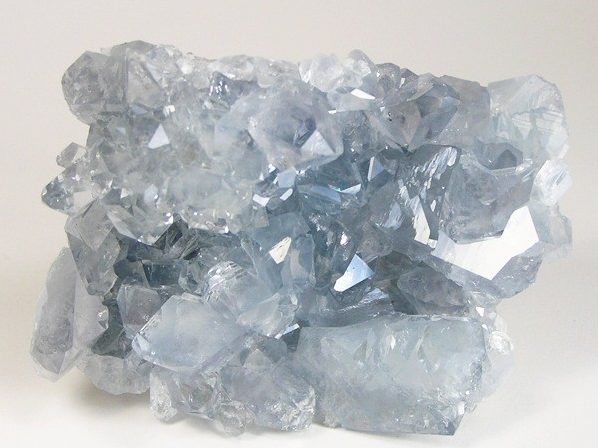
Celestite Cluster
Sky-blue celestite forms delicate orthorhombic clusters in geode cavities, associated with angelic communication, dream clarity.
- Celestite contains strontium - the same element that produces the brilliant red color in fireworks and emergency flares.
- The Sakoany deposit in Madagascar is so extensive that large celestite geodes - some weighing 50 kilograms or more - are commonly available in the collector market.
- Celestite's pale blue color fades when exposed to prolonged direct sunlight - a property that needs to be considered when choosing display locations.
- Strontium in celestite is chemically similar to calcium and is actually incorporated into bones in small amounts when consumed - though celestite specimens are not edible.
- Ohio's Put-in-Bay island on Lake Erie has been a noted celestite locality for over 150 years, and the mineral appears in Ohio geological history museum collections.
- Practitioners working with angelic communication, higher guidance, and serene crown chakra states
- Those who want a gentle blue stone with visual beauty for a calm, peaceful space
- Meditation practitioners seeking a soft high-vibration stone that supports expanded but peaceful awareness
- Gift givers looking for a visually stunning pale blue geode or cluster as a unique home display piece
- Dream workers and anyone wanting to enhance dream recall and nighttime awareness
- Those wanting a durable handling stone - Mohs 3-3.5 means celestite requires protected display only
- Buyers wanting vivid, saturated blue - celestite's blue is characteristically pale and sky-like; choose lapis lazuli for deep blue
- Anyone who needs water-safe stones for elixirs - celestite contains strontium and is not appropriate for gem water
What Is Celestite Cluster?
Celestite (also spelled celestine) is strontium sulfate (SrSO4), a mineral that forms pale blue, white, or colorless tabular orthorhombic crystals in sedimentary and hydrothermal environments. The sky-blue color - the most prized variety - results from trace amounts of organic or inorganic pigments distributed within the crystal structure.
The name derives from Latin caelestis (celestial, of the sky), a reference to the mineral's ethereal blue color.
Celestite has a Mohs hardness of 3 to 3.5, making it relatively soft and vulnerable to scratching. Specific gravity of 3.96 to 3.97 is notably heavy for the hardness - celestite is denser than quartz despite being much softer.
The orthorhombic crystals are tabular or prismatic and frequently form in geode-like cavities, with crystal clusters radiating inward from the cavity walls in the characteristic display form that makes celestite clusters prized as home objects.
The primary commercial source of collector-quality celestite geodes and clusters is the Sakoany region of northwestern Madagascar, where large deposits in sedimentary limestone yield the pale blue color that has made celestite famous. Oman produces fine white and pale blue specimens; Ohio's Put-in-Bay area historically yielded strontianite and celestite.
The pale blue color fades with prolonged direct sunlight exposure - an important care note for display placement.
How Celestite Compares
| Property | Celestite Cluster | Blue Lace Agate | Aquamarine |
|---|---|---|---|
| Hardness | 3 - 3.5 | 6.5 - 7 | 7.5 - 8 |
| Price / piece | $ Budget | $ Budget | $ Budget |
| Blue Quality | Pale sky blue, translucent | Lacy pale blue | Clear blue-green |
| Best For | Angelic energy, display | Gentle communication | Jewelry, throat chakra |
Meaning and Symbolism
Celestite's metaphysical tradition centers on its celestial color and name. Practitioners across multiple traditions associate it with angels, divine messengers, and the quality of communication that flows between the human and the higher spiritual realms.
The pale sky-blue color is seen as a visual representation of the threshold between earthly and celestial existence - the quality of clear sky at the horizon where earth meets heaven.
In contemporary crystal healing communities, celestite is among the most widely recommended stones for angelic communication practices. Practitioners describe placing a celestite cluster near the bed as creating an environment conducive to receiving messages in dreams, and using it in meditation specifically to invite higher guidance and spiritual communication.
The stone is said to create a serene, expanded atmosphere in any space, gently raising the vibration of the environment.
Celestite is also associated with peaceful resolution of conflict, calm and precise communication, and the quality of inner stillness that allows genuine listening. Many practitioners use it in spaces dedicated to therapy, counseling, meditation, or any environment where clear, compassionate communication is paramount.
The combination of throat, third eye, and crown chakra associations reflects a holistic clarity - seeing, speaking, and knowing in aligned harmony.
Historical Timeline
Healing Tradition
Emotional
Practitioners believe celestite carries one of the most peaceful and serene emotional energies in the crystal world - a quality many describe as the hush of early morning sky before the day begins.
It is said to quiet anxiety, reduce mental chatter, and create the internal stillness necessary for genuine emotional clarity to emerge. Many crystal workers use it specifically for sleep environments and pre-sleep practices, noting its reputation for creating a calm, protected nighttime atmosphere.
Celestite is traditionally associated with the resolution of conflict through serenity rather than force - the sense that stillness creates more space for understanding than argument. Practitioners describe it as particularly supportive for highly sensitive individuals who become overwhelmed by emotional or energetic intensity in their environment.
Spiritual
In crystal healing tradition, celestite is described as one of the premier angelic and celestial energy stones. Practitioners use it in meditation practices specifically aimed at opening communication with angelic guides, higher self, and spiritual teachers.
It is associated with the throat, third eye, and crown chakras, with the combined activation of all three described as creating a clear channel from earthly voice through intuitive perception to divine reception.
Many practitioners place a celestite cluster in their bedroom or meditation space as a permanent atmospheric stone rather than an actively handled working stone, allowing its energy to permeate the environment continuously. Dream guidance and prophetic dreaming practices frequently incorporate celestite.
Physical
Crystal wellness practitioners use celestite in relaxation and nervous system support sessions, placing it near the head or in the room where breathwork and relaxation practices occur. It is said to support deep physical stillness and the release of muscular tension associated with chronic anxiety and sensory overstimulation.
Some practitioners recommend it for those with tension headaches or jaw clenching associated with stress, placing it at the crown or third eye during relaxation sessions. Celestite must never be used in water elixirs because it contains strontium, which in large concentrations can be harmful.
All wellness uses are visual, atmospheric, and meditative - not medicinal.
Zodiac, Birthstone and Gifts
Gemini's association with communication, duality, and the capacity to receive and transmit information aligns with celestite's throat and third eye channel. Practitioners suggest that celestite helps Gemini individuals access the quality of still, receptive listening that complements the sign's natural verbal expressiveness.
The angelic communication association resonates with Gemini's role as the zodiac's natural messenger.
Libra's pursuit of peace, harmony, and beautiful balanced environments connects naturally to celestite's serene atmospheric energy. The stone's reputation for creating calm in conflict situations suits Libra's role as natural mediator. Practitioners recommend celestite for Libra individuals in environments of tension, noting its tradition of supporting resolution through stillness.
Care and Cleansing
Celestite requires careful dry cleansing only. The pale blue color fades with prolonged sunlight; water can dull crystal faces; salt can damage the relatively soft orthorhombic crystal surface. This is one of the more restricted cleansing situations in the standard crystal toolkit. Avoid water, salt, and direct sun for cleansing this stone.
Sound cleansing with a singing bowl is the safest and most effective method - gentle, non-contact, and aligned with celestite's vibrational energy associations. Moonlight on a dry, shaded surface (indirect moonlight, not direct sun) works well overnight. Selenite plates are the most practical daily option for maintenance charging.
Smudging with sage or palo santo is safe as long as the stone stays completely dry.
- CRITICAL: Do NOT display in direct sunlight - the pale blue color fades irreversibly with prolonged UV exposure.
- DO NOT use water, salt baths, or wet cleansing - orthorhombic crystal faces are soft (Mohs 3-3.5) and can dull with moisture.
- DO NOT make water elixirs - celestite contains strontium which can leach into water.
- DO store in indirect light or in a display cabinet with UV-filtering glass if near windows.
- DO handle large geodes from the base only, supporting the weight evenly to avoid cracking the crystal matrix.
- NOTE: celestite is brittle and crystals can chip - avoid contact with harder minerals and display on padded, stable surfaces.
Real vs Fake
Genuine celestite clusters and geodes show characteristic pale sky-blue to colorless tabular or prismatic orthorhombic crystals with a vitreous to pearlescent luster. The blue color should be internal and translucent, not surface-applied - light passing through genuine celestite shows the color within the crystal body.
Madagascar geodes have a characteristic pale blue that glows in a way glass or dyed stone cannot replicate.
The density test is useful: celestite (SG 3.97) is surprisingly heavy for its size. Glass imitations are lighter. Dyed quartz or calcite substitutes can approach celestite's appearance but their crystal habit differs - quartz has trigonal system crystals, calcite shows rhombohedral cleavage, and neither has celestite's specific orthorhombic tabular form.
A refractometer confirms celestite's RI of 1.619-1.631.
Price at reasonable collector levels confirms genuine material - celestite geodes are not inexpensively produced enough to make extensive faking profitable. Imitation concerns are primarily about quality grading (genuine but low-quality material) rather than outright faking.
Verify Madagascar origin for standard market material and look for the characteristic pale blue translucent glow rather than opaque or painted color.
Celestite Cluster Jewelry & Gifts
Celestite clusters and geodes are mid-range collector and crystal healing stones with accessible prices for most quality levels. Small clusters and geode halves typically sell for $20 to $60. Quality large geode clusters with vivid pale blue color and well-formed crystals run $60 to $200.
Exceptional large geodes (10+ kg) or pieces with unusually deep blue color can reach $200 to $500 at specialist dealers.
Color saturation is the primary quality factor. The most prized celestite is a clear, saturated sky-blue with good translucence showing the color throughout the crystal depth. Very pale or nearly white specimens are less desirable.
Crystal size and completeness of individual tabular crystal faces also affect value - larger, undamaged crystal faces show the characteristic luster better than small or damaged specimens.
Madagascan material from the Sakoany area is the standard commercial quality. Oman produces quality specimens with slightly different blue tone. Ohio celestite is historically significant and desirable but no longer in active production.
Purchase from crystal shops, mineral dealers, or gem shows where the color and crystal quality can be assessed in person before purchase.
Where to Buy Celestite Cluster
Affiliate disclosure: Some links below earn us a small commission at no extra cost to you. See our affiliate disclosure page.
Handmade, raw, and tumbled pieces from independent sellers worldwide.
Shop Celestite Cluster on Etsy →Accessories, tools, and specimen sets with fast Prime delivery.
Shop Celestite Cluster on Amazon →Certified loose gemstones graded and photographed for online buyers.
Shop Celestite Cluster on GemSelect →Pairs Well With


Where Celestite Cluster Is Found


