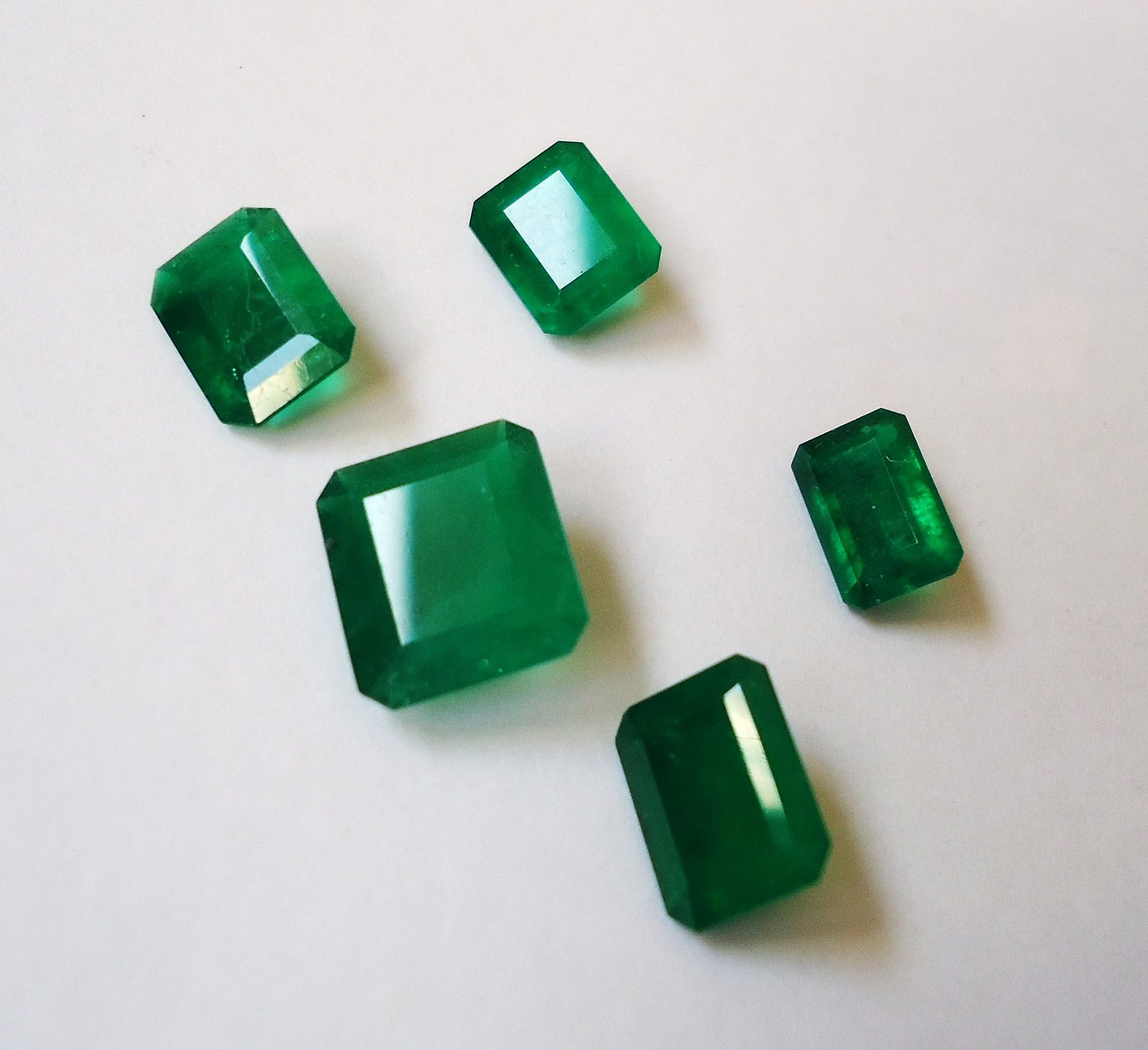
Colombian Emerald
From the Andes cloud forests to the world's finest jewelry houses, Colombian emerald sets the universal standard for green gemstone beauty.
- Cleopatra operated her own emerald mines in Egypt but prized Colombian material so highly that she sent expeditions seeking new emerald sources throughout the known world.
- The Mogul Mughal Emerald - a 217.8-carat stone covered in Islamic inscriptions - sold at major auction houses for $2.2 million, showing the enduring investment power of exceptional Colombian material.
- Colombian emeralds are nearly always oiled or resin-treated to fill surface fractures - this is the industry standard accepted trade practice, not deception, and must be disclosed.
- The term jardin (French for garden) describing emerald inclusions reflects the Renaissance view that emerald's internal landscape was as beautiful as a formal garden rather than a flaw.
- Colombia's emerald fields were so fought-over that the phrase the emerald wars refers to the violent conflicts between mining factions in Boyaca department from the 1970s to 1990s.
- Serious collectors seeking the world's benchmark emerald
- Investment buyers wanting a premium colored gemstone with appreciation history
- May birthstone shoppers who want the finest possible stone
- Heirloom jewelry creators choosing a stone with multi-generational appeal
- Green gemstone enthusiasts who insist on chromium-colored natural material
- Buyers expecting inclusion-free clarity (consider lab emerald for eye-clean material)
- Budget jewelry makers (consider zambian emerald or lab emerald for accessible prices)
- Daily-wear ring buyers without significant cushioning (emerald's jardin makes it fragile)
What Is Colombian Emerald?
Colombian emerald is beryl (Be3Al2Si6O18) colored by chromium and vanadium, mined in the Eastern Andes range of Colombia. The Muzo, Chivor, and Coscuez deposits produce stones with a distinctly pure, warm bluish-green to vivid yellowish-green color recognized globally as the emerald standard. It rates 7.5-8 on the Mohs hardness scale.
What distinguishes Colombian emeralds is their jardin - the French word for garden - the characteristic three-phase inclusions of fluid, gas, and salt crystals that form during hydrothermal growth. Unlike other gems where inclusions reduce value, emerald's jardin is considered proof of natural origin and the accepted character of the stone.
Colombia produces approximately 70-90% of the world's top-quality emeralds by value. The Muzo mine produces the warm, pure green stones most prized by collectors; Chivor produces slightly cooler, more bluish-green material; Coscuez stones lean vivid and slightly yellowish-green.
How Colombian Emerald Compares
| Property | Colombian Emerald | Zambian Emerald | Lab Emerald |
|---|---|---|---|
| Color tone | Warm vivid green | Cool bluish green | Consistent vivid green |
| Price/ct | $$$ Premium | $$ Mid-range | $ Budget |
| Inclusions | Jardin (expected) | Fewer inclusions | Eye-clean |
| Best For | Investment, prestige | Value fine emerald | Fashion jewelry |
Meaning and Symbolism
Emerald has been sacred to Venus in Roman tradition and associated with the goddess Isis in Egyptian culture - traditions that practitioners today believe give the stone its powerful connection to love, fertility, and the renewal of life.
Said to open and protect the heart chakra, emerald is traditionally associated with unconditional love, compassion, and the healing of emotional wounds. Practitioners believe Colombian emerald carries additional power from its Andean origin, connecting it to ancient indigenous wisdom traditions of the region.
Cleopatra famously prized emeralds above all other stones, and modern practitioners continue to associate the gem with royalty, wisdom, and the deep, regenerative power of nature. It is said to enhance memory, mental clarity, and truthful speech.
Historical Timeline
Healing Tradition
Emotional
Emerald is said to be the preeminent stone of the heart, with practitioners believing Colombian specimens carry the most potent expression of this energy due to their unique chromium-chromophore and Andean geological history. It is traditionally associated with loyalty, unconditional love, and the healing of emotional wounds from abandonment, betrayal, or grief.
Crystal healers often work with emerald when helping clients release patterns of unworthiness or difficulty receiving love. While these practices have no medical basis, many people find the emerald's deep green color inherently calming and connective, evoking the restorative power of nature.
Spiritual
Practitioners believe emerald activates and balances the heart chakra, the energetic center of compassion, connection, and spiritual love. Colombian emerald is said to carry earth wisdom from the Andes mountains and ancient indigenous traditions, giving it a unique depth of spiritual resonance compared to stones from other origins.
It is traditionally used in practices focused on spiritual evolution, opening to divine love, and developing the compassionate wisdom necessary for genuine service to others. Some practitioners work with emerald to strengthen clairvoyant abilities, believing its association with Mercury (in Western astrological tradition) sharpens intuitive perception.
Physical
In crystal healing traditions, emerald is said to support the heart, lungs, spine, and muscular system - though none of these claims have scientific backing and emerald should never replace professional medical care.
It is traditionally associated with fertility and reproductive health in many ancient cultures, including those of the Inca, Mughal, and medieval European traditions. Practitioners sometimes place emerald over the heart during relaxation practices for what they describe as a deeply calming, heart-opening effect.
As with all crystal healing practices, individual experiences vary and these rituals are best understood as mindfulness and intention-setting tools.
Zodiac, Birthstone and Gifts
Taurus, the earth sign ruled by Venus, finds natural kinship with emerald - both are associated with beauty, abundance, and the sensuous pleasure of the natural world. Practitioners believe emerald enhances Taurus's innate loyalty and deepens their capacity for lasting love.
Gemini, the Mercury-ruled communicator, is said to benefit from emerald's traditionally attributed ability to sharpen memory and facilitate truthful, eloquent expression. Cancer, whose deep emotional sensitivity benefits from heart-centered support, is traditionally associated with emerald in many astrological traditions, where practitioners believe it provides protective, nurturing energy that mirrors Cancer's own instincts.
Care and Cleansing
Handle Colombian emerald with care when cleansing - most natural stones are oiled or resin-treated, and prolonged water immersion can affect the treatment. Use a barely damp cloth for physical cleaning, not soaking.
Energetic cleansing with moonlight, sound (singing bowls), or smoke (sage or palo santo) is ideal for emerald. Avoid prolonged UV exposure as some oils used in treatment can darken with sustained sunlight.
Smudging is the recommended energetic cleanse - pass the stone through sage or palo santo smoke while setting a clear intention. Many practitioners feel this method is particularly resonant with emerald's earth and heart energy.
- DO NOT place Colombian emerald in ultrasonic cleaners - the vibrations can worsen existing fractures and displace filler treatments.
- DO NOT use steam cleaners - heat and moisture can remove oil or resin treatments used to fill surface fractures.
- DO store emerald in a padded box or soft pouch away from harder gems like diamonds and sapphires.
- NOTE emerald rates 7.5-8 Mohs but its jardin inclusions make it more fragile than its hardness suggests - avoid sharp impacts.
- DO ask your jeweler about retreatment every few years if the stone shows signs of dulling, as oil treatments can dry out over time.
Real vs Fake
Colombian origin certification is provided by respected labs including gemological laboratories, Gübelin, and SSEF. A certificate is essential for any emerald costing over $1,000 per carat. Without independent certification, Colombian origin claims are unverifiable.
Green tourmaline, tsavorite garnet, and chrome diopside are natural alternatives that can resemble emerald. Refractive index testing distinguishes them: emerald reads 1.565-1.602, tsavorite 1.74+, tourmaline 1.62-1.64.
Synthetic emeralds (hydrothermal and flux-grown) are genuine emeralds chemically but require disclosure. Lab emeralds typically show different inclusion types under magnification - flux-grown inclusions look like wispy veils; hydrothermal shows chevron growth patterns.
Doublets and triplets - thin slices of natural emerald laminated over glass or quartz - are a significant fraud risk. Check the girdle edge under magnification for a seam where layers join, and test specific gravity (natural emerald: 2.67-2.78).
Color-enhanced glass and beryl doped with other elements can mimic emerald color. If a stone is offered as Colombian emerald at prices below $200 per carat for quality material, extreme caution is warranted.
Colombian Emerald Jewelry & Gifts
Colombian emerald pricing ranges dramatically: commercial quality starts around $500 per carat and fine, unheated Muzo material with minor treatment can reach $30,000+ per carat. The four quality factors - color, clarity, cut, and carat weight - apply, with color most important.
Color is paramount: the most valued Colombian emerald shows a vivid medium-dark green with pure hue, no grayish or brownish modifiers. Muzo's warm, slightly yellowish green and Chivor's cool bluish green are both prized styles at the top tier.
Treatment disclosure is essential: ask specifically about oil or resin filling (minor, moderate, or significant) and request written disclosure. Significantly oiled stones are worth meaningfully less than minor or no-treatment equivalents.
Buy certified for any investment-quality stone. Gemological laboratories, Gübelin, or SSEF reports confirming Colombian origin and treatment level are standard for high-value transactions and essential for resale.
For fashion jewelry, Zambian emerald or lab emerald offer the same color beauty at dramatically lower prices. Colombian origin commands a premium worth paying only when provenance, natural character, and investment potential are priorities.
Where to Buy Colombian Emerald
Affiliate disclosure: Some links below earn us a small commission at no extra cost to you. See our affiliate disclosure page.
Handmade, raw, and tumbled pieces from independent sellers worldwide.
Shop Colombian Emerald on Etsy →Accessories, tools, and specimen sets with fast Prime delivery.
Shop Colombian Emerald on Amazon →Certified loose gemstones graded and photographed for online buyers.
Shop Colombian Emerald on GemSelect →Pairs Well With



Where Colombian Emerald Is Found
