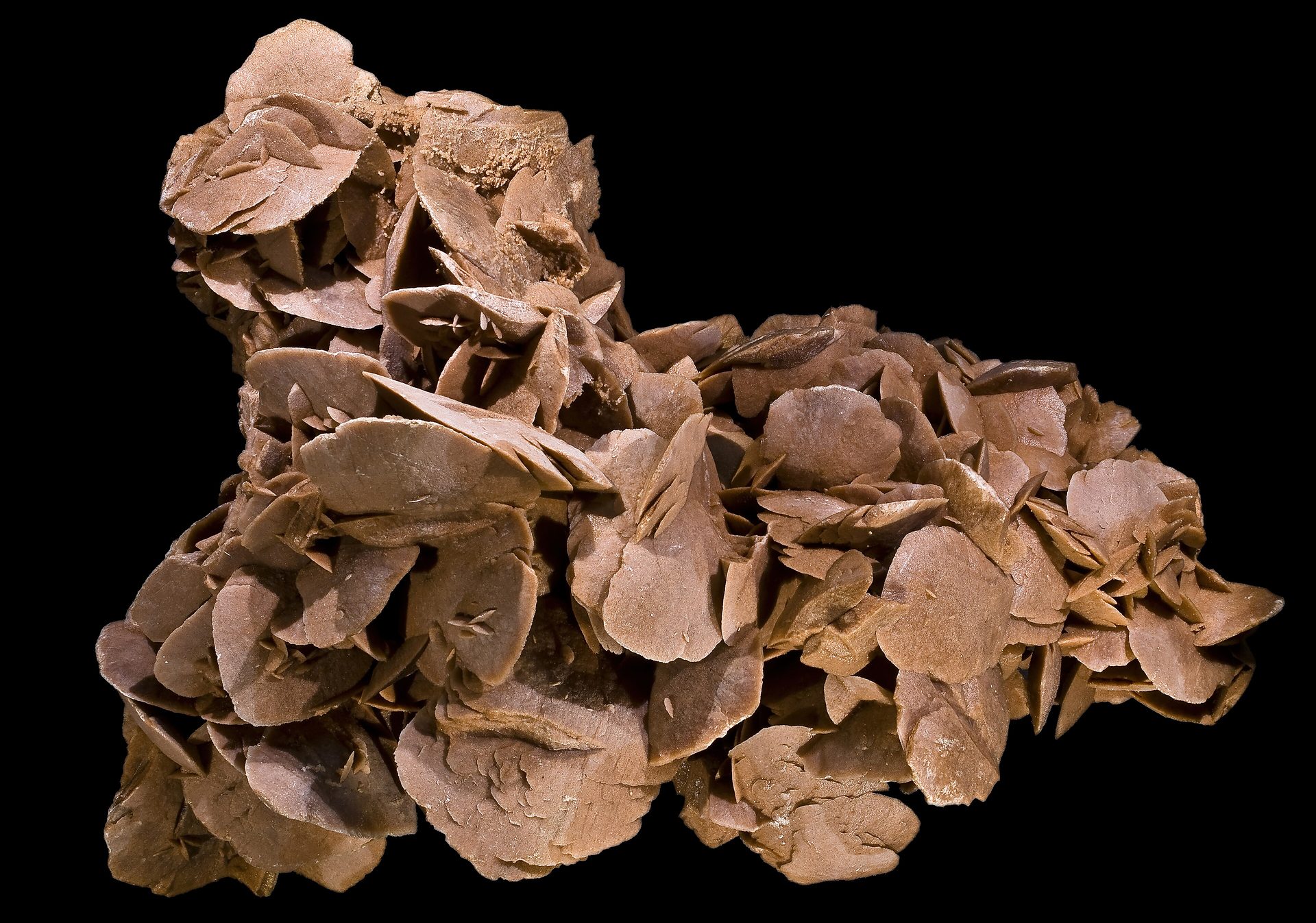
Desert Rose
Desert rose forms when mineral crystals grow in radiating petal-like clusters in arid soils - a flower made entirely from stone.
- Desert roses form at the capillary fringe just below the desert surface - a narrow zone where seasonal moisture meets evaporation, creating ideal mineral precipitation conditions.
- Each desert rose petal contains trapped sand grains from the host soil, meaning desert roses are literally made partly from their birthplace.
- The largest documented desert rose crystals weigh several kilograms and measure over 30 cm across - though these are rare museum specimens.
- Oklahoma's state rock is the barite desert rose - 'rose rock' is a significant cultural identifier for the state, recognized in 1968.
- Despite their fragile appearance, desert roses form over periods of hundreds to thousands of years as minerals slowly accumulate layer by layer in arid soil environments.
- Nature lovers who find the natural sculpture of a stone flower deeply appealing
- Those drawn to desert, earth, and wind energy in grounding practices
- Display collectors who want natural mineral art forms at an accessible price
- Root and Earth Star chakra practitioners wanting a deeply grounding formation
- Anyone who wants to give a uniquely shaped natural gift that feels special without a high price
- Those wanting a stone for daily handling - desert rose is fragile and the petals break easily
- Buyers who rinse their crystals in water - gypsum-based desert roses dissolve with water exposure
- Those seeking intense spiritual activation - desert rose is gentle and grounding rather than high-energy
What Is Desert Rose?
Desert rose is the common name for a specific mineral growth habit in which tabular crystals of *gypsum* (CaSO4·2H2O) or *barite* (BaSO4) form radiating rosette clusters that visually resemble flower petals. It rates 1.5 - 3.5 (varies) on the Mohs hardness scale.
The formation occurs in arid and semi-arid environments when capillary water carrying dissolved calcium sulfate or barium sulfate migrates through sandy soil and evaporates, depositing mineral crystals in the layer of trapped sand grains. The sand is incorporated into the mineral structure, giving desert roses their characteristic grainy, sandy texture.
Gypsum desert roses are the most common variety, forming in Saharan deposits across Morocco, Algeria, Libya, and Tunisia, and in Mexican and American desert regions. Barite desert roses are less common and occur primarily in Oklahoma, USA and in parts of Africa.
The two types look similar but are distinguished by density - barite is significantly heavier than gypsum of equivalent size. Both form at or just below the soil surface in shallow hydrological zones where evaporation concentrates minerals seasonally.
**Hardness varies** significantly between types: gypsum desert roses are very soft at 1.5 to 2 on the Mohs scale - softer than a fingernail - while barite roses are harder at 3 to 3.5. Both are fragile due to the thin, petal-like crystal forms that break easily under physical stress.
Desert roses are primarily display and collection objects rather than handled healing stones, though small specimens work well as gentle contact meditation objects when handled carefully.
How Desert Rose Compares
| Property | Desert Rose | Selenite | Sand Dollar |
|---|---|---|---|
| Unique Form | Natural flower-petal cluster | Transparent or satin plates | Flat rounded formation |
| Hardness | 1.5 - 3.5 | 2 | Varies |
| Water Safety | ✗ Avoid | ✗ Avoid | N/A (not mineral) |
| Best For | Display, grounding | Cleansing, light | Art object |
Meaning and Symbolism
Desert rose carries the energy of the desert itself - patient, resilient, and capable of unexpected beauty in harsh conditions. Tuareg and Berber peoples of North Africa collected desert roses as protective talismans, believing them to carry the power of the desert and to protect against misfortune when kept in the home.
In Moroccan folk tradition, larger desert roses were placed at the entrance of homes or buried at property boundaries as protective markers.
The flower shape emerging from sand resonates with the idea of beauty and grace under extreme conditions. In contemporary crystal healing, desert rose is associated with the qualities needed to thrive under difficulty - not force or resistance but patient, steady presence within whatever conditions arise.
Many practitioners find it speaks to the capacity for quiet strength that doesn't announce itself.
**Root and Earth Star chakra associations** ground desert rose firmly in the physical, practical dimensions of life. Its energy is described as earthy, patient, and fundamentally accepting - supportive for those who need to build foundations, establish stability, or simply be present in physical reality after periods of excessive idealism or escapism.
Historical Timeline
Healing Tradition
Emotional
Practitioners associate desert rose with the emotional quality of patient endurance - the capacity to remain present, functional, and even beautiful under difficult or barren conditions. Its desert origin resonates with the experience of managing scarcity, limitation, or isolation without losing one's essential self.
Many find it supportive during periods of low energy, emotional exhaustion, or the slow work of rebuilding after loss. Crystal healing tradition describes its energy as quietly stabilizing - not dramatic in its effects but consistently anchoring.
Spiritual
In spiritual practice, desert rose is associated with earth-based spirituality and the recognition of divine intelligence in natural process. Its formation in the deep desert - where water is scarce but creates extraordinary beauty when it appears - is used as a meditation metaphor for the spiritual principle that apparent deprivation contains its own gifts.
Some practitioners work with it in ancestor veneration practices, connecting to the Berber and North African traditions from which the stone's spiritual identity partially derives. The Earth Star chakra connection links it to practices of deep earth connection and collective ancestral grounding.
Physical
Crystal healing texts associate desert rose with the skeletal system, joints, and the body's structural framework through its calcium or barium sulfate composition and its root chakra connection. Practitioners sometimes place it near the feet or below the body during grounding practices, believing it reinforces the physical body's connection to earth energy.
Its silica-sand content is noted by some traditions in connection with skin and tissue integrity. These are metaphysical associations based in crystal healing tradition.
Zodiac, Birthstone and Gifts
Scorpio connects to desert rose through the sign's relationship with transformation in extreme conditions and the finding of hidden beauty in unlikely places. The desert rose's formation story - beauty emerging from scarcity through patient mineral accumulation - resonates with Scorpio's consistent theme of profound emergence through difficulty.
Capricorn's earth element and Saturn rulership align naturally with desert rose's patient, structural, foundation-building energy. Taurus shares the earth element and the appreciation for natural beauty in understated forms. All three signs benefit from the stone's grounding, patient-endurance quality that supports steady effort toward long-term goals over dramatic short-term changes.
Care and Cleansing
**Never use water** with desert rose - gypsum-based specimens (the most common variety) will dissolve and physically degrade with water contact. Barite roses are more resistant to water but still best avoided for wet cleansing as a general rule.
This is the primary care rule for desert rose and should be communicated to anyone receiving it as a gift.
**Sound cleansing** is ideal - a singing bowl or bell held nearby effectively cleanses without any physical contact or moisture risk. Sunlight and moonlight on a dry surface are both appropriate options.
Dry smudging with sage or palo santo in a well-ventilated space is a particularly resonant option for a stone with desert and North African traditional associations. Selenite plates provide easy maintenance cleansing for displayed specimens.
- DO NOT expose to water - gypsum desert roses will dissolve; even barite varieties are best kept dry.
- DO NOT place in humid environments like bathrooms or near water features.
- DO handle with two hands and gentle support - the petal formations are brittle and break easily.
- DO NOT allow children to handle freely - the petals fracture with rough play.
- DO store on a padded surface and away from areas where the specimen could be knocked over.
- DO dust lightly with a soft dry brush rather than wiping, to avoid pressure that could snap petal formations.
- NOTE: Some sellers spray desert roses with a protective coating to reduce fragility - this is aesthetic only and does not change the water sensitivity.
Real vs Fake
Genuine desert roses contain trapped sand grains visible in the crystal structure - running a finger lightly over the petal surface reveals a slightly grainy texture from the embedded sand. This sandiness is absent in manufactured or cast fake desert roses, which have a uniform, smooth texture throughout.
The petals in real specimens show natural variation in thickness and orientation; molded fakes show suspiciously perfect symmetry.
Colored or dyed desert roses are common in tourist markets, particularly dyed with bright artificial colors not found in nature. Natural desert rose colors range from white and cream to pale tan, light gray, and sometimes pale golden-brown.
Any vivid blue, pink, purple, or green desert rose is dyed and should be purchased with that understanding - it remains natural mineral with added color, not a natural color.
**Weight is a useful test** for the barite versus gypsum distinction: barite roses feel notably heavy for their size (specific gravity 4.5); gypsum roses feel lighter (specific gravity 2.3). This distinction matters for care because barite is more resistant to water than gypsum, though both are best treated as water-sensitive.
Desert Rose Jewelry & Gifts
Desert rose is among the most affordable mineral specimens in any crystal market. Small specimens 5 to 10 cm across sell for $5 to $15; quality mid-size specimens 10 to 20 cm range from $15 to $40; large statement specimens above 20 cm with complete petal formation reach $40 to $100.
The price is primarily driven by size and the completeness and clarity of the petal rosette pattern.
Look for specimens where the rosette is complete with no broken petals, the sandy texture is naturally distributed, and the color is consistent throughout. Avoid specimens that appear to have been repaired with adhesive or that have obvious broken surfaces on prominent petals.
Natural color variation (cream to tan) is desirable; uniformly perfect white may indicate bleaching.
**Moroccan market specimens** are widely available and generally excellent value. Souvenir markets and gem shows in North African countries, France, and Spain often provide the best price-to-quality ratios.
Avoid paying for 'rare' coloration or 'special formation' at significantly higher prices without a verifiable reason - this is a common stone and extreme price premiums are rarely justified.
Where to Buy Desert Rose
Affiliate disclosure: Some links below earn us a small commission at no extra cost to you. See our affiliate disclosure page.
Handmade, raw, and tumbled pieces from independent sellers worldwide.
Shop Desert Rose on Etsy →Accessories, tools, and specimen sets with fast Prime delivery.
Shop Desert Rose on Amazon →Certified loose gemstones graded and photographed for online buyers.
Shop Desert Rose on GemSelect →Pairs Well With


Where Desert Rose Is Found


