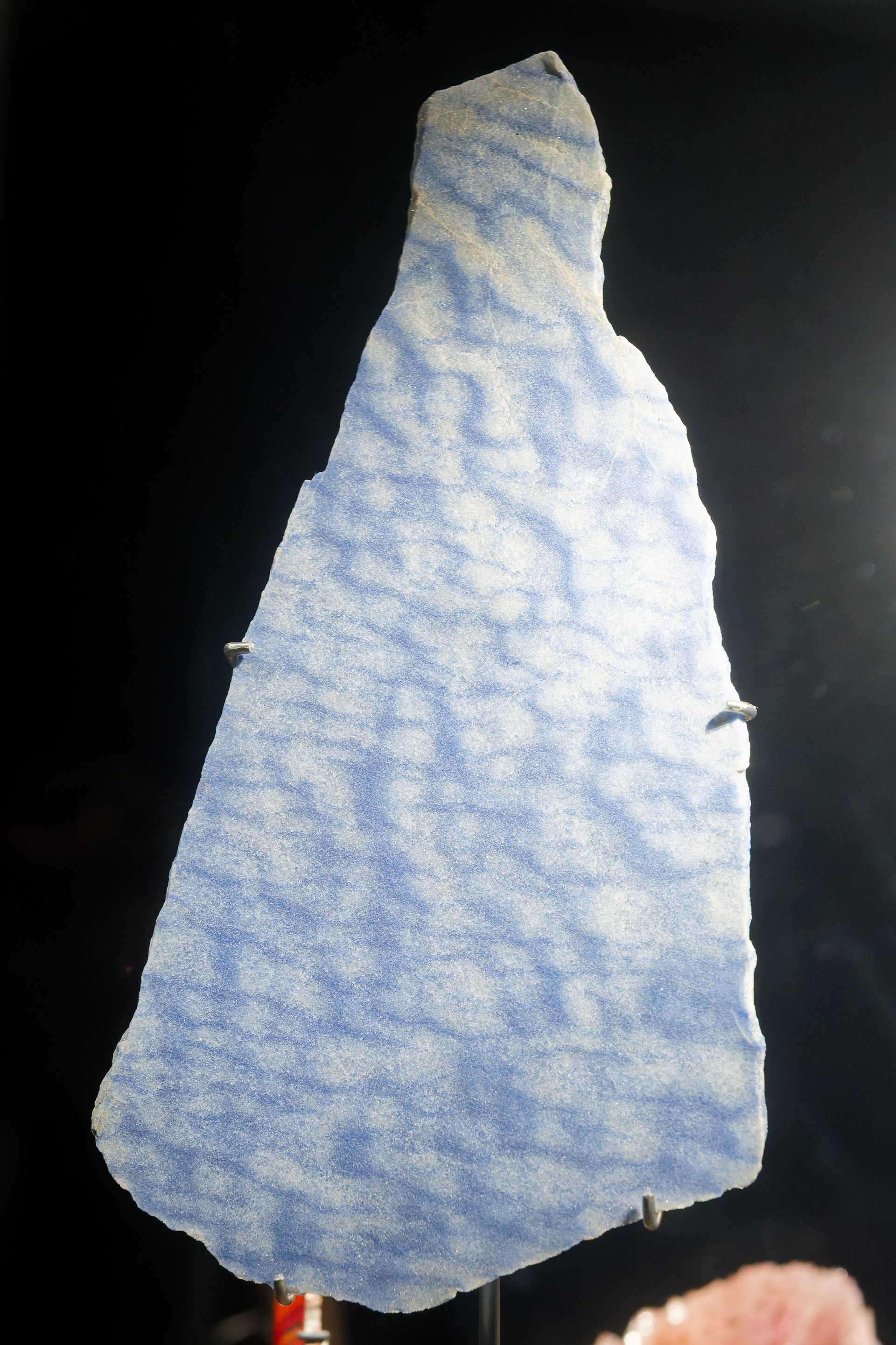
Dumortierite
Deep royal-blue quartz inclusion mineral from Nevada and Madagascar, dumortierite is the stone practitioners associate with patience, learning, and mental discipline
- Dumortierite has industrial uses beyond jewelry - its extreme heat resistance makes it valuable in manufacturing high-temperature ceramics, porcelain, and refractory materials.
- When dumortierite inclusions color quartz blue, the resulting stone is sold as 'dumortierite quartz' - a natural composite that is often more affordable than pure massive dumortierite.
- Dumortierite's blue is sometimes so intense that early gem traders mistook it for blue sapphire or lapis lazuli before modern mineralogical testing became widespread.
What Is Dumortierite?
Dumortierite belongs to the orthosilicate family, a mineral group where silicon-oxygen tetrahedra stand isolated rather than linked. Its chemical formula, Al7(BO3)(SiO4)3O3, reveals a complex blend of aluminum, boron, and silicon oxides. This composition creates the distinctive deep blue hues collectors and jewelers prize worldwide.
This striking stone crystallizes in the orthorhombic system, displaying vitreous to silky luster when polished or rough. Dumortierite ranks 7 to 8.5 on the Mohs hardness scale, making it durable enough for pendants and rings. Its refractive index ranges from 1.686 to 1.723, with specific gravity between 3.26 and 3.41.
Dumortierite's iconic cornflower-to-violet-blue coloration stems from trace aluminum and iron impurities within its crystal lattice. Major deposits occur in California, Nevada, Arizona, Brazil, Madagascar, Austria, France, Namibia, and Sri Lanka. These worldwide occurrences make quality specimens accessible to collectors and designers seeking this intense, jewel-toned gemstone.
Meaning and Symbolism
Dumortierite was first described in 1881 from specimens in France's Rhone-Alps, named for Lyon naturalist Eugene Dumortier. Within decades, commercially significant deposits were identified in California, Nevada, and Brazil, establishing it as a globally distributed mineral available to both scientific collectors and gem buyers, with full gemological data at the International Gem Society.
The stone's intense blue made it industrially valuable: dumortierite is highly refractory and was used in manufacturing spark plug porcelain and high-temperature ceramics by the early twentieth century. This industrial relevance made it one of the better-studied aluminum silicate minerals long before its gemological appeal was widely recognized.
Brazilian and Madagascan deposits introduced affordable dumortierite quartz into the gem trade during the mid-twentieth century, expanding its audience from collectors to jewelry buyers and metaphysical practitioners. Its consistent deep blue - sometimes mistaken for lapis lazuli - made it a popular and accessible blue stone in Western markets.
Historical Timeline
Healing Tradition
Emotional
Crystal healers describe dumortierite as calming to anxious or scattered minds, said to encourage a patient, methodical approach to challenges and reduce the emotional overwhelm that comes with complexity. Practitioners believe it helps those prone to overthinking find a steadier, more organized emotional baseline from which to engage with difficult situations.
Spiritual
In metaphysical traditions, dumortierite is believed to sharpen intuitive perception through the third eye chakra, helping practitioners distinguish genuine spiritual insight from projection or wishful thinking. Crystal healing tradition holds that it supports the serious spiritual student who seeks consistent inner development through disciplined, methodical practice rather than sporadic or reactive engagement.
Physical
Practitioners traditionally associate dumortierite with supporting the nervous system and reducing mental tension associated with chronic stress, though no medical evidence supports these claims. It is used in wellness settings as a companion stone during focus practices and study sessions, valued for the calm clarity it is said to bring to sustained mental work.
Care and Cleansing
- Dumortierite is a hard, durable stone suitable for most jewelry applications.
- Store separately from harder stones (corundum, diamond, topaz) to avoid surface scratching.
- Avoid ultrasonic cleaning if the stone has visible fractures; steam cleaning is generally safe.
- Dyed dumortierite imitations exist - verify natural color if purchasing unmounted rough material.
Where to Buy Dumortierite
Affiliate disclosure: Some links below earn us a small commission at no extra cost to you. See our affiliate disclosure page.
Handmade, raw, and tumbled pieces from independent sellers worldwide.
Shop Dumortierite on Etsy →Accessories, tools, and specimen sets with fast Prime delivery.
Shop Dumortierite on Amazon →Certified loose gemstones graded and photographed for online buyers.
Shop Dumortierite on GemSelect →Pairs Well With
