
Fairy Stone
Ancient Cambrian clay concretions shaped by glacial action in Quebec, each a unique sculptural form said to carry guardian fairy.
- Fairy stones are found exclusively in one small area of Quebec, Canada - the Saint-Amable region in Montérégie - making them among the most geographically restricted collectible stones on Earth.
- The oldest Indigenous name for the region where fairy stones are found translates roughly as 'the place where fairies live,' reflecting the ancient association between the stones and guardian spirits.
- Each fairy stone is approximately 500 million years old, dating to the Cambrian Period when the first complex marine animals were evolving in Earth's oceans.
- Fairy stones are the only stone on this site that is regulated under Quebec natural heritage protection law - collection quotas limit how many can be removed from the site annually.
- No two fairy stones are alike - the glacial shaping process creates a completely unique sculptural form in every individual concretion.
- Collectors drawn to rare geological formations found in only one place on Earth
- Practitioners who work with guardian spirit energy, fairy traditions, or nature-based spiritual practices
- Gift givers who want something genuinely one-of-a-kind with a compelling regional story
- Root chakra and deep-time practitioners wanting an ancient Cambrian earth stone
- Anyone building a collection of stones with rich regional folk mythology
- Those wanting vivid color or visual drama - fairy stones are gray-brown and sculptural; choose labradorite for Quebec stone with color
- Budget-only shoppers - fairy stones from Saint-Amable are legally protected and genuinely rare; pricing reflects that rarity
- Those wanting a hard, durable everyday stone - Mohs 3-4 makes fairy stone a protected display piece, not a jewelry candidate
What Is Fairy Stone?
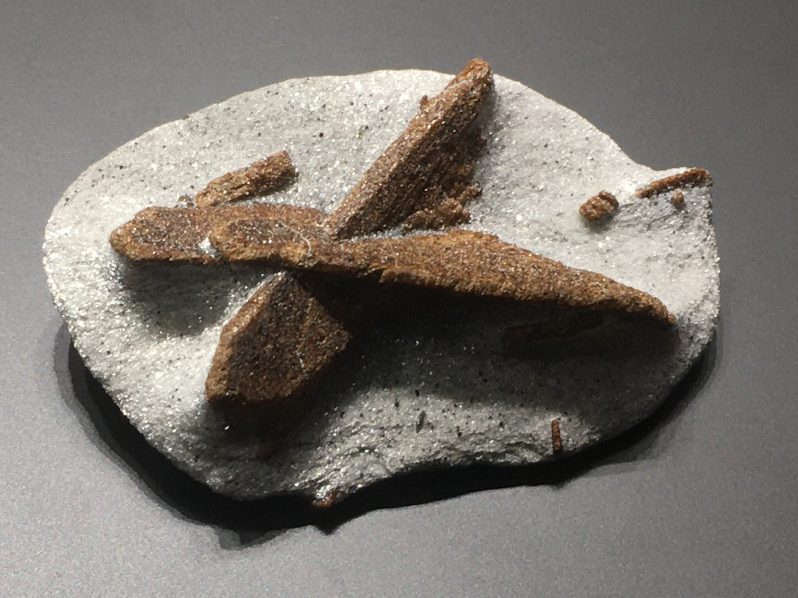
Fairy stones (French: pierres aux fées) are naturally formed sedimentary concretions found exclusively in the Saint-Amable area of Quebec, Canada. They form in ancient Cambrian clay deposits approximately 500 million years old when calcium carbonate, iron oxides. It rates 3 - 4 (clay-calcite concretion) on the Mohs hardness scale.
Clay minerals precipitate around an organic nucleus, creating rounded, sculptural shapes that were subsequently shaped and polished by Quaternary glacial action. No two specimens are identical, and their organic, rounded forms range from disc-like to elongated, lobed, or asymmetrical.
The mineral composition of fairy stones is primarily clay minerals with a calcite (CaCO3) cement and iron oxide coloring, giving them a Mohs hardness of approximately 3 to 4. Specific gravity varies with composition but typically falls between 2.0 and 2.5.
The concretions are not crystalline minerals in the conventional sense but are classified as mineral aggregates formed through authigenic precipitation in sediment. Their gray, tan, and brown coloring comes from iron and manganese oxide distribution through the clay matrix.
The Saint-Amable area in Montérégie, Quebec, is the only known location for these specific concretions. Their formation is linked to the unique combination of Cambrian clay composition, groundwater chemistry, and the specific glacial overriding that polished and shaped them over millennia.
The area has been recognized as a natural heritage site, and collection is regulated to protect the remaining deposits. Authentic fairy stones from this location carry significant scientific and cultural heritage value.
How Fairy Stone Compares
| Property | Fairy Stone | Moqui Marble | Boji Stone |
|---|---|---|---|
| Origin | Saint-Amable, QC only | Navajo Sandstone, Utah | Kansas, USA |
| Composition | Clay-calcite concretion | Hematite-sandstone | Pyrite-marcasite |
| Rarity | Extremely rare | Uncommon | Uncommon |
| Best For | Rare collection, guardian energy | Earth grounding | Balancing energy pairs |
Meaning and Symbolism
Fairy stones carry deep roots in the oral traditions of the Algonquin and Abenaki peoples of Quebec, who called them pierres aux fées and associated them with the fairy guardian spirits of the land. The Iroquois also revered them as protective talismans and gifts from the earth.
When French settlers arrived in Quebec, they incorporated these traditions into their own folk beliefs, continuing the practice of collecting and keeping fairy stones as household protectors.
In Indigenous Quebecois tradition, fairy stones were said to bring good fortune, protect the home, and serve as markers of places where fairies - the spirit keepers of the land - had gathered. Finding a fairy stone on a walk was considered a gift of luck from the forest spirits.
Farmers kept them in barns and houses as protective talismans, and the tradition of gifting them at christenings and weddings persisted into the 20th century.
In contemporary crystal healing, fairy stone carries the combined energy of ancient Earth, guardian spirit tradition, and the deep time of half-billion-year-old Cambrian sediment. Practitioners describe it as connecting the holder to land-spirit energies and to the protection of place.
Many use it in nature-based altars, home protection grids, and practices focused on connecting with the genius loci - the spirit of a specific location.
Historical Timeline
Healing Tradition
Emotional
Practitioners believe fairy stone carries a gentle, guardian-energy that is said to create a sense of being watched over and protected in day-to-day life. It is associated with the energy of benevolent nature spirits who hold the well-being of those in their care without requiring anything in return.
Many crystal workers describe it as a stone of unconditional support, making it particularly meaningful for individuals who carry heavy caretaking responsibilities and rarely receive care themselves.
The stone is said to ease the emotional burden of feeling alone with difficult situations, bringing a subtle but genuine sense of companionship from the natural world. Practitioners use it in self-compassion practices and in intention-setting for safe, protected emotional environments.
Spiritual
In crystal healing tradition and in the Indigenous heritage from which its use originates, fairy stone is associated with the spirit guardians of the land - the fairy beings, nature spirits, or genius loci that practitioners across many traditions believe protect specific places and the people who live with care on the land.
Placing fairy stone in a home, garden, or sacred space is said to invite these guardian energies and acknowledge a relationship of reciprocity with the land. Many practitioners use it on nature altars alongside other earth and forest materials.
It is associated with the root chakra and earth star chakra and with the protective, nurturing qualities of the Earth mother archetype.
Physical
Crystal wellness practitioners use fairy stone in grounding practices focused on the lower body and on releasing physical tension associated with anxiety and feeling unsafe. It is said to support a quiet, held quality in the physical body - the sensation of being safely contained and protected.
Some practitioners place it at the threshold of rooms or homes as an energetic guardian stone, following the traditional folk practice of fairy stone as house protector. As with all crystal wellness approaches, fairy stone is a complement to qualified medical care.
Its gentle, supportive energy associations make it suitable for sensitive individuals who find more intense grounding stones overwhelming.
Zodiac, Birthstone and Gifts
Virgo's deep connection to the Earth element, service, and attention to the natural world resonates with fairy stone's land-spirit and guardian tradition. Practitioners suggest Virgo individuals may find fairy stone supportive during periods of caregiving fatigue, when the stone's tradition of being watched over and supported provides needed emotional reinforcement.
Taurus, an earth sign associated with stable home environments and deep roots in physical place, connects naturally to fairy stone's tradition as a home protector and land guardian. The stone's half-billion-year geological age resonates with Taurus's affinity for permanence and endurance.
Many practitioners recommend fairy stone as a Taurus altar or home-guardian stone.
Care and Cleansing
Fairy stone's clay-calcite composition makes it sensitive to extended water and salt exposure - use brief water rinsing only and dry immediately and completely. Avoid salt baths, which can draw moisture into the porous clay matrix and weaken the structure over time.
The softness of Mohs 3-4 also means avoiding abrasive surfaces during cleansing.
The most appropriate cleansing for fairy stone is return to nature: place it outside on dry earth or a wooden surface under moonlight, in a garden bed for a few hours (not overnight in wet soil), or near plants and natural materials.
Sound cleansing with gentle bells or singing bowls is equally safe. Smudging with sage or palo santo is fully appropriate and aligns with the Indigenous tradition associated with this stone.
- DO NOT soak in water or salt baths - the clay-calcite matrix absorbs moisture and can weaken or crack with prolonged water exposure.
- DO rinse briefly if needed and dry immediately and thoroughly with a soft cloth.
- DO NOT use chemical cleaners or abrasive cloths on the natural surface.
- DO store on a padded surface or soft cloth away from harder minerals that could scratch the Mohs 3-4 surface.
- DO handle with care - fairy stones are regulation-protected natural heritage items and represent an irreplaceable geological resource.
- NOTE: some fairy stones show surface clay friability - store in a dry environment and handle over a soft surface to catch any loose clay particles.
Real vs Fake
Authentic Saint-Amable fairy stones are completely unique in form - no two are identical - and show the characteristic rounded, sculptural quality of glacially shaped concretions. The color is typically gray to gray-brown or tan, with surface texture that reflects the original clay composition.
They feel relatively light for their apparent density, reflecting the clay matrix rather than dense mineral composition.
Fraudulent 'fairy stones' occasionally appear as shaped and dyed ordinary rocks or resin castings. Genuine Saint-Amable fairy stones should come with dealer provenance indicating legal acquisition from authorized Quebec sources. Any supplier unable to provide basic provenance documentation should be viewed skeptically given the regulated collection status of the material.
A useful informal test: genuine fairy stones are slightly porous clay-calcite and will feel slightly different from polished smooth stone when rubbed - a faintly grainy or matte surface quality. The weight should feel moderate for the size, not the heaviness of dense stone nor the lightness of foam.
Any 'fairy stone' that appears machine-smooth or uniformly shaped is almost certainly not authentic Saint-Amable material.
Fairy Stone Jewelry & Gifts
Fairy stones are a mid-range specialty collectible with prices reflecting both their geological rarity and their protected status. Small specimens typically range from $20 to $50 depending on form uniqueness and quality. Larger or unusually shaped specimens run $50 to $150.
The genuinely exclusive geology of Saint-Amable justifies premium pricing compared to other concretion stones.
Purchase exclusively from dealers who can document Quebec origin and legal acquisition. The Saint-Amable area has conservation regulations around fairy stone collection, and reputable dealers work within these frameworks and can describe their sourcing.
Unauthorized collection or unprovenanced material bypasses the conservation effort and may involve legally collected stones misrepresented regarding their origin.
Online marketplaces frequently sell unverified 'fairy stones' of unclear origin, some of which may be shaped rocks or material from other locations entirely. The best sources are Quebec regional dealers, Indigenous-owned cultural businesses in the region, and specialist mineral dealers with documented supplier relationships for Saint-Amable material.
Where to Buy Fairy Stone
Affiliate disclosure: Some links below earn us a small commission at no extra cost to you. See our affiliate disclosure page.
Handmade, raw, and tumbled pieces from independent sellers worldwide.
Shop Fairy Stone on Etsy →Accessories, tools, and specimen sets with fast Prime delivery.
Shop Fairy Stone on Amazon →Certified loose gemstones graded and photographed for online buyers.
Shop Fairy Stone on GemSelect →Pairs Well With

Where Fairy Stone Is Found
