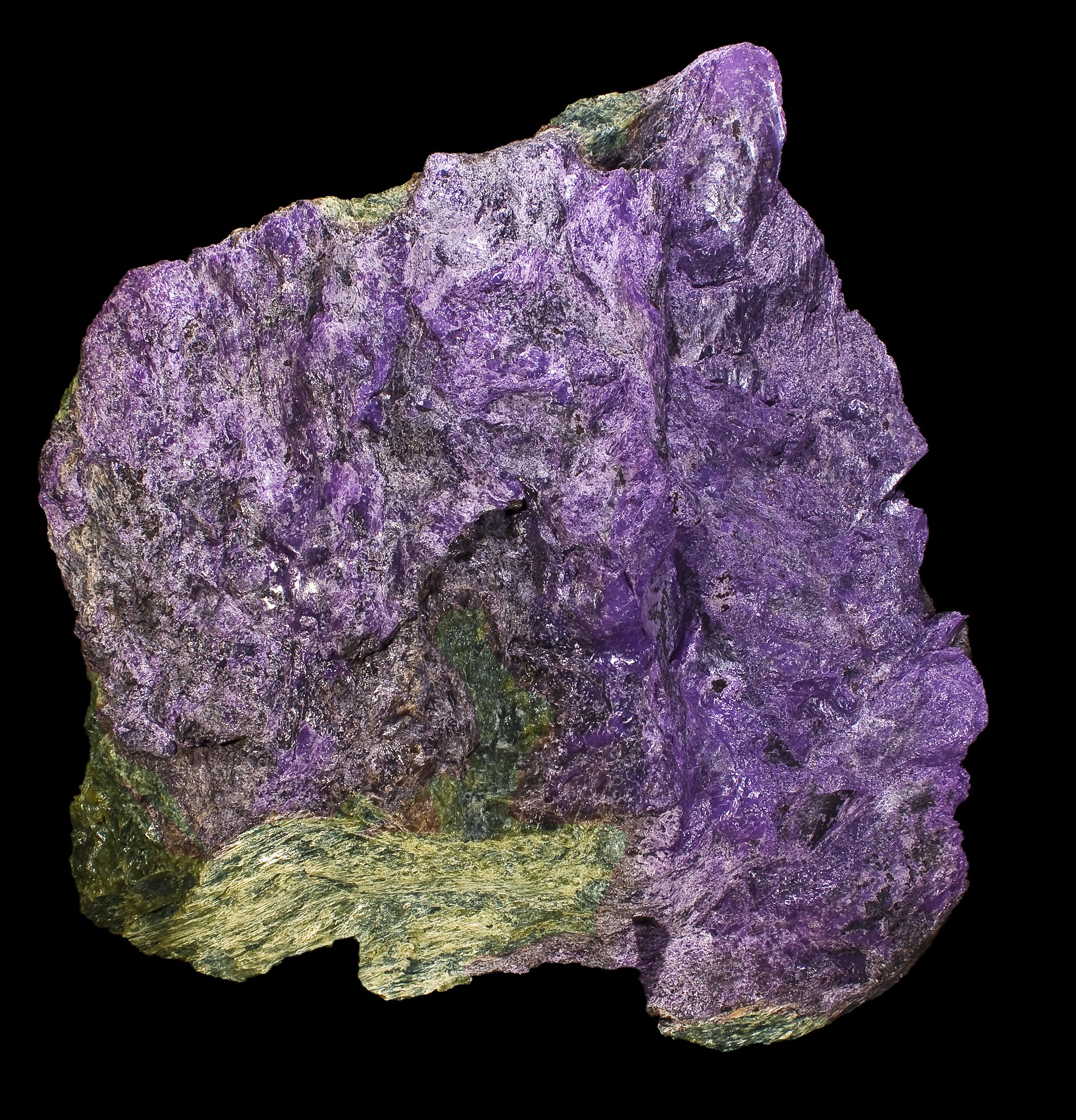
Hackmanite
A rare tenebrescent sodalite that reversibly shifts from pale lavender in daylight to deep violet under UV - one of nature's most dramatic and unusual optical effects
- Hackmanite's tenebrescence can be demonstrated with a simple UV flashlight - the stone changes color in seconds and returns to pale again within minutes of being returned to darkness.
- The speed of hackmanite's color change depends on the intensity of UV exposure - direct summer sunlight can produce full color in under 30 seconds.
- Afghan hackmanite is sometimes sold under the trade name 'Afghan sodalite' in markets that do not recognize or test for its tenebrescent property - a buyer who never tests with UV may never discover what they have.
What Is Hackmanite?
Hackmanite belongs to the sodalite group, a feldspathoid mineral family. Its formula, Na8Al6Si6O24(Cl,S)2, reflects rare sulfur content that distinguishes it from typical sodalite. The mineral crystallizes in the isometric cubic system, displaying vitreous to greasy luster with translucent to opaque appearance throughout.
This gemstone rates 5.5 to 6 on the Mohs hardness scale, making it moderately durable for collectors but requiring careful handling. Hackmanite typically appears pale gray, lavender, or pink in its natural state. Its refractive index ranges from 1.483 to 1.487, with specific gravity between 2.14 and 2.40.
Hackmanite forms in nepheline syenite pegmatites and occurs in select worldwide localities including Afghanistan, Canada, Myanmar, Greenland, and Russia. The mineral's most remarkable feature is tenebrescence - its ability to reversibly shift from pale gray to vivid purple when exposed to sunlight, then fade again in darkness or under prolonged indoor storage.
Meaning and Symbolism
Hackmanite is a rare sulfur-bearing sodalite variety first described in 1901 by Finnish geologist Victor Axel Hackman from Greenland specimens. The mineral is remarkable for tenebrescence - reversible color change triggered by light exposure - caused by photochemical behavior of sulfur radical anions trapped within the sodalite crystal structure, a phenomenon described in Britannica's sodalite entry.
Fine tenebrescent hackmanite from Afghanistan entered the collector market significantly in the late twentieth century as Afghan mineral exports expanded. The Badakhshan region - ancient source of lapis lazuli traded across the ancient world - produces hackmanite from the same geological marble setting, lending it considerable mineralogical and historical provenance.
Hackmanite from Canada's Mont-Saint-Hilaire and from Myanmar also enters the market with different tenebrescence characteristics. Its reversible color change - fading from pink or violet in darkness to white in light, then reverting under UV - has made it a favorite of collectors interested in optical phenomena.
Historical Timeline
Healing Tradition
Emotional
Practitioners believe hackmanite supports emotional transformation and the courage to reveal authentic feelings that have long remained hidden or unexpressed. It is said to mirror the stone's own tenebrescent color change - gradually revealing inner color as external conditions change - encouraging practitioners to trust the gradual emergence of their own emotional truth.
Spiritual
Traditionally associated with the third eye chakra and inner illumination in crystal healing practice, hackmanite is said to activate latent psychic sensitivity and support the development of mediumship, clairvoyance, and deep inner perception. Crystal healing tradition holds that its UV-reactive quality makes it a stone of hidden light, revealing what is present but not yet seen.
Physical
Some practitioners believe hackmanite supports the third eye and pineal gland, associations drawn from its violet and pink tones and third eye chakra attribution in crystal healing lore. These claims are not medically verified and should not replace professional care. Hackmanite is used in wellness settings as a meditation companion during practices focused on developing intuitive and perceptual awareness.
Care and Cleansing
- Hardness of 5.5 to 6 means it scratches against harder stones and minerals; store separately.
- Avoid salt cleansing as it can abrade the surface of polished specimens.
- Do not use ultrasonic cleaners - the vibration can stress specimens with internal fractures.
- Sunlight activates color and is beneficial; prolonged sustained sun over months may gradually reduce tenebrescent intensity in some specimens.
Where to Buy Hackmanite
Affiliate disclosure: Some links below earn us a small commission at no extra cost to you. See our affiliate disclosure page.
Handmade, raw, and tumbled pieces from independent sellers worldwide.
Shop Hackmanite on Etsy →Accessories, tools, and specimen sets with fast Prime delivery.
Shop Hackmanite on Amazon →Certified loose gemstones graded and photographed for online buyers.
Shop Hackmanite on GemSelect →Pairs Well With