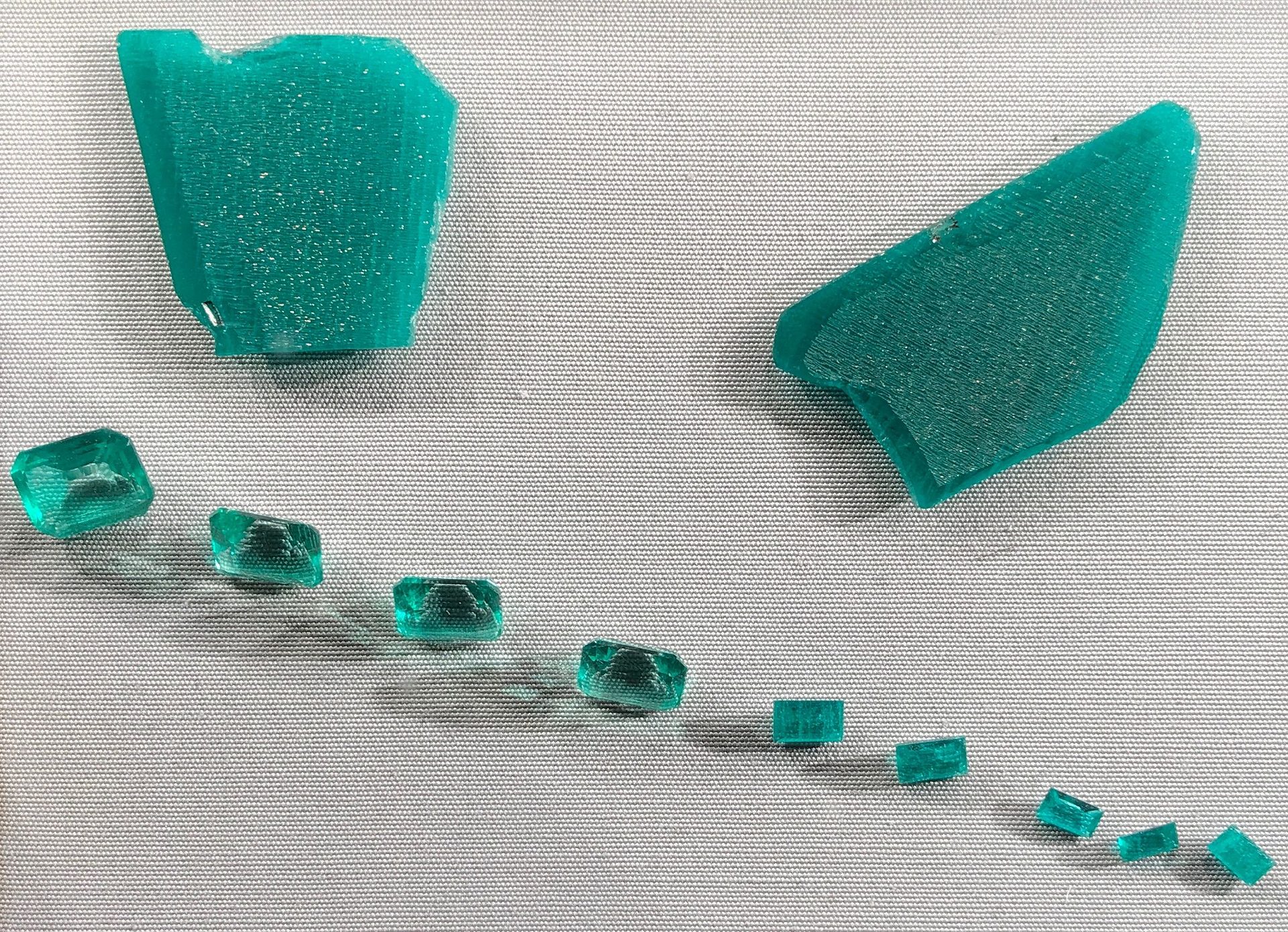
Lab Created Emerald
Lab Created Emerald is genuine beryl with chromium and vanadium - the same vivid green fire as natural emerald, often cleaner.
- Lab emerald was among the first lab-created gemstones commercially produced and sold - flux-grown synthetic emeralds appeared in markets as early as the 1930s.
- Natural emerald almost always has visible inclusions - the trade term 'jardin' (garden) acknowledges this as a feature rather than a flaw. Lab emerald routinely achieves what natural emerald rarely does: true eye-clean clarity.
- Emerald's intense green comes from chromium - the same element that makes chrome green and also gives rubies their red. Small concentration differences produce dramatically different colors in corundum vs beryl.
- The Mogul emerald - a historic 217-carat Colombian emerald engraved with Quranic text - sold at auction in 2001 for $2.2 million. A comparable lab emerald of that size would cost under $1,000.
- Beryllium, a key component of emerald, is one of the rarest elements in Earth's crust - more precious than gold by weight. Lab emerald requires the same beryllium, making it more chemically complex to produce than lab corundum.
- May birthday buyers who want a vivid green emerald birthstone at an accessible price without natural emerald's fragility concerns
- Jewelry wearers who love emerald's green but find natural emerald's typical inclusions aesthetically distracting
- Ethical shoppers concerned about artisanal emerald mining conditions in Colombia, Zambia, and Zimbabwe
- Those wanting a large emerald center stone - high-quality natural emerald above 1 carat is extremely expensive
- Gift givers wanting a meaningful green gemstone in genuine beryl at a reasonable price point
- Collectors who value the inclusion character, jardin, and geological story of natural emerald
- Investors - lab emerald has minimal resale value; natural high-quality emeralds can appreciate significantly
- Those buying for daily-wear rings - at Mohs 7.5-8, emerald is less ideal for ring wear than sapphire or ruby, lab or natural
What Is Lab Created Emerald?
Lab Created Emerald is beryl - the same mineral family as aquamarine and morganite - with chromium and sometimes vanadium trace elements that produce its characteristic vivid green. The chemical formula Be₃Al₂Si₆O₁₈:Cr,V is identical to natural emerald. It rates 7.5 - 8 on the Mohs hardness scale.
Lab emerald differs from natural only in how it formed: in a controlled laboratory environment, not in the hydrothermal veins and pegmatites of the Earth's crust over millions of years.
Two primary laboratory methods produce gem-quality emerald. *Hydrothermal synthesis* grows emerald crystals in pressurized vessels where beryllium, aluminum, silica. Chromium are dissolved in hot acidic solution and crystallized onto seed crystals over weeks to months - closely mimicking natural emerald's hydrothermal formation. *Flux growth* uses molten lead oxide or lithium molybdate as a solvent.
Hydrothermal lab emerald is generally considered higher quality, with more natural-looking optical properties and a closer resemblance to fine natural material.
Lab emerald typically has fewer inclusions than natural emerald. In the natural world, fine clean emeralds are extraordinarily rare - almost all natural emeralds contain what the trade calls *jardin* (French for garden) - a network of fractures, inclusions, and healing planes.
These inclusions are so expected in natural emerald that oil or resin filling is standard industry practice. Lab emerald, grown in more controlled conditions, can achieve eye-clean or near-eye-clean quality routinely - a characteristic that appeals to those who prefer a clear stone.
Lab Created vs Natural Emerald
| Property | Lab Emerald | Natural Emerald | Green Tourmaline |
|---|---|---|---|
| Hardness | 7.5 - 8 | 7.5 - 8 | 7 - 7.5 |
| Price / carat | $ Budget | $$ Mid-range | $$ Mid-range |
| Inclusions | Usually eye-clean | Jardin expected; filled | Typically clean |
| Color | Vivid green, consistent | Variable; some outstanding | Green, various shades |
| Resale value | Minimal | High for fine quality | Moderate |
Meaning and Symbolism
Emerald's meaning is one of the most universally consistent in gemstone tradition: the stone of love, the heart, growth, renewal, and the verdant abundance of life. The ancient Egyptians considered emerald sacred to Isis and used it in funerary jewelry as a symbol of eternal life and regeneration.
Cleopatra was famous for her passion for emeralds and claimed ownership of all Egyptian emerald mines. The Incas and Aztecs revered emerald as a sacred stone, and Mughal emperors had their finest emeralds engraved with sacred texts and worn as amulets.
Lab Created Emerald carries this meaning fully. The same chromium and beryl chemistry that gives natural emerald its vivid green - the green most closely associated with spring, growth, the heart, and the renewal of life - is present in lab emerald in identical form.
Crystal healing practitioners who work with emerald for heart-opening, love attraction, and connection to the growth-force of nature find lab emerald an equivalent working stone.
The May birthstone association applies equally to lab emerald. For Taurus and Gemini - the signs that span May - the stone carries the same traditional associations regardless of origin.
Contemporary practitioners often appreciate lab emerald specifically for its clearer body, which they interpret as a stone with less historical trauma and fewer energetic 'programs' - a fresh, clean vessel for new intentions.
Historical Timeline
Healing Tradition
Emotional
Emerald is considered one of the most powerful heart-centered stones in crystal healing - and lab emerald is said to carry this quality cleanly, without the accumulated energetic history that older natural stones may hold.
Practitioners believe emerald works with the heart's capacity for both giving and receiving love, supporting the opening of the heart after grief or loss, and dissolving the self-protective emotional armor that prevents genuine connection.
It is traditionally associated with unconditional love - the kind that flows without condition or expectation - and with the emotional quality of renewal: the sense, like spring after winter, that the heart can open again no matter how long or deep the closing has been.
Spiritual
In spiritual tradition, emerald is linked to Venus, the planet of love, beauty, and the creative principle, and to the goddess archetype of generative life force.
Lab emerald is said to activate the Heart chakra directly, opening the practitioner to the experience of love as a fundamental quality of reality rather than a personal emotion.
Many crystal healers use it in sessions focused on self-love - the specific work of learning to turn the heart's generosity back toward oneself after years of directing it outward.
It is also associated with wisdom traditions that link the heart to intelligence: the idea that the deepest knowing comes through an open heart rather than an analytical mind.
Physical
Crystal healing tradition associates emerald with the heart, lungs, and the immune system - all associated with the heart chakra's domain in the body. It is sometimes placed on the chest or at the heart during layouts focused on cardiovascular support, respiratory health, or the physical symptoms of chronic loneliness and disconnection.
Some practitioners associate its vivid green with the lymphatic system and the body's cleansing and renewal processes. These are traditional metaphysical associations and should not substitute for medical care.
Zodiac, Birthstone and Gifts
Emerald's May birthstone status gives it primary associations with Taurus and Gemini, the two signs that span May. Taurus, the Venus-ruled earth sign of sensory pleasure, steady love, and material abundance, resonates deeply with emerald's lush green and its associations with Venus and natural abundance.
Emerald is said to amplify Taurus's natural gifts of loyalty, appreciation of beauty, and the capacity for deep, committed love. Gemini, the mercurial sign of communication, duality, and the capacity to hold multiple realities at once, finds in emerald a heart-centered anchor that keeps its natural brilliance grounded in genuine feeling.
Cancer, the water sign of home, nurturing, and the tender heart that loves with great depth, benefits from emerald's Heart chakra support during the emotional vulnerability that is both Cancer's gift and its challenge.
Care and Cleansing
Lab emerald is beryl - chemically stable but slightly more sensitive than corundum. Avoid salt water immersion, which can affect the stone's surface polish over time. Plain water rinsing is fine.
Avoid ultrasonic cleaners if your stone is fracture-filled (check with the seller) - high-quality lab emerald should not need filling, but verify.
Moonlight, sunlight (brief), sound, smoke, and selenite slab cleansing are all safe and effective. Moonlight on the full moon is the classic choice for a love stone.
Rose water spray - a light misting with rose water - is a traditional and fragrant choice for emerald cleansing that connects to its Venus associations. Regular cleansing after wearing is recommended, particularly if used actively in heart chakra work.
- DO protect from hard impacts - emerald has natural cleavage planes making it more chip-prone than corundum.
- DO choose protective settings (bezel, halo, or channel) for ring use rather than high-prong solitaire settings.
- DO NOT use ultrasonic cleaners without confirming the stone has no filling or fracture treatment.
- DO clean with warm water, mild soap, and a soft brush only.
- DO NOT soak in salt water - can damage surface polish.
- DO disclose as lab created when selling or insuring - required by FTC regulations.
- Note: Lab emerald typically has fewer fractures than natural, making it more structurally stable despite the same Mohs rating.
Real vs Fake
Lab emerald is genuine beryl - not an imitation. The identification challenge is distinguishing lab from natural, which requires professional gemological examination. Under magnification, natural emerald shows characteristic jardin inclusions - networks of fractures, chromite inclusions, two-phase or three-phase inclusions (liquid + gas + mineral), and growth planes.
Lab emerald typically appears much cleaner; hydrothermal lab emerald may show flux-related inclusions and growth veils that look different from natural emerald's jardin.
Chatham, Gilson, Biron, and Tairus are established brands of lab emerald with recognized internal characteristics that experienced gemologists can identify. Spectroscopic analysis, UV fluorescence, and trace element composition can distinguish lab from natural in most cases.
A stone that is dramatically cleaner than natural emerald of comparable size and color should prompt a question about origin.
Glass imitations are less convincing: glass shows single refraction, scratches with a steel file, and has a notably lower specific gravity than emerald. The singly refractive nature of glass vs emerald's double refraction is quickly identified with a polariscope.
Purchase from sellers who provide clear origin disclosure and, for significant purchases, a gemological lab report.
Lab Created Emerald Jewelry & Gifts
Lab Created Emerald is available at multiple price points. Small faceted stones (0.5 to 1 carat) typically run $10 to $40. Good quality lab emerald in the 1 to 3 carat range runs $30 to $100. Premium hydrothermal lab emerald with excellent color and clarity can reach $50 to $200 per carat.
Compared to natural high-quality emerald at $1,000 to $20,000+ per carat for fine Colombian material, the value proposition is dramatic.
Color saturation is the primary quality factor - look for vivid, pure green without gray or yellow modifiers. The finest lab emerald matches Colombian natural emerald's signature bluish-green. Clarity is typically better than natural emerald, so a heavily included lab stone is a quality red flag.
Ask about the production method - hydrothermal commands a premium for its more natural character.
Reputable lab-created gemstone dealers include Chatham, Biron, Tairus, and others who provide documentation. For fine jewelry, request a lab report from gemological laboratories, AGL, or another recognized laboratory confirming lab-created origin and quality grades.
Where to Buy Lab Created Emerald
Affiliate disclosure: Some links below earn us a small commission at no extra cost to you. See our affiliate disclosure page.
Handmade, raw, and tumbled pieces from independent sellers worldwide.
Shop Lab Created Emerald on Etsy →Accessories, tools, and specimen sets with fast Prime delivery.
Shop Lab Created Emerald on Amazon →Certified loose gemstones graded and photographed for online buyers.
Shop Lab Created Emerald on GemSelect →Pairs Well With


Where Lab Created Emerald Is Found


