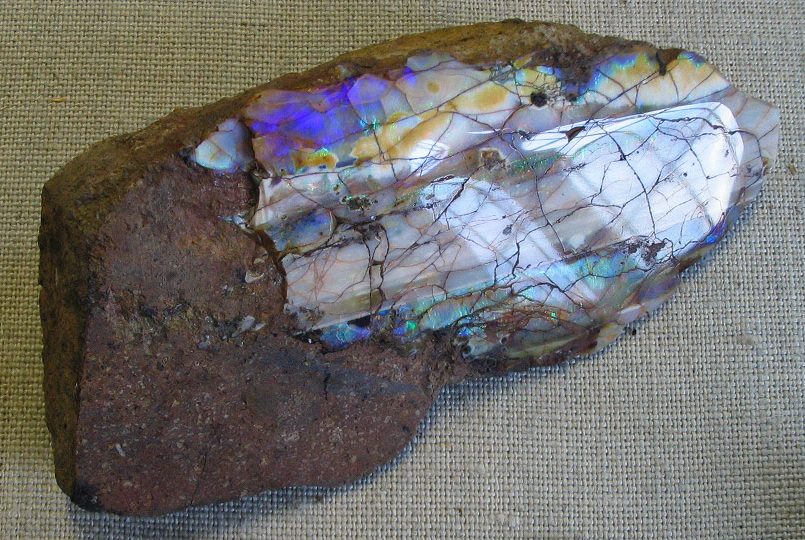
Lab Created Opal
Lab Created Opal replicates the stunning play-of-color of precious opal through controlled silica sphere arrangement - vivid.
- The play-of-color in both natural and lab opal comes from silica spheres so perfectly sized that they diffract visible light wavelengths - natural physics at the nanoscale producing macro-scale rainbow displays.
- Lab opal can be produced to emphasize specific color ranges - a predominantly red and orange lab opal can be grown by choosing the appropriate silica sphere diameter for those wavelengths.
- Gilson Created Opal, the original commercial synthetic, is recognizable by its 'snakeskin' pattern of color patches - more geometric and regular than natural opal's typically organic arrangement.
- Natural opal contains 5-21% water by weight, which contributes to its fragility. Lab opal's water content is controlled during production and may be more stable than some water-rich natural specimens.
- Australian opal - the source of most natural precious opal - formed in ancient inland seabeds that dried out over millions of years; lab opal replicates the mineral product without the geological journey.
- October birthday buyers who want vivid play-of-color opal without natural opal's fragility and price
- Those who want maximum color spectacle in jewelry - lab opal can produce more uniform and vivid color than most natural opals
- Gift givers looking for a visually stunning iridescent stone at an accessible price point
- Those who prioritize consistent, predictable aesthetics - lab opal offers color uniformity natural opal never provides
- Jewelry designers who need matched opals for sets - lab opal can produce consistent color patterns across multiple stones
- Buyers seeking the character and uniqueness of natural opal's one-of-a-kind pattern - lab opal is beautiful but formulaic
- Ring wearers who want maximum durability - at Mohs 5.5-6.5, all opals need protective settings for ring use
- Serious opal collectors - natural Australian black opal or crystal opal from known sources is irreplaceable for the collector market
What Is Lab Created Opal?
Lab Created Opal is synthetic hydrated silica that replicates the internal structure producing natural opal's play-of-color. In nature, precious opal's rainbow display is created by arrays of uniform-sized silica spheres (150-300 nanometers) that diffract light according to their diameter and spacing, producing different colors at different wavelengths.
In the laboratory, these sphere arrays are grown under controlled conditions that produce more uniform sphere sizing and more regular stacking than natural processes typically achieve.
The laboratory process for opal synthesis was developed by Pierre Gilson in the 1970s, and Gilson Created Opal remains the most recognized brand of lab opal. The process grows silica spheres in solution and allows them to settle and compact into ordered arrays, which are then compressed and hardened.
The color produced is controlled by adjusting sphere diameter - larger spheres produce red, smaller spheres produce blue-violet, and intermediate sizes produce green.
Lab opal's play-of-color is often more vivid and uniform than most natural opal because the sphere array is more perfectly ordered. Natural precious opal forms in groundwater conditions over millions of years; imperfect sphere sizing and stacking creates the unique, never-repeated patterns that make each natural stone individual.
Lab opal sacrifices individuality for consistent visual performance - a trade-off that appeals to many jewelry buyers and designers.
Lab Opal vs Natural Opal
| Property | Lab Opal | Natural Black Opal | Natural White Opal |
|---|---|---|---|
| Hardness | 5.5 - 6.5 | 5.5 - 6.5 | 5.5 - 6.5 |
| Price | $ Budget | $$ Mid-range | $ Budget |
| Color uniformity | Very consistent | Unique, variable | Unique, variable |
| Play-of-color | Often vivid, regular | Variable - best are spectacular | Softer, less vivid |
| Origin | Laboratory | Australia (Lightning Ridge) | Australia, Ethiopia |
Meaning and Symbolism
Opal's meaning across cultures has been shaped by its play-of-color - a single stone that shows all colors, shifting and changing, never fixed in one identity. Ancient Romans considered opal the most beautiful of gemstones because it contained all colors within it.
The word derives from the Sanskrit 'upala' (precious stone) and the Greek 'opallios' (color change). Opal has been associated with hope, creativity, and the full spectrum of human experience across many traditions.
Lab opal carries the core of this meaning through its identical optical phenomenon. The play-of-color - the shifting rainbow within - is the physical expression of the stone's spiritual identity, and this is present in lab opal as fully as in natural.
Crystal healing practitioners who work with opal for creativity, full-spectrum emotional expression, and connection to the intuitive self find lab opal a valid working stone.
The October birthstone association applies equally to lab opal. For Libra and early Scorpio - the signs spanning October - the stone's balancing, full-spectrum quality aligns with Libra's search for equilibrium and Scorpio's depth and emotional intensity.
Practitioners often note that lab opal's more consistent color pattern can be a meditation advantage - a cleaner, more predictable visual field for color meditation work.
Historical Timeline
Healing Tradition
Emotional
Opal - lab or natural - is associated in crystal healing tradition with the full spectrum of the emotional life. Where single-color stones are said to support specific emotional states, opal with its all-color nature is traditionally associated with the capacity to experience the full emotional range without getting stuck in any one color.
Practitioners believe it supports emotional fluidity - the ability to move through emotions as experiences rather than identities, feeling grief without becoming grief, feeling joy without fearing its end.
It is said to be particularly helpful for those who have learned to suppress or avoid parts of their emotional spectrum, encouraging a more complete and integrated emotional life.
Spiritual
Crystal healing tradition associates opal with spiritual inspiration, creativity, and the activation of dormant psychic sensitivity. The play-of-color is interpreted as a visible invitation to look beyond the obvious, to see what is hidden within the ordinary, to cultivate the perceptive sensitivity that allows the unseen to become visible.
Many practitioners use opal specifically for opening to creative inspiration - the unexpected insight, the sudden new perspective, the creative solution that arrives from a direction not previously considered.
Lab opal is used in the same spiritual context as natural, with practitioners noting that the more regular color patterning of lab opal can make it a gentler, more consistent spiritual companion.
Physical
Crystal healing tradition associates opal with the eyes and vision - both physical and intuitive. The stone's rainbow display is said to support optical sensitivity and clarity of visual perception. Some practitioners use it in layouts focused on the eyes, particularly for conditions of strain or fatigue from excessive screen time.
Opal is also traditionally linked to the kidneys and water balance in the body - reflecting its high water content and the moon-water associations of October. These are traditional associations and not medical claims.
Zodiac, Birthstone and Gifts
Opal as the primary October birthstone connects it to Libra and early Scorpio. Libra, the sign of balance, beauty. The aspiration to hold all perspectives in equilibrium, resonates with opal's all-color nature - a stone that contains all the colors of the spectrum and lets them dance together without hierarchy or separation.
Cancer, the sign of deep feeling, home, and the inner life that few others see, connects to opal's hidden depths - the colors that live inside the stone, visible only to those who look with care and patience.
Scorpio, entering at month's end, is drawn to opal for its mystery - a stone that shows more the longer you look, yielding its secrets in layers to those with the persistence to stay present.
Care and Cleansing
Lab opal requires more careful cleansing than most gemstones due to its amorphous structure and water content. Avoid salt, salt water, and prolonged water immersion - these can damage the silica structure over time. Brief cool water rinsing is generally safe. Avoid strong chemical cleaners entirely.
Moonlight is the preferred cleansing method - safe, effective, and resonant with opal's water-and-light associations. Sound cleansing is excellent and completely safe for the stone. Smoke cleansing with sage or palo santo is effective without any moisture concerns. Selenite slab cleansing is ideal for regular maintenance.
Avoid prolonged direct sunlight, which can cause dehydration cracking in some opals over time - both natural and lab material with significant water content can be affected.
- DO NOT soak in water, salt water, or chemical solutions - opal's amorphous silica structure can deteriorate.
- DO NOT use ultrasonic cleaners - vibration stress can cause internal cracking in any opal.
- DO NOT expose to extreme temperature changes - thermal shock is a known cause of opal cracking.
- DO choose protective settings (bezel or halo) for rings - opal at Mohs 5.5-6.5 chips more easily than harder gems.
- DO store in a slightly humid environment if in a very dry climate - keep away from extreme dryness.
- DO clean with a soft slightly damp cloth and dry immediately.
- Note: Lab opal may be somewhat more stable than natural opal in dry conditions, but basic opal care rules still apply.
Real vs Fake
Identifying lab opal vs natural opal requires examination of the color pattern. Natural precious opal has organic, irregular color patch shapes that never repeat in a systematic pattern.
Lab opal (particularly Gilson) typically shows a more geometric, snakeskin or lizard-scale regular pattern to the color patches - visible under magnification as a repeating lattice arrangement rather than random organic shapes.
Under magnification, the columnar structure of Gilson lab opal is sometimes visible as vertical pillars in cross-section. Natural opal shows no such regular columnar structure. The specific gravity of lab opal (around 2.0) may be slightly lower than natural precious opal (2.0-2.2) but the overlap makes this test inconclusive.
For trade purposes, lab opal must be disclosed as synthetic and sold with appropriate trade name ('Gilson Created Opal,' 'synthetic opal,' or similar). The FTC requires this disclosure.
When purchasing, ask directly whether the stone is natural or synthetic opal - this simple question should always receive a clear, honest answer from a reputable seller.
Lab Created Opal Jewelry & Gifts
Lab Created Opal is very affordable - small cabochons and beads start from $5 to $20. Good quality lab opal cabochons with vivid full-spectrum play-of-color run $20 to $80 per stone. Premium Gilson or equivalent quality lab opal in larger sizes or exceptional color can reach $50 to $150 per stone.
These prices are dramatically below natural precious opal.
Color play vividness and pattern coverage are the primary quality factors. Look for red in the color play - red play-of-color is the rarest and most prized in both natural and lab opal, as it requires the largest silica sphere sizes.
Full spectrum (red, orange, green, blue all visible) is more valuable than stones showing only partial spectrum. Even coverage across the face of the stone is preferred over small isolated color windows.
Buy from sellers who clearly state 'synthetic opal,' 'lab created opal,' or use brand names like 'Gilson Opal.' Any seller offering what appears to be vivid precious opal at very low prices without disclosure of lab origin should be asked directly.
Transparent disclosure is both legally required and the standard of ethical practice.
Where to Buy Lab Created Opal
Affiliate disclosure: Some links below earn us a small commission at no extra cost to you. See our affiliate disclosure page.
Handmade, raw, and tumbled pieces from independent sellers worldwide.
Shop Lab Created Opal on Etsy →Accessories, tools, and specimen sets with fast Prime delivery.
Shop Lab Created Opal on Amazon →Certified loose gemstones graded and photographed for online buyers.
Shop Lab Created Opal on GemSelect →Pairs Well With



Where Lab Created Opal Is Found


