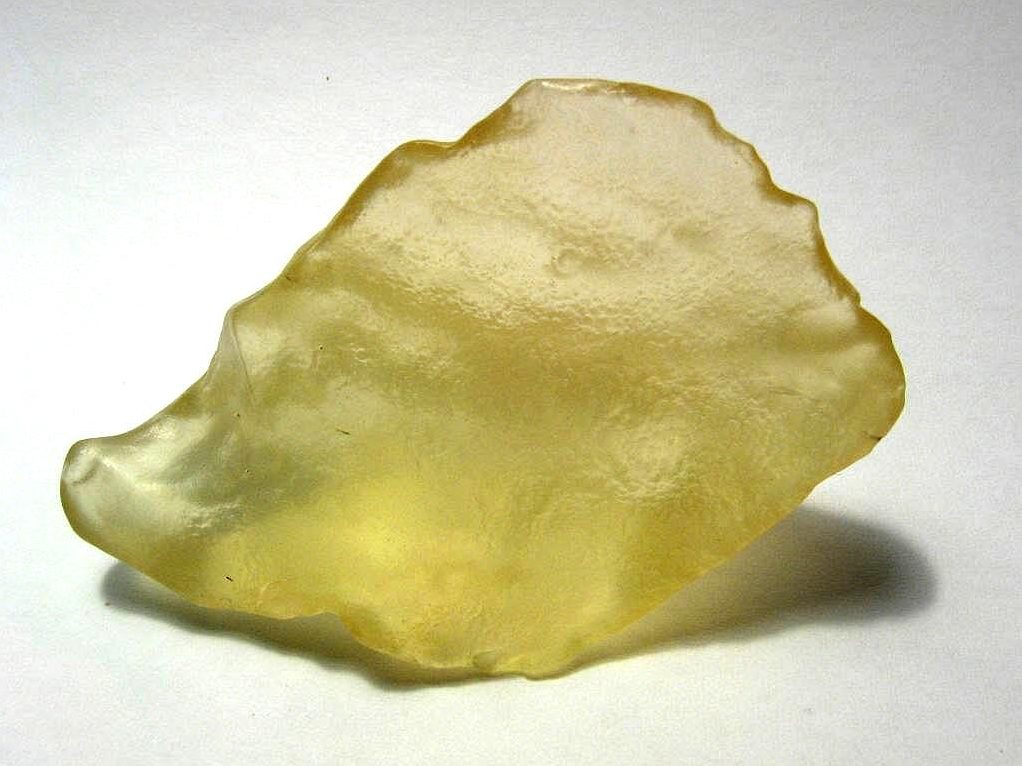
Libyan Desert Glass
A pale yellow cosmic glass from the Sahara, used in Tutankhamun's breastplate and formed by a mysterious ancient impact or airburst.
- The scarab in Tutankhamun's breastplate is the most famous piece of Libyan Desert Glass ever worked - making it arguably the most historically significant gemstone carving from the ancient world.
- Libyan Desert Glass is approximately 28 million years old - roughly 27 times older than moldavite, the other famous cosmic glass.
- At 98% purity, Libyan Desert Glass is purer than most manufactured silica glass and nearly rivals laboratory-grade fused quartz.
- Prehistoric stone tool artifacts made from Libyan Desert Glass have been found up to 100 kilometers from the strewn field, suggesting active prehistoric trade networks.
- The Great Sand Sea where the glass is found is one of the most remote and inhospitable places on Earth, making legal collection increasingly difficult and expensive.
- Collectors seeking one of Earth's rarest and most historically significant natural glasses
- Egyptian history enthusiasts captivated by the Tutankhamun connection and pharaonic lore
- Solar plexus chakra workers seeking a high-vibration yellow stone with celestial energy
- Advanced spiritual practitioners working with cosmic consciousness or solar alignment
- Serious gemstone investors looking for scarce natural materials with documented provenance
- Budget buyers - authentic Libyan Desert Glass starts at $20 per gram; skip if cost is a concern
- Jewelry buyers wanting a durable daily-wear stone - at Mohs 5.5-6, consider yellow sapphire instead
- Beginners who may be overwhelmed by its rarity and authenticity challenges
What Is Libyan Desert Glass?
Libyan Desert Glass is an extremely pure silica glass found on the surface of the Great Sand Sea, straddling the Libya-Egypt border in the eastern Sahara. Composed of approximately 98% silicon dioxide, it is among the purest natural silica glasses on Earth. It rates 5.5 - 6 on the Mohs hardness scale.
Its pale yellow to yellow-green color comes from trace iron inclusions and minute amounts of rare minerals created under the extreme conditions of its formation.
The origin of Libyan Desert Glass has been debated since its scientific description in 1932. Current consensus favors formation by a cosmic airburst or shallow impact event approximately 28 to 29 million years ago.
The incoming body - whether a comet or asteroid - generated temperatures exceeding 2,000°C that fused the desert sand into glass without leaving a crater. Some researchers have proposed a cometary airburst similar to the Tunguska event but far more energetic.
The glass occurs in a strewn field of roughly 6,500 square kilometers and has been collected from the surface for centuries - ancient peoples clearly recognized its unusual beauty and workability. Specimens range from pale straw yellow to rich amber gold, and the finest pieces are nearly as transparent as window glass.
Total global supply is finite and diminishing as surface material is collected and export becomes increasingly restricted.
How Libyan Desert Glass Compares
| Property | Libyan Desert Glass | Yellow Sapphire | Citrine |
|---|---|---|---|
| Hardness | 5.5 - 6 | 9 | 7 |
| Price | $ Budget | $$ Mid-range | $ Budget |
| Rarity | Extremely Rare | Uncommon | Common |
| Best For | Collecting, spiritual | Fine jewelry | Everyday spiritual |
Meaning and Symbolism
The most famous piece of Libyan Desert Glass ever found is the carved scarab in Tutankhamun's ceremonial pectoral breastplate, now housed in the Egyptian Museum in Cairo. When Howard Carter excavated Tutankhamun's tomb in 1922, the pale yellow stone in the scarab was initially misidentified as chalcedony.
Only in 1998 did geologist Vincenzo de Michele confirm it as Libyan Desert Glass - establishing that ancient Egyptians prized this material enough to use it in royal funerary regalia.
Ancient peoples of the Sahara worked Libyan Desert Glass into tools and ornamental objects long before the pharaonic period. Prehistoric flakes and tools made from the glass have been found throughout the strewn field, suggesting it was recognized as an exceptional cutting material for at least 100,000 years.
The combination of its otherworldly appearance and practical utility made it uniquely valuable.
In contemporary crystal healing tradition, practitioners associate Libyan Desert Glass with solar energy, personal power, and access to ancient wisdom. Many believe it carries an encoded memory of both earthly and cosmic history, making it a bridge between human consciousness and stellar time.
Its connection to Tutankhamun and Egyptian royalty has cemented its status as a stone of spiritual nobility and divine connection.
Historical Timeline
Healing Tradition
Emotional
Practitioners believe Libyan Desert Glass carries the emotional energy of the sun - warming, clarifying, and empowering. Crystal healing tradition suggests it helps dissolve self-doubt and emotional stagnation, replacing hesitation with a solar-plexus confidence that many find both calming and invigorating.
Working with it is said to align one's emotional center with a higher sense of purpose, stripping away the accumulated doubts and fears that accumulate over time.
Many find that holding Libyan Desert Glass during moments of creative block or indecision brings a felt sense of solar clarity - as if a light inside has been turned up. It is traditionally recommended for those recovering their sense of personal worth after loss or betrayal.
Spiritual
Crystal healing tradition holds that Libyan Desert Glass carries an ancient celestial memory encoded at the moment of its creation millions of years ago - a record of cosmic forces far older than human civilization.
Practitioners believe meditating with this glass connects the practitioner to the Akashic field of universal information, with particular resonance for those drawn to Egyptian spirituality, past-life work, or solar initiatory traditions.
Many find that it activates the solar plexus and crown chakras simultaneously, creating an energetic pillar from personal will to divine intelligence. The Tutankhamun connection makes it especially potent for anyone working with themes of sacred kingship, divine purpose, or royal self-authorization. Its energy is described as regal, warm, and expansive.
Physical
In traditional crystal healing, Libyan Desert Glass is associated with digestive vitality and the solar plexus region of the body, which governs digestion, metabolism, and personal power in energetic frameworks.
Practitioners suggest placing it over the solar plexus during relaxation or breathwork to support the body's natural energetic flow in this area, though no scientific evidence supports any physical health claim.
Its warm, solar energy is said to lift physical vitality and support the adrenal system - an association based on its golden color and traditional fire-element correspondence rather than clinical research. Always consult a qualified healthcare provider for health concerns.
Zodiac, Birthstone and Gifts
Leo, ruled by the Sun and associated with solar royalty and radiant self-expression, finds a perfect ally in Libyan Desert Glass. The stone's golden color, solar energy, and royal historical connection to Tutankhamun align naturally with Leo's themes of nobility, creative power, and authentic self-expression.
Practitioners believe it amplifies Leo's natural leadership gifts and helps the Lion step into their highest potential without fear of being seen.
Aries benefits from Libyan Desert Glass as a catalyst for courageous new beginnings, lending its ancient solar power to the Ram's pioneering spirit. Crystal healers traditionally recommend it for Aries during periods of launching new ventures or stepping into unfamiliar leadership roles, suggesting it provides both the cosmic blessing and the solar-plexus confidence needed for bold action.
Care and Cleansing
Libyan Desert Glass is safe for brief water rinsing and sunlight charging - appropriate given its desert and solar origins. A few seconds under cool running water followed by a few hours in direct sunlight is a symbolically resonant and practically effective cleansing method. Avoid prolonged saltwater soaking.
Selenite charging plates are ideal for overnight energetic cleansing without water contact. Alternatively, burying the specimen briefly in dry sand - a nod to its Saharan birthplace - is a creative traditional option. Moonlight charging works as well, particularly during a full moon in Leo or Aries.
- DO NOT use ultrasonic or steam cleaners - glass structures are vulnerable to vibration and thermal shock.
- DO store wrapped in soft cloth away from harder gemstones that can scratch it.
- DO NOT subject to rapid temperature changes - thermal shock can crack natural glass.
- DO handle faceted or thin-edged specimens with care - glass fractures conchoidally and edges can be sharp.
- NOTE: Export from Libya and Egypt is restricted; always verify legal provenance before purchasing.
- DO NOT confuse with artificial yellow glass or slag - verify with a reputable mineralogical dealer.
Real vs Fake
Libyan Desert Glass fakes are less common than moldavite fakes, but manufactured yellow glass and slag glass are sometimes sold under this name. Authentic material has a pale lemon to golden-yellow color, high transparency or translucency, and shows flow structures and elongated bubbles under magnification - just like other tektites.
The specific gravity of Libyan Desert Glass is approximately 2.21 g/cm3 - unusually light for a glass because of its high silica content and vesicular structure. A piece that feels noticeably heavy for its volume is suspicious.
Authentic specimens are found exclusively in the Great Sand Sea region and should come with provenance documentation from a verified collector or dealer.
Laboratory testing is the definitive method for confirmation: the nearly pure SiO2 composition of genuine Libyan Desert Glass produces a distinctive trace element fingerprint that can be confirmed by X-ray fluorescence analysis. For high-value purchases, requesting an independent gemological analysis is a reasonable precaution given the stone's price per gram.
Libyan Desert Glass Jewelry & Gifts
Libyan Desert Glass is expensive and becoming more so as surface material in the strewn field is depleted and export regulations tighten. Raw natural pieces in small sizes (under 10 grams) typically cost $20 to $60 per gram from reputable mineral dealers.
Larger, cleaner, high-transparency pieces can reach $80 to $150 per gram.
Faceted gemstones cut from Libyan Desert Glass are rare and command significant premiums due to the material wasted in cutting and the scarcity of gem-quality transparent pieces. A well-cut faceted stone of 5 carats or more from a named cutter typically sells for several hundred dollars.
Purchase only from established mineral dealers with documented provenance - ideally pieces collected before recent export restrictions. Request information about the collection locality within the Great Sand Sea and any associated documentation. Be cautious of any vendor who cannot explain the provenance chain or offers prices far below the market rate.
Where to Buy Libyan Desert Glass
Affiliate disclosure: Some links below earn us a small commission at no extra cost to you. See our affiliate disclosure page.
Handmade, raw, and tumbled pieces from independent sellers worldwide.
Shop Libyan Desert Glass on Etsy →Accessories, tools, and specimen sets with fast Prime delivery.
Shop Libyan Desert Glass on Amazon →Certified loose gemstones graded and photographed for online buyers.
Shop Libyan Desert Glass on GemSelect →Pairs Well With


Where Libyan Desert Glass Is Found

