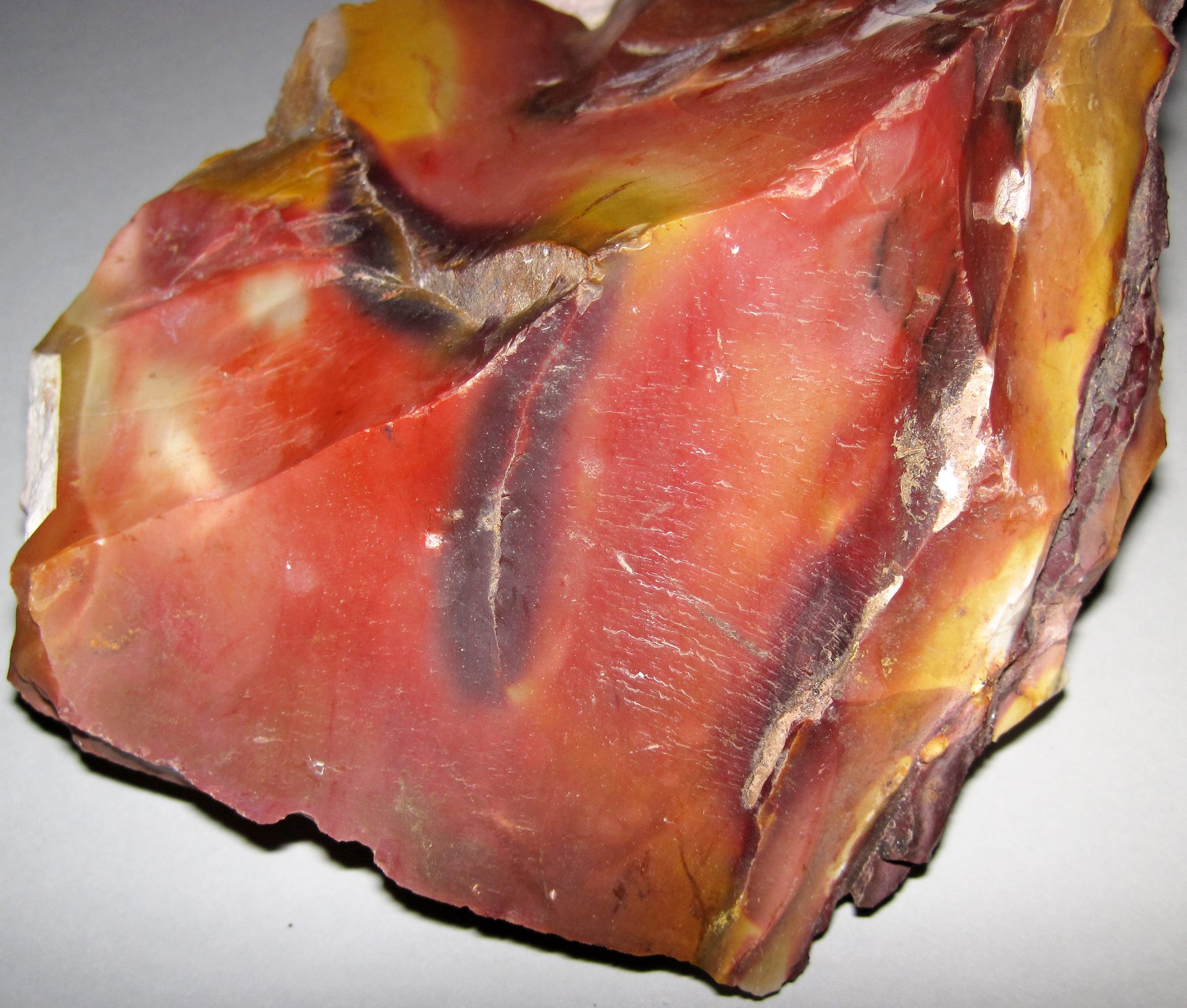
Mookaite
Mookaite blazes with Australia's outback in mineral form - swirling reds, yellows.
- Mookaite contains visible fossil radiolarian skeletal remains - the tiny silica structures of ancient marine microorganisms visible under magnification as circular or star-shaped fossils.
- The name mookaite derives from the Aboriginal word 'mooka' meaning 'running waters' - referring to Mooka Creek where the stone is found.
- Because mookaite is found in a national park, commercial mining operates under strict permits; the limited supply contributes to its moderate scarcity despite relatively affordable prices.
- Mookaite's color range in a single specimen - deep red through bright yellow to purple - is extraordinary among jaspers and makes each piece visually unique.
- At approximately 160 million years old, the radiolarian organisms in mookaite were living creatures during the age when the dinosaurs roamed the supercontinent of Gondwana.
- Those drawn to bold, earthy color stones that carry a sense of ancient land energy
- Crystal practitioners seeking a lower chakra grounding and energizing stone with visual drama
- Australia-connected individuals or those with ties to indigenous earth wisdom traditions
- Collectors building a collection of regionally exclusive stones with geographic identity
- Gift seekers wanting a genuinely distinctive, colorful, and durably wearable natural stone
- Those seeking soft, gentle feminine energy - mookaite is bold, vital, and earthy rather than delicate
- Buyers wanting a stone from a globally distributed source - mookaite comes only from one Australian creek valley
- Those wanting precise chakra targeting - mookaite works across multiple lower chakras simultaneously
What Is Mookaite?
Mookaite is a colorful *chert or jasper* composed primarily of microcrystalline silica (SiO2) colored by iron oxides, organic matter, and the fossilized remains of radiolarians - tiny ancient marine organisms whose skeletal silica accumulated in shallow sea beds in Western Australia approximately 150 to 165 million years ago during the Jurassic period.
The stone is found exclusively in and around Mooka Creek in Kennedy Range National Park, Western Australia, making it one of the most geographically restricted gemstone sources on Earth.
The extraordinary color range of mookaite - swirling combinations of deep red, burnt orange, bright yellow, cream, purple, and mauve within a single specimen - results from varying concentrations of iron oxide minerals and the organic content of the original radiolarian sediment. No two mookaite specimens show exactly the same color pattern.
The stone polishes to a smooth, waxy luster that enhances the color flow and makes it particularly attractive for jewelry and decorative carving.
**Hardness of 6 to 7** makes mookaite durable enough for jewelry including rings and bracelets, though the range within the stone means some areas may be softer than others.
It is a highly regarded stone in the international lapidary community for its exceptional color combination and the dramatic visual impact of polished cabochons. Indigenous Australians regard the Mooka Creek area as a significant sacred site, and the stone carries this cultural context as part of its identity.
How Mookaite Compares
| Property | Mookaite | Red Jasper | Brecciated Jasper |
|---|---|---|---|
| Color Range | Red, yellow, purple, cream (all in one) | Solid red | Red and cream mixture |
| Origin | Western Australia only | Global | Global |
| Hardness | 6 - 7 | 6.5 - 7 | 6.5 - 7 |
| Best For | Energy + grounding, bold jewelry | Grounding, stability | Vitality, dynamic energy |
Meaning and Symbolism
Mookaite's sacred context begins with the Macumba and other Aboriginal peoples of Western Australia, for whom the Kennedy Range area has deep spiritual significance.
Aboriginal oral traditions connect the land and its minerals to the Dreamtime - the complex cosmological framework describing the origins of the world, of people, and of the laws that govern life.
The stone's multicolored appearance is sometimes described in these contexts as encoding the diversity of life forms in the ancient sea that existed where the Kennedy Range now stands.
In contemporary crystal healing, mookaite is associated with ancestral wisdom, connection to Earth's deep time, and the courage to face change with flexibility rather than rigidity.
Its multiple colors are interpreted as representing the full spectrum of human experience - joy and struggle, clarity and mystery, vitality and rest - within a single integrated stone. Practitioners describe it as teaching the wholeness of experience rather than seeking only the pleasant parts.
**The lower chakra associations** reflect mookaite's emphasis on embodied vitality - being fully alive in the physical body, connected to ancestral lineage, and motivated by genuine instinct and desire rather than conditioned responses. It is a stone practitioners use during life transitions to maintain both adaptability and rootedness simultaneously.
Historical Timeline
Healing Tradition
Emotional
Practitioners associate mookaite with the courage to embrace change while remaining rooted in one's essential nature - the emotional combination of flexibility and groundedness. Its multiple warm colors are said to activate vitality, motivation, and the instinctual body-wisdom that helps navigate uncertainty from a centered rather than fearful place.
Many find it supportive during major life transitions - career changes, relationship shifts, geographical moves - where both boldness and stability are simultaneously needed. Crystal healing tradition describes it as awakening the 'adventurous self' that can meet the unknown with enthusiasm rather than anxiety.
Spiritual
In spiritual practice, mookaite is associated with ancestral healing, connection to indigenous wisdom traditions, and the body of knowledge encoded in the land itself.
Practitioners believe its radiolarian fossil content carries a direct connection to ancient life forms and the unbroken chain of biological evolution - a physically tangible link to Earth's deep time.
Some traditions use it in practices focused on ancestral lineage healing, particularly around the reclamation of indigenous or earth-based spiritual wisdom suppressed by colonization. Its Aboriginal sacred site origin gives it a specific cultural context that practitioners are encouraged to hold with appropriate respect.
Physical
Crystal healing texts associate mookaite with the immune system, digestive health, and the physical body's adaptive vitality through its lower chakra connections. The stone's multiple warm colors are said to activate multiple body systems simultaneously, making it popular for general physical vitality practices.
Some practitioners use it to support recovery from chronic fatigue or to activate the body's own self-healing capacity during convalescence. These associations are metaphysical in nature.
Zodiac, Birthstone and Gifts
Leo's solar vitality and bold creative self-expression resonate with mookaite's dramatic colors and its association with the courage to live fully and visibly. The stone's warm reds and yellows mirror Leo's solar fire energy.
Virgo's earth element and its connection to physical health and practical wisdom align with mookaite's grounding lower chakra energy and its indigenous wisdom associations.
Scorpio's deep connection to ancestral patterns, transformative capacity, and the wisdom that emerges from engaging with the full spectrum of experience - including its darkest aspects - finds a natural resonance with mookaite's complex multi-color story of ancient sea life and sacred land.
All three signs benefit from the stone's combination of bold vitality, earthly grounding, and wisdom drawn from depth.
Care and Cleansing
Mookaite tolerates all standard cleansing methods without concern. Water rinsing is safe - at hardness 6 to 7 the stone is chemically stable and physically durable. Mild soap and a soft brush will clean the surface effectively. Dry thoroughly after washing.
**Sunlight** is particularly appropriate for mookaite given its solar, earth, and fire element associations - placing it in morning sunlight on a natural surface (wood, stone, earth) connects the cleansing to the stone's indigenous land energy in a symbolically resonant way.
Smudging with native Australian plants like eucalyptus when available is a culturally respectful cleansing option. Sound cleansing and selenite plates are appropriate for regular maintenance.
- DO clean with mild soap, warm water, and a soft brush; rinse and dry fully.
- DO NOT use ultrasonic cleaners on specimens with visible inclusions or fractures.
- DO store away from harder stones like diamonds or corundum that can scratch the surface.
- NOTE: Color patterns vary significantly between specimens - photograph your stone for comparison if you receive it damaged.
- DO handle with care for carved or delicate thin-section pieces - standard jasper durability applies.
- NOTE: Mookaite is found only in Kennedy Range National Park - confirm authentic Australian origin before purchasing.
- DO enjoy direct handling and use - mookaite's durability supports active use in practice.
Real vs Fake
Genuine mookaite is a siliceous sedimentary rock with opaque, swirling patterns of multiple warm colors. The color patterns show organic, geological flow - irregular curved bands, mottled zones, and color gradients that follow the natural rock formation.
Under magnification, radiolarian fossil fragments may be visible as small circular structures embedded in the matrix. The surface should feel smooth but slightly waxy after polishing.
Some colorful jaspers and cherts from non-Australian sources are occasionally sold as mookaite or 'similar to mookaite.' True mookaite from Mooka Creek has a specific color palette - particularly the combination of warm maroon-red, bright yellow, and lavender-purple in the same specimen - that is difficult to replicate from other sources.
The purple-and-red-and-yellow combination in particular is highly characteristic.
**Weight and translucency** help confirm jasper identification - mookaite is opaque throughout with no internal light transmission visible even in thin sections. Glass fakes would show different optical behavior. Geographic documentation of Australian origin is the most reliable confirmation for significant purchases.
Mookaite Jewelry & Gifts
Mookaite quality is primarily assessed by color richness and the visual drama of the swirling pattern. The most prized specimens show multiple distinct colors - particularly when vivid red, bright yellow, and purple appear together in a single piece with clear, swirling contrast.
Pale or muddy specimens with primarily cream and dull tan coloring are lower quality. Cabochons cut to maximize the color pattern are typically higher priced than simply cut pieces.
Prices are very accessible for this geographically restricted stone: small tumbled stones sell for $5 to $20; quality medium cabochons for $15 to $50; larger display pieces and high-quality carved forms for $30 to $100. The relatively affordable price reflects adequate but restricted supply from the Australian national park source.
**Buy from dealers who know the Australian source** and can specifically confirm the stone is from the Mooka Creek / Kennedy Range area. Generic 'Australian jasper' without specific locality documentation may be a different material. The stone is widely distributed through Australian gem and mineral exporters with established international relationships.
Where to Buy Mookaite
Affiliate disclosure: Some links below earn us a small commission at no extra cost to you. See our affiliate disclosure page.
Handmade, raw, and tumbled pieces from independent sellers worldwide.
Shop Mookaite on Etsy →Accessories, tools, and specimen sets with fast Prime delivery.
Shop Mookaite on Amazon →Certified loose gemstones graded and photographed for online buyers.
Shop Mookaite on GemSelect →Pairs Well With


Where Mookaite Is Found
