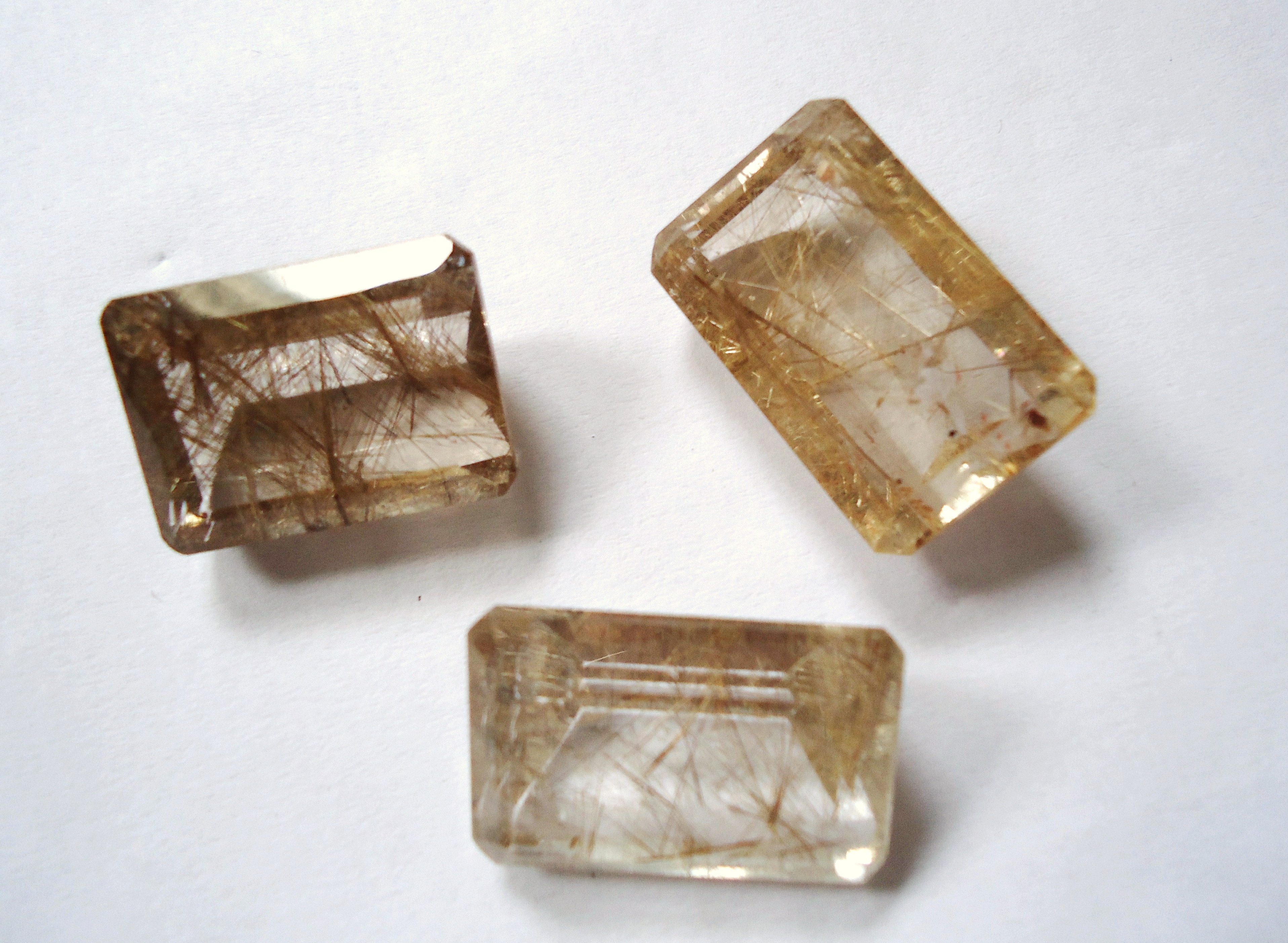
Rutilated Quartz
Shot through with golden rutile needles, rutilated quartz is the crystal of focused ambition and illuminated purpose.
- The golden needles in rutilated quartz are pure rutile, the same titanium mineral used in white pigment and sunscreen.
- Rutile inclusions can grow so long they exit the quartz host entirely, leaving protruding needles.
- Star sapphires owe their asterism to the same rutile needle mineralogy visible in rutilated quartz.
- The finest rutilated quartz often comes from Novo Horizonte and Diamantina in Brazil's Bahia and Minas Gerais states.
- Some rare specimens contain both rutile and tourmaline needles in the same quartz host.
- Readers drawn to an inclusion-rich crystal with visible golden fibers
- Solar plexus practitioners wanting a stone associated with confident direction
- Collectors who appreciate angel hair and Venus hair specimen patterns
- Meditators seeking a clear quartz variant with strong visual focal points
- Gift givers wanting an affordable alternative to citrine for ambition work
- Buyers wanting perfectly clean transparent quartz (try classic clear quartz or herkimer diamond)
- Those who dislike visible needle inclusions (try smoky quartz or rose quartz)
- Fine-jewelry engagement shoppers (try yellow sapphire or imperial topaz)
What Is Rutilated Quartz?
Rutilated quartz is transparent or translucent clear quartz threaded with needle-like crystals of rutile, a titanium dioxide mineral. The rutile inclusions can appear golden, copper, silver, reddish, or black, depending on trace impurities. These acicular needles often form dense sprays, parallel bundles, or star-like clusters inside the host quartz.
Host quartz scores Mohs 7 while the embedded rutile is a slightly softer 6 to 6.5. Rutile crystallizes first, then the surrounding quartz envelopes the needles during later silica-rich fluid events.
The stone has carried several poetic names across cultures: Venus hair stone, angel hair, fleches d'amour (arrows of love), and sagenitic quartz. Clear quartz hosts with exceptionally dense or aesthetically arranged needles command the highest prices.
Most commercial rutilated quartz on the market is untreated, which is unusual for the quartz family. The visual drama comes from natural mineralogy rather than heat, irradiation, or coating.
Cutters typically orient the rough to showcase the most striking needle pattern, often producing cabochons, freeform polished pieces, and step-cut faceted stones with large open tables.
How Rutilated Quartz Compares
| Property | Rutilated Quartz | Tourmalinated Quartz | Clear Quartz |
|---|---|---|---|
| Hardness | 7 | 7 | 7 |
| Inclusions | Golden rutile needles | Black tourmaline needles | None (ideal) |
| Price / carat | $ Budget | $ Budget | $ Budget |
| Best For | Ambition, focus work | Protection grounding | Amplification, clarity |
Meaning and Symbolism
Rutilated quartz has been treasured across cultures for the striking appearance of its golden threads. Renaissance Europeans called it fleches d'amour, or arrows of love, believing the inclusions represented Cupid's arrows captured in crystal. Classical Roman writers referred to similar needle-threaded stones in descriptions of Venus's hair.
In crystal healing tradition, the stone is traditionally associated with the solar plexus chakra and with focused, ambitious action. Practitioners describe the rutile needles as channels of illuminating energy, said to carry clarity through confusion and disperse stagnant patterns. The golden variants are most often linked with drive and confidence.
Many modern crystal workers position rutilated quartz as a manifestation stone, said to amplify intentions set during meditation because the host quartz is considered an amplifier in its own right. The rutile is framed as the directional signal within that amplifier.
The stone is also used in decision-making rituals and has long been associated with cutting through indecision. Readers drawn to solar work sometimes pair it with citrine for warmth or with pyrite for more grounded action orientation.
Historical Timeline
Healing Tradition
Emotional
Practitioners believe rutilated quartz supports emotional clarity and the lifting of what crystal workers describe as mental fog. The golden needles are traditionally associated with steady optimism, and the stone has long been used during periods of indecision or emotional reshuffling.
Many readers keep a rutilated quartz piece nearby during career transitions, with the stone framed as a reminder to stay pointed toward goals rather than diffused across worries. Crystal healing tradition associates the combination of rutile and quartz with illuminated willpower.
Spiritual teachers sometimes pair rutilated quartz with rose quartz for balance between drive and tenderness. Practitioners often recommend it for people pulled between too many priorities, with the stone considered a solar plexus support for choosing one path without guilt.
Spiritual
In crystal healing tradition, rutilated quartz is linked with both the solar plexus chakra and the crown chakra. Practitioners describe the rutile needles as antennae, said to draw down higher guidance while the quartz amplifies the signal through the body.
Many readers use rutilated quartz during journaling, meditation, and visualization practices focused on long-term vision work. The stone has long been used by those setting year-ahead intentions, and it is considered especially supportive during new moon or solar return rituals.
Crystal workers sometimes place rutilated quartz in the center of a grid with clear quartz points radiating outward as amplification, and citrine along the edges for warm manifestation support.
Physical
Practitioners believe rutilated quartz supports what they describe as steady energy and vital focus. Crystal healing tradition associates the stone with overall nervous system ease and the capacity to move through long work days without scattering.
Many readers wear rutilated quartz as a pendant near the solar plexus during demanding weeks, a practice framed as supportive rather than therapeutic. The stone is not a substitute for medical care, and practitioners should frame its role as companioning rather than curing.
Crystal workers sometimes recommend rutilated quartz during recovery from exhaustion, treating it as a stone of gentle re-ignition rather than forceful stimulation. Traditional lore associates the solar plexus with digestive rhythm, and the stone is often kept on desks during slow rebuilding phases.
Zodiac, Birthstone and Gifts
Rutilated quartz is not a traditional birthstone, but astrologers commonly recommend it for Gemini (for mental clarity across many interests), Taurus (for patient manifestation), and Leo (for the solar confidence associated with the golden needles).
The stone is sometimes paired with solar return rituals regardless of sign, with practitioners describing it as a birthday-year amplifier for clarity of purpose. Many readers wear rutilated quartz during Saturn return and other long-cycle astrological transitions.
Care and Cleansing
Rutilated quartz tolerates most common cleansing methods because the host quartz is hard and chemically stable. Warm soapy water with a soft cloth works well for physical cleaning, and brief rinses in running tap water are safe for energetic cleansing.
Smoke cleansing with palo santo or sage is a gentle daily option favored by many practitioners.
Moonlight charging is widely recommended, especially at the full moon, because practitioners describe quartz-family stones as receptive to lunar frequency. Brief morning sunlight is also safe because rutile and quartz both have stable color and do not fade.
Dry salt cleansing is fine, and saltwater soaks are tolerated for short periods though not ideal for settings.
Crystal workers sometimes cleanse rutilated quartz by placing it on a bed of clear quartz points overnight, a method considered especially suited to this stone because of the shared quartz chemistry.
- DO clean rutilated quartz with warm soapy water and a soft brush for stubborn residue.
- DO NOT subject the stone to thermal shock (sudden hot-to-cold transitions) as it can fracture along inclusion planes.
- DO store separately from harder gems like diamond, sapphire, and ruby to prevent surface scratches.
- DO NOT use harsh chemical cleaners such as bleach or strong acids on rutilated quartz.
- DO remove rutilated quartz jewelry before heavy impact activities despite its reasonable hardness.
- DO ask your seller whether the piece is natural or assembled (some doublet imitations exist).
- Note: dense needle bundles can act as weak planes; handle faceted stones with care during setting.
Real vs Fake
Genuine rutilated quartz shows internal rutile needles that appear metallic and angular under magnification. The needles are typically straight, with some showing slight curvature and occasional branching. Natural specimens often display parallel growth patterns, star-like sprays, or crossed needle bundles that reflect the underlying crystallography.
Common imitations include glass with gold-colored fiber inclusions, resin casts with embedded fibers, and assembled doublets pairing clear quartz tops with colored backing. Glass imitations often show curved gas bubbles, swirl marks, and fibers that look too uniform or too glittery.
Natural rutile needles reflect light with a distinct metallic luster and have crisp angular terminations, while synthetic fibers tend to look plastic or waxy under a 10x loupe. Authentic specimens also show the characteristic specific gravity of quartz around 2.65 to 2.70.
Under UV light, rutilated quartz is typically inert while many resin imitations fluoresce. For practical at-home checks, examine the inclusions under magnification for angular terminations, check the surface for quartz's characteristic conchoidal fracture, and verify the cool temperature feel of genuine mineral versus the warmer touch of resin or glass.
High-value specimens should be verified by a qualified gemologist who can confirm the titanium oxide composition of the needles.
Rutilated Quartz Jewelry & Gifts
Rutilated quartz is one of the more affordable collector crystals. Commercial tumbled pieces run $5 to $25, small cabochons and pendants typically price at $15 to $80, and large faceted specimens with exceptional needle patterns can reach $100 to $300 per carat.
Top museum-grade specimens with dense golden starbursts or perfectly parallel needle sprays command the highest premiums, especially in sizes above 10 carats.
Look for strong contrast between the clear host quartz and the visible rutile needles, good transparency through the quartz, and aesthetic needle arrangement that cuts showcase effectively.
Brazilian material from Novo Horizonte and Diamantina is considered the world benchmark for gem-quality specimens, with Madagascar supplying abundant secondary commercial material at moderate prices.
Where to Buy Rutilated Quartz
Affiliate disclosure: Some links below earn us a small commission at no extra cost to you. See our affiliate disclosure page.
Handmade, raw, and tumbled pieces from independent sellers worldwide.
Shop Rutilated Quartz on Etsy →Accessories, tools, and specimen sets with fast Prime delivery.
Shop Rutilated Quartz on Amazon →Certified loose gemstones graded and photographed for online buyers.
Shop Rutilated Quartz on GemSelect →Pairs Well With


Where Rutilated Quartz Is Found


