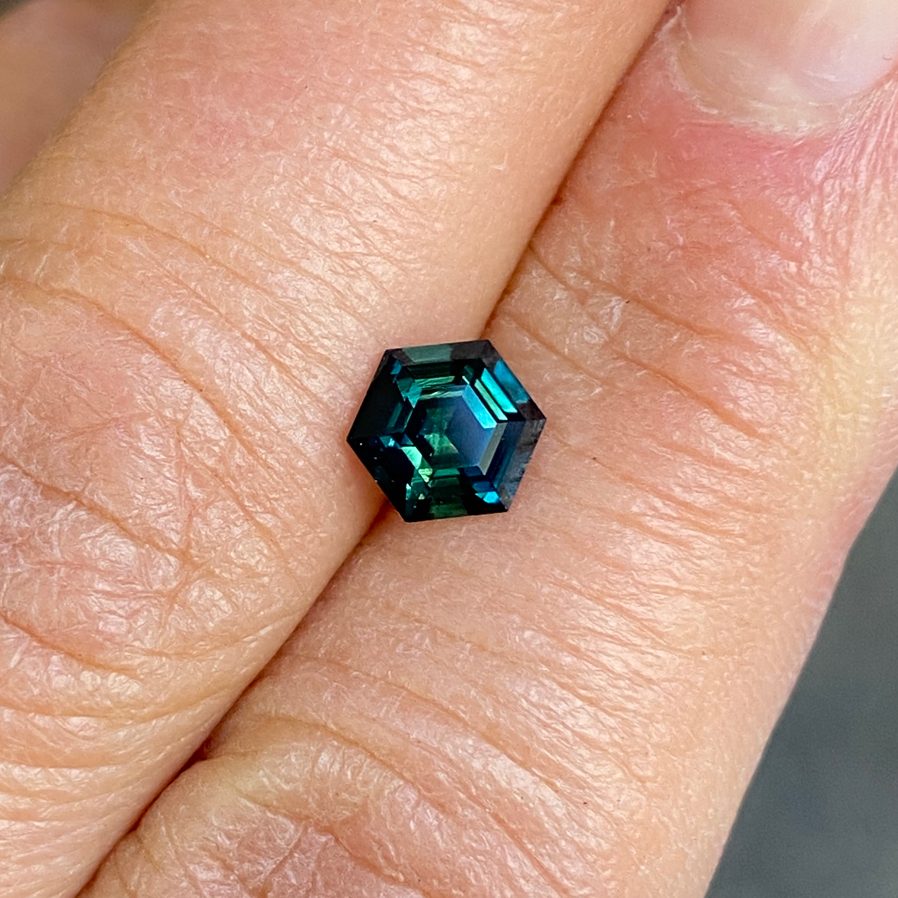
Teal Sapphire
Sapphire's blue-green spectrum has become the defining gem of contemporary fine jewelry - cool, unique, and impossible to ignore.
- Montana teal sapphires are among the only commercially significant sapphires in the USA and carry a strong patriotic provenance premium in the American market.
- The color teal is named after the Eurasian teal duck, whose iridescent head feathers show the same blue-green spectrum that gives these sapphires their name.
- Some teal sapphires are also slightly color-change, appearing more blue in one light and more green in another - adding a bonus phenomenon to their already striking color.
- Heat treatment often destroys teal sapphire's characteristic color, pushing it toward pure blue or pure green - which is why unheated teal specimens are particularly prized.
- Aquamarine and teal sapphire look similar to the eye but are entirely different minerals with dramatically different hardness: sapphire at Mohs 9 versus aquamarine at 7.5 to 8.
- Engagement ring buyers seeking a distinctive, highly durable alternative to traditional blue sapphire
- Design-forward jewelry shoppers attracted to the teal-to-blue-green spectrum's modern aesthetic
- Heart and throat chakra workers wanting a gem-grade stone with strong dual-chakra energy
- Montana sapphire collectors drawn to the USA provenance and natural unheated material
- Aquarius and Libra individuals resonating with teal's air-water balance energy
- Budget shoppers - quality teal sapphires start at $150 per carat; consider chrysocolla for a budget teal option
- Traditional jewelry buyers who prefer classic blue - teal's blue-green character is distinctly non-traditional
- Anyone needing a specific stable color for matching - teal sapphires vary from more blue to more green across specimens
What Is Teal Sapphire?
Teal sapphire is corundum in the blue-green color zone, where iron, titanium, and sometimes vanadium combine to produce hues ranging from seafoam through teal to deep ocean green-blue. It rates 9 on the Mohs hardness scale.
While not a formally distinct sapphire variety by gemological classification - it sits within the blue-to-green corundum spectrum - teal sapphire has become a distinct market category driven by extraordinary demand from the contemporary jewelry design world.
The color range is wide: teal sapphires can appear more blue than green (closer to a deep blue-teal), evenly balanced (true teal), or greener (teal to blue-green). Montana sapphires from the USA are especially prized for their natural, unheated teal and blue-green tones that range from steel-blue to vivid teal.
Madagascar and Sri Lanka produce teal material as well, much of it heat treated to optimize the blue-green balance.
Teal sapphires surged in popularity with the engagement ring market beginning around 2015 as couples sought distinctive alternatives to classic blue. The color's association with both the sea and sky makes it feel simultaneously timeless and fresh.
At Mohs 9, teal sapphires are as durable as blue sapphires, making them fully practical for engagement rings and everyday jewelry.
How Teal Sapphire Compares
| Property | Teal Sapphire | Aquamarine | Teal Tourmaline |
|---|---|---|---|
| Hardness | 9 | 7.5 - 8 | 7 - 7.5 |
| Price / carat | $$ Mid-range | $ Budget | $$ Mid-range |
| Color | Blue-green to teal | Pale blue-green | Teal, indicolite |
| Best For | Engagement rings, fine jewelry | Pendants, earrings | Spiritual use, jewelry |
Meaning and Symbolism
Teal occupies the liminal space between blue and green - between sky and sea, between logic and emotion, between thought and feeling. This threshold quality makes teal sapphire a stone of integration in crystal healing tradition, said to support those who must navigate between different worlds, roles, or ways of knowing.
In Vedic tradition, blue-green gemstones are associated with Mercury and the planet's gifts of communication, travel, and adaptability. The teal spectrum's proximity to turquoise and aquamarine links it to ancient traditions associating these sea-colored stones with protection during journeys - physical, emotional, and spiritual.
Contemporary crystal practitioners value teal sapphire for its perceived ability to harmonize the heart's compassion with the throat's clear expression. Many find it useful for improving communication in relationships - especially for conversations that require both emotional openness and clear, honest articulation.
It is said to dissolve the gap between what one feels and what one is able to say.
Historical Timeline
Healing Tradition
Emotional
Practitioners believe teal sapphire harmonizes the heart and throat centers, dissolving the common blockage between what one feels deeply and what one is able to express clearly.
Crystal healing tradition associates it with emotional courage in communication - not aggression, but the gentle bravery to say true and important things with warmth rather than defensiveness.
Many find that working with teal sapphire during periods of relational difficulty helps them access what they genuinely feel and find the words to express it authentically. It is said to support emotionally intelligent conversation, the kind that acknowledges feeling without being overwhelmed by it.
Its aquatic color is associated with emotional fluidity and adaptability - the ability to flow around obstacles rather than shattering against them.
Spiritual
In crystal healing tradition, teal sapphire is associated with the bridge between heart-centered spiritual awareness and the ability to express and share that awareness in the world. Practitioners believe it supports spiritual teachers, healers, and communicators who need to translate deep inner experience into language that reaches and resonates with others.
It is said to activate a pathway between the heart chakra's unconditional love and the throat chakra's gift of articulation, supporting those who feel called to serve through speaking, writing, or creative expression of spiritual wisdom.
Many find it useful during periods of searching for one's true vocation - a time when knowing what one values (heart) and how to offer it (throat) are both equally important.
Physical
Crystal healing tradition associates teal sapphire with the throat and thyroid in an energetic framework, reflecting its throat chakra correspondence. Some practitioners use it during energy work focused on thyroid balance or immune function in a holistic context, though no scientific evidence supports any specific physical claim.
Its water-air element correspondence is also linked in crystal lore to the respiratory and circulatory systems - the body's fluid and gaseous flow channels. Always consult qualified medical professionals for health concerns.
Zodiac, Birthstone and Gifts
Aquarius, the water bearer who pours wisdom into the world, resonates with teal sapphire's bridging quality between the intuitive water realm and the intellectual air element.
Practitioners believe the stone amplifies Aquarius's visionary gifts while grounding its humanitarian impulses in emotional warmth - a combination the Water Bearer often needs to avoid becoming too detached from the human dimension of its ideals.
Libra, the sign of balance, harmony, and refined aesthetic perception, finds in teal sapphire an ideal companion: a stone that literally embodies balance between two colors and two elemental frequencies.
Crystal healers suggest Libra use it during times requiring both diplomatic communication and genuine emotional honesty - the delicate balance the Scales seek in all their relationships.
Care and Cleansing
Teal sapphire is highly durable and easy to cleanse. Warm soapy water with a soft brush, brief running water rinse, and ultrasonic cleaning (for non-fracture-filled stones) are all safe and effective. The color is permanently embedded in the crystal structure and is unaffected by any standard cleansing method.
Energetically, moonlight and the sound of flowing water are the most symbolically resonant cleansing methods for this sea-colored stone. Setting it near a water feature, a bowl of fresh water (without direct immersion if preferred), or outdoors during rain is a poetic option.
Smudging with ocean-scented herbs like sage or cedar is another gentle choice.
- DO clean regularly with warm soapy water and soft brush.
- DO NOT use ultrasonic cleaners on fracture-filled specimens.
- NOTE: Teal sapphires can appear significantly different under different light sources; always view in natural light before purchase.
- DO request treatment disclosure - unheated teal sapphires (especially Montana material) command premiums.
- DO store away from softer stones that sapphire's Mohs 9 can scratch.
- NOTE: Montana sapphires are naturally unheated and should be purchased with documentation confirming this status.
Real vs Fake
Teal sapphire is sometimes substituted by teal tourmaline, aquamarine, or blue-green glass. A refractometer easily distinguishes them: sapphire reads 1.762 to 1.770, tourmaline 1.624 to 1.644, aquamarine 1.577 to 1.583, and glass varies widely. Any jeweler with basic equipment can confirm identification in minutes.
Lab-created teal sapphire is commercially available and requires inclusion analysis to distinguish from natural material. Natural teal sapphires show mineral inclusions, fine silk rutile needles, and growth zoning under magnification. Synthetic stones show curved striae and gas bubbles.
For valuable engagement ring stones, a gemological laboratories or AGL laboratory report is strongly recommended.
Montana sapphires deserve special attention: their natural, unheated character and USA provenance are primary value drivers. A seller claiming Montana origin should be able to document the mining location and ideally provide a laboratory report confirming the provenance and unheated status.
Ask specifically for this documentation for any Montana sapphire above $300 per carat.
Teal Sapphire Jewelry & Gifts
Teal sapphire prices reflect both color quality and origin. Heat-treated commercial-grade teal sapphires from Madagascar or Australia typically sell for $150 to $350 per carat. Fine, well-balanced true-teal material with vivid saturation and good clarity reaches $400 to $600 per carat with laboratory certification.
Montana sapphires command a significant premium for their natural unheated status and domestic USA origin: $400 to $1,000 per carat for quality unheated Montana teal material with provenance documentation. The premium is justified by the unheated designation and the limited supply from these historically significant deposits.
For engagement rings, prioritize balanced teal over strongly blue or strongly green specimens - a 50/50 blue-green balance is the most visually distinctive and enduring choice. Eye-clean clarity is essential for an engagement ring stone at any price tier.
Always view the stone under natural daylight and indoor lighting before committing to purchase.
Where to Buy Teal Sapphire
Affiliate disclosure: Some links below earn us a small commission at no extra cost to you. See our affiliate disclosure page.
Handmade, raw, and tumbled pieces from independent sellers worldwide.
Shop Teal Sapphire on Etsy →Accessories, tools, and specimen sets with fast Prime delivery.
Shop Teal Sapphire on Amazon →Certified loose gemstones graded and photographed for online buyers.
Shop Teal Sapphire on GemSelect →Pairs Well With



Where Teal Sapphire Is Found


