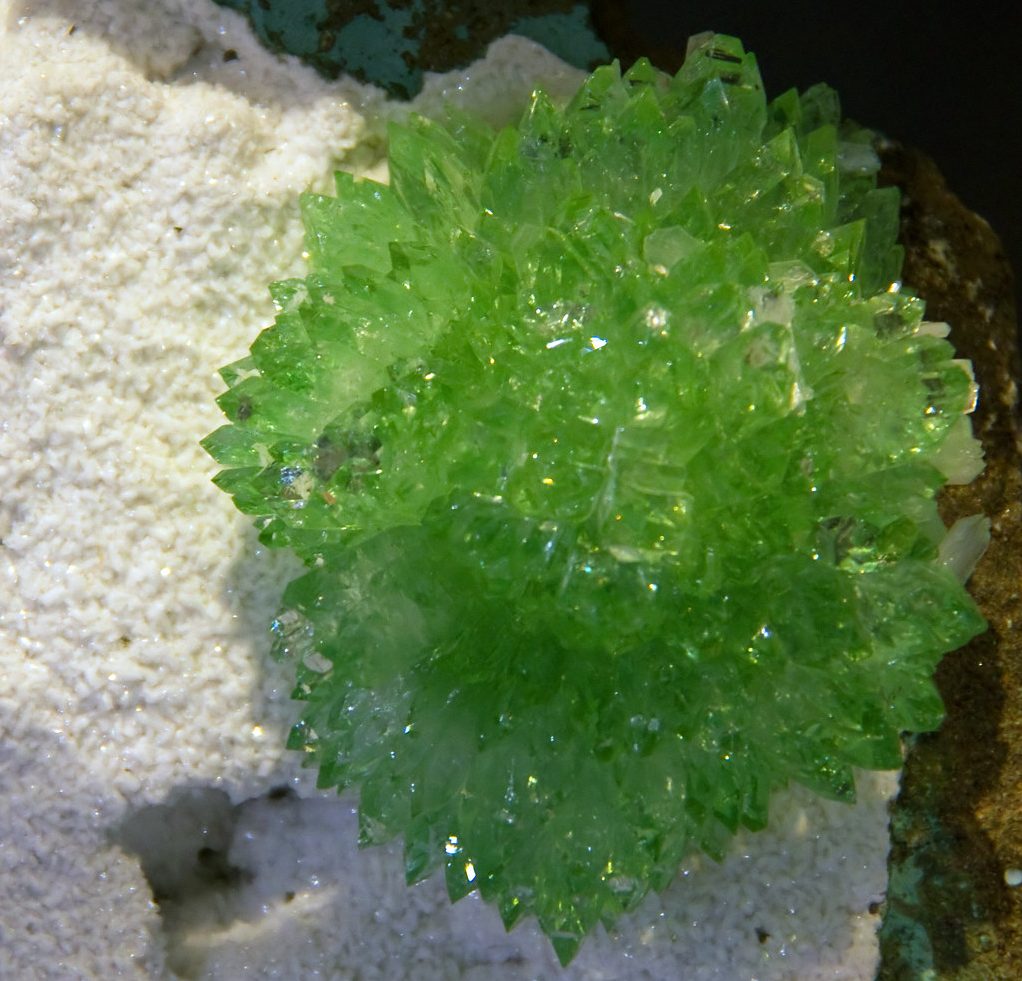
Apophyllite Green
Brilliant green apophyllite pyramidal crystals radiate with inner light from volcanic basalt cavities in India.
- Green apophyllite gets its color from trace chromium - the same element responsible for the green in emerald and the red in ruby.
- The brilliant luster on apophyllite pyramid faces reflects nearly as much light as a polished glass surface, creating the 'fish-eye' optical effect prized by collectors.
- Apophyllite exfoliates along its basal cleavage when heated, which is the property its name references - 'apo' (away) and 'phyllon' (leaf) in Greek.
- Colorless and white apophyllite are the most abundant forms; green apophyllite (colored by chromium) represents only a small percentage of Pune production and commands a significant price premium.
- Some of the largest and most spectacular apophyllite specimens ever found weigh multiple kilograms and are preserved in major natural history museums collections, having been excavated from exceptionally large Deccan Trap basalt vugs.
- Crown chakra practitioners seeking one of the most highly regarded high-vibration collector minerals
- Anyone drawn to translucent, pyramid-shaped crystals with exceptional inner brilliance
- Zeolite collectors building a complete Indian basalt specimen collection with apophyllite as its showpiece
- Meditation practitioners who want a powerful yet visually calm focal stone for deep expanded awareness
- Gift givers looking for a genuinely spectacular and unusual crystal with undeniable visual impact
- Those needing a durable everyday handling stone - Mohs 4.5-5 and delicate pyramid faces require careful protected storage
- Budget-only buyers - quality green apophyllite from Pune is priced as a specialty collector mineral
- Those wanting a common or familiar stone - apophyllite is niche and requires some collector knowledge to fully appreciate
What Is Apophyllite Green?
Green apophyllite is the fluorine-rich variety of the mineral apophyllite-(KF) (KCa4Si8O20F·8H2O), a potassium calcium phyllosilicate that forms in the zeolite group's broader context within volcanic basalt cavities. Green apophyllite gets its color from trace amounts of chromium substituting for silicon in the crystal structure. It rates 4.5 - 5 on the Mohs hardness scale.
The crystals grow in a tetragonal system with characteristic four-sided pyramidal or cubic-to-prismatic forms, often terminating in brilliant reflective faces that earn them the name fish-eye stone in some traditions.
The name apophyllite comes from the Greek apo (away from) and phyllon (leaf), referring to the mineral's tendency to exfoliate along basal cleavage when heated. Mohs hardness of 4.5 to 5 is slightly harder than heulandite and stilbite, but the perfect basal cleavage makes the pyramidal crystal tips vulnerable to chipping.
Specific gravity ranges 2.33 to 2.37. The refractive index of 1.530 to 1.537 contributes to the exceptional brilliance on crystal faces that gives apophyllite its distinctive inner light.
Green apophyllite is found primarily in the Pune District's Deccan Trap basalt vugs alongside stilbite, heulandite, and calcite. Green color is rarer than clear or white (colorless) apophyllite and commands notably higher prices. Occasionally specimens show both green (chromian) and colorless zones in the same crystal cluster.
Brazil's zeolite occurrences and Greenland's metamorphic deposits provide secondary sources, but Indian material dominates the collector market.
How Green Apophyllite Compares
| Property | Green Apophyllite | Clear Apophyllite | Fluorite (Green) |
|---|---|---|---|
| Hardness | 4.5 - 5 | 4.5 - 5 | 4 |
| Price / piece | $ Budget | $ Budget | $ Budget |
| Brilliance | Exceptional inner light | Exceptional inner light | Good, waxy luster |
| Best For | Crown + heart | Crown chakra | Heart, psychic protection |
Meaning and Symbolism
Apophyllite carries no ancient folk mythology - it was formally identified as a mineral species in the early 19th century and entered crystal healing traditions in the late 20th century.
Its metaphysical reputation was built rapidly and powerfully by the experiences of practitioners who worked with the extraordinary clarity and luminosity of fine specimens. Few minerals produce the same quality of inner light, and this visual quality became the foundation of its spiritual associations.
Green apophyllite specifically is associated with combining the crown chakra's expanded awareness with the heart chakra's compassionate warmth. The green chromian color adds an earth and heart dimension to the clear-crystal crown energy of the colorless variety, making it particularly prized by practitioners who want expanded awareness to be simultaneously warm, loving.
Grounded in nature. The color resonates with both the forest-green of the natural world and the heart chakra's emerald.
Practitioners describe apophyllite as one of the most powerful crown chakra activation stones available, comparing it favorably to selenite, clear quartz, and even meteorite glass in its ability to rapidly shift meditative states.
The green variety is described as accessing this expansion with an additional quality of gentle joy and connection to living earth energy. Many practitioners use it as their primary high-vibration meditation anchor.
Historical Timeline
Healing Tradition
Emotional
Practitioners believe green apophyllite supports emotional states associated with genuine joy, connection to the natural world, and the dissolution of anxious, contracted thinking. It is said to expand the heart's capacity for appreciation - what many practitioners describe as the simple, uncomplicated awareness of beauty in ordinary moments.
Many crystal workers use it in practices focused on releasing existential anxiety or depression rooted in disconnection from meaning, describing the stone's energy as offering an immediate experience of expanded aliveness. The green variety's heart-crown connection is said to make expanded awareness feel warm and personal rather than cold and intellectual.
Practitioners note that green apophyllite works quickly compared to many high-vibration stones - the shift in inner atmosphere can be felt within the first minutes of working with it.
Spiritual
In crystal healing tradition, green apophyllite is considered one of the premier stones for crown chakra activation, with the additional quality of keeping the heart chakra open and engaged during expansion.
Practitioners use it in advanced meditation practices focused on dissolution of ego boundaries, connection to higher guidance, and the experience of unified awareness. Many describe it as a direct conduit for spiritual light - holding a fine green apophyllite specimen in meditation is said to create an immediate sense of illumination that other stones approach only gradually.
It is used in light body activation practices, Reiki sessions, and in crystal healing grids where the highest vibration anchor stone is needed.
Physical
Crystal wellness practitioners use green apophyllite at the crown and heart positions in crystal body layouts, noting its strong influence on states of deep physical relaxation and expanded somatic awareness.
It is said to support the physical experience of meditation - the softening of muscular tension, the deepening of breath, and the quieting of the nervous system that accompany genuine meditative absorption.
Some practitioners place it in treatment rooms as an ambient stone, noting that even at a distance its luminous quality influences the room's energy. Green apophyllite should not be used in water elixirs. Its physical wellness applications are through visual presence and energetic influence only.
Zodiac, Birthstone and Gifts
Libra's association with beauty, balance, and the search for higher understanding connects naturally to green apophyllite's combination of visual brilliance and crown chakra expansion. Practitioners suggest the stone supports Libra's natural idealism by providing experiential access to the expanded awareness that Libra seeks intellectually.
The heart-crown connection resonates with Libra's fundamental desire for harmonious, loving relationship.
Gemini's air-sign curiosity and capacity for rapid perception make it receptive to apophyllite's fast-acting energy shifts. Practitioners recommend green apophyllite for Gemini individuals who want to experience expanded states of consciousness without excessive time investment - the stone's reportedly quick action suits the sign's appetite for variety and immediacy of experience.
Care and Cleansing
Green apophyllite requires dry cleansing only due to its phyllosilicate cleavage structure and water sensitivity. Avoid water, salt baths, and prolonged direct sunlight, which can fade the chromium-based green color over extended time. The pyramidal crystal faces are particularly vulnerable - any wet or abrasive contact risks surface dulling.
Sound cleansing with a singing bowl or crystal bowl is the preferred method and consistently effective. Selenite plates are ideal for daily or between-session charging. Moonlight on a dry protected surface is popular among practitioners who work with the stone's connection to lunar and crown energies.
Smudge smoke is safe and effective without any physical contact risk.
- DO NOT use water, salt, or wet cleansing - phyllosilicate cleavage and soft faces degrade with moisture contact.
- DO keep away from prolonged direct sunlight - chromium-based green color may fade with extended UV exposure.
- DO NOT expose to heat sources - apophyllite exfoliates (separates along basal cleavage) when heated.
- DO store in padded display case away from harder minerals; the pyramidal crystal tips are the most vulnerable points.
- DO handle with both hands, supporting the entire specimen from below rather than gripping crystal points.
- DO NOT make water elixirs - phyllosilicate minerals should not be used in water-based preparations.
Real vs Fake
Genuine green apophyllite shows characteristic tetragonal pyramidal crystals with a brilliant, almost mirror-like vitreous luster on the pyramid faces. The green color is pale to medium emerald-green and typically unevenly distributed through the crystal mass, concentrating in growth zones.
Fresh crystal faces catch light with exceptional brilliance - the 'fish-eye' effect that distinguishes high-quality specimens.
Green dyed glass or green fluorite is occasionally mislabeled as apophyllite. Fluorite at Mohs 4 is slightly softer and shows octahedral cleavage rather than tetragonal pyramid habit. Glass copies lack the internal crystal structure visible under magnification.
Genuine apophyllite under a loupe shows the characteristic right-angle tetragonal prismatic structure and distinct basal cleavage planes.
Colorless apophyllite is sometimes dyed green, which produces unnatural uniform coloration without the growth-zone variation of genuine chromian apophyllite. UV light exposure distinguishes dyed specimens (which may show dye concentrated at surface features or cracks) from natural chromian green (which shows no UV fluorescence difference between crystal interior and surface).
Purchase from mineral dealers who can confirm Pune origin.
Apophyllite Green Jewelry & Gifts
Green apophyllite is a mid-range specialty mineral with a significant price premium over colorless varieties. Small green apophyllite specimens on matrix typically start at $30 to $60. Quality cabinet pieces with multiple vivid green pyramidal crystals run $60 to $200 depending on crystal size and color intensity.
Exceptional large specimens with deep green color and undamaged pyramidal faces command $200 to $500 at mineral shows and specialty dealers.
Color saturation is the primary quality driver for green apophyllite - the deeper and more saturated the chromium green, the more valuable the specimen. Crystal size and completeness of pyramidal form matter secondarily. Association with co-occurring stilbite and heulandite in the same vug increases collector interest without necessarily increasing price proportionally.
Large individual crystal faces with the characteristic brilliant luster are especially prized.
Purchase from established zeolite specialty dealers, Indian mineral importers, or mineral shows where Indian Deccan Trap material is well-represented. Ask specifically for chromian green apophyllite or color-confirmed green varieties. Colorless apophyllite is significantly cheaper and should not be substituted without clear disclosure.
Fine green specimens are among the most beautiful collector minerals available at any price point.
Where to Buy Apophyllite Green
Affiliate disclosure: Some links below earn us a small commission at no extra cost to you. See our affiliate disclosure page.
Handmade, raw, and tumbled pieces from independent sellers worldwide.
Shop Apophyllite Green on Etsy →Accessories, tools, and specimen sets with fast Prime delivery.
Shop Apophyllite Green on Amazon →Certified loose gemstones graded and photographed for online buyers.
Shop Apophyllite Green on GemSelect →Pairs Well With
Where Apophyllite Green Is Found


