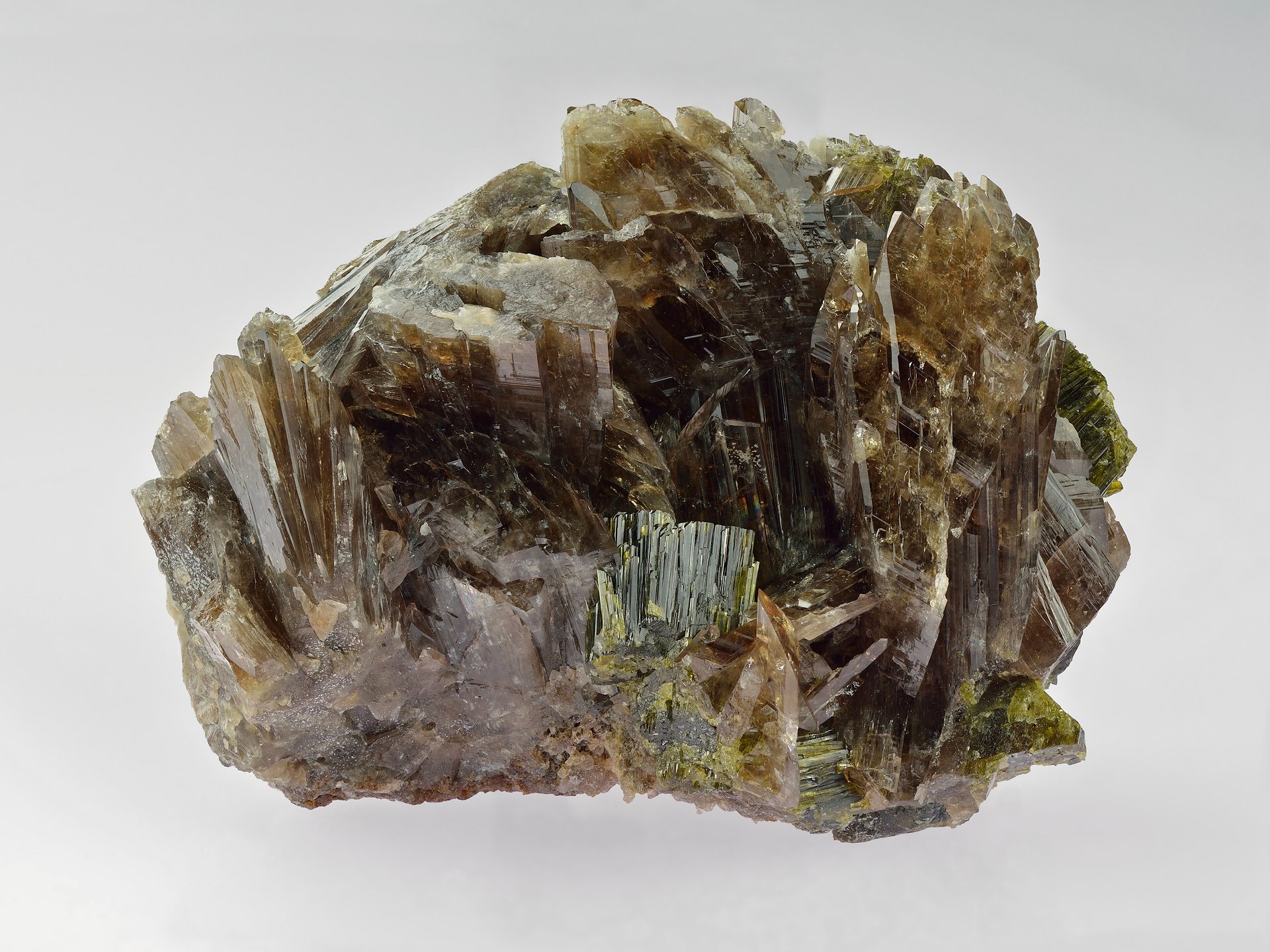
Axinite
Named for its razor-sharp axe-head crystal habit, axinite offers a rare brown-violet beauty and strong pleochroism in an earth-rooted.
- Axinite's name comes from the Greek word axios meaning axe, describing its characteristic wedge-shaped, sharp-edged crystal habit.
- The Bourg d'Oisans locality in the French Alps has produced axinite specimens in European museum collections for over 200 years.
- Axinite shows strong trichoism - three different colors from three different crystallographic directions - making it unusually pleochroic even among strongly pleochroic gems.
- The mineral contains both boron and silicon as structural components - a chemical combination found in relatively few gem minerals.
- Mexican axinite from Baja California has produced some of the largest faceted specimens available on the collector market.
- Mineral collectors who appreciate rare species with dramatic crystal habits and strong optical properties
- Gem enthusiasts seeking strongly pleochroic stones that change color when viewed from different angles
- Crystal practitioners working with deep earth grounding and Root chakra energy
- Collectors building comprehensive European mineral specimens, particularly from the French Alps
- Anyone drawn to unusual brown-violet colors not commonly found in other gem species
- Jewelry buyers wanting a recognized stone for daily wear - axinite is a specialist collector gem
- Anyone expecting broad availability and easy sourcing - gem-quality axinite requires specialist dealers
- Budget buyers expecting standard gem prices - quality faceted specimens from Bourg d'Oisans command collector premiums
What Is Axinite?
Axinite is a calcium borosilicate hydroxide mineral with the complex formula Ca2(Fe,Mn,Mg)Al2BSi4O15(OH). The mineral group includes several species: ferro-axinite (iron-rich), magnesio-axinite (magnesium-rich), and tinzenite (manganese-rich), though the name axinite commonly refers to the broader group in gem and mineral commerce. It rates 6.5 - 7 on the Mohs hardness scale.
It crystallizes in the triclinic crystal system and is most famously recognized by its distinctive wedge-shaped, sharp-edged crystals that resemble axe heads - a feature captured in its name from the Greek axios (axe).
The most prized gem-quality axinite comes from Bourg d'Oisans in the French Alps - a locality that has produced specimen-quality material for over two centuries.
The characteristic color of ferroaxinite is a rich brown with violet, plum, or clove overtones that shifts depending on viewing angle due to strong trichoism (three different colors visible from three crystal directions).
This strong pleochroism - showing brown, violet, and yellowish tones from different angles - makes axinite one of the more dramatically pleochroic gems in the collector market.
Axinite forms in contact metamorphic zones where boron-rich fluids interact with calcium and aluminum silicate-bearing rocks. It appears in skarn environments near granite intrusions and in some hydrothermal veins. Besides Bourg d'Oisans, significant localities include Luning, Nevada (USA), Baja California (Mexico), and the Ural Mountains (Russia).
Japanese, Tanzanian, and Peruvian deposits also contribute to the collector market, though the French Alps material remains the primary reference for fine gem-quality specimens.
Axinite vs Smoky Quartz vs Brown Tourmaline
| Property | Axinite | Smoky Quartz | Brown Tourmaline |
|---|---|---|---|
| Chemistry | Ca borosilicate (unique) | SiO2 | Complex borosilicate |
| Hardness | 6.5 - 7 | 7 | 7 - 7.5 |
| Price / carat | $ Budget | $ Budget | $ Budget |
| Pleochroism | Strong - 3 colors visible | Weak | Moderate to strong |
| Best For | Collector, rare species, Alps origin | Affordable, abundant | Jewelry, diverse colors |
Meaning and Symbolism
Axinite carries no ancient gem tradition - it was formally described as a mineral species only in the late 18th century and has not been worked into pre-modern jewelry traditions. In crystal healing practice, it is approached primarily through color and mineral family associations.
Its rich brown-violet tones connect it to earth-element grounding and, through the violet component, to the subtle bridging of earthly and higher awareness.
Practitioners who work with axinite describe it as a stone that encourages honest assessment of one's physical and material situation - a grounding gem that resists fantasy and asks for clear-eyed engagement with practical reality.
The sharp, axe-head crystal habit is sometimes interpreted symbolically as the stone's capacity to cut through confusion and reveal what is genuinely present beneath surface appearances. Is said to support direct, unvarnished self-knowledge as a foundation for authentic spiritual development.
The strong pleochroism of axinite - its capacity to show genuinely different colors from different viewing angles - is interpreted by some practitioners as the stone's teaching: that every situation contains multiple genuine aspects visible only by shifting perspective deliberately.
Many crystal practitioners use axinite as a meditation object for contemplating multiplicity and the incompleteness of any single viewpoint, finding it valuable for developing intellectual and emotional flexibility.
Historical Timeline
Healing Tradition
Emotional
Practitioners believe axinite supports the honest, grounded processing of emotions rather than the avoidance or amplification of difficult feelings. Many who work with this stone in crystal wellness find it helpful during periods requiring emotional clarity and honest self-assessment - moments when the temptation to dramatize or minimize one's experience is strong.
Is said to create a quiet, stabilizing presence that encourages the feeling of feelings without being overwhelmed by them. The stone's strong earth-element character is described as an anchor during emotional storms, providing a sense of being held in something larger and more stable than the current emotional experience.
Spiritual
In crystal healing tradition, axinite is associated with the Root chakra and the Earth Star chakra below the feet - the deepest grounding energy available in the chakra system.
Practitioners believe it supports the development of genuine earthed spirituality: a practice that honors the body, the physical world, and the present moment rather than seeking escape into purely abstract or disembodied states.
Is said to help practitioners integrate spiritual insights into daily life, which many find the most challenging part of sustained spiritual development. The axe-head crystal form symbolizes for many the cutting away of what is not genuine.
Physical
While no gemstone replaces medical care, earth-element stones linked to the Root chakra are traditionally associated with physical vitality, bone health, and the foundational energy of the physical body.
Practitioners place axinite near the base of the spine or feet during grounding meditations, intending to support the body's physical foundation and sense of embodied stability. Is said in crystal wellness tradition to support recovery of physical energy after depletion and to encourage a felt sense of bodily groundedness and capability.
These are traditional and personal spiritual associations.
Zodiac, Birthstone and Gifts
Axinite's earth and fire element combination, combined with its sharp crystal form and direct character, resonates with Aries (March 21 - April 19) - the cardinal fire sign of direct action and honest initiative. Aries's tendency toward impulsive action is balanced by axinite's grounding earth energy, creating a useful counterweight.
Capricorn (December 22 - January 19) shares an affinity for axinite through shared earth-element association and the stone's quality of patient, honest engagement with material reality.
Both signs benefit from axinite's grounding quality during periods of ambitious effort: Aries for channeling fiery energy into sustainable action; Capricorn for maintaining energetic reserves during long-term goal pursuit. Crystal practitioners often suggest axinite for these signs during periods of major work, business development, or physical projects requiring sustained earth-element vitality.
Care and Cleansing
Axinite tolerates most standard cleansing methods. Brief water rinsing is safe for the mineral, though avoid prolonged soaking. Sunlight, moonlight, selenite plate, and sound cleansing are all appropriate.
The stone is chemically stable under normal conditions and does not require special care beyond keeping it dry and stored away from harder abrasive materials.
For energetic cleansing, earth burial - wrapping in cloth and placing briefly in clean garden soil - is a particularly resonant method for a deeply earth-element stone. Sound cleansing with a low-pitched bowl or bell harmonizes with axinite's grounding quality.
Many practitioners simply place it on a selenite plate during periods of intensive use for continuous gentle clearing between sessions.
- DO store away from harder gems (sapphire, topaz, quartz) that can scratch the Mohs 6.5-7 surface.
- DO wrap in soft cloth for transport; the sharp crystal edges on raw specimens can scratch other minerals and surfaces.
- DO NOT use ultrasonic cleaners - the triclinic crystal structure and sometimes included nature of axinite can be stressed by vibration.
- DO handle fine specimen crystals with particular care - the axe-head edges are razor-sharp and fragile.
- DO examine pleochroism under a single directional light source when purchasing faceted stones - it is the primary quality criterion.
- DO request documentation of locality for collector specimens - Bourg d'Oisans material commands the strongest premiums.
Real vs Fake
Axinite is rarely counterfeited because it is a specialist gem without wide recognition. The more practical risk is misidentification with other brown minerals: brown tourmaline, smoky quartz, and brown glass are the most likely confusions in the marketplace.
Hardness testing quickly eliminates glass (Mohs 5-6) and provides a reference against quartz (Mohs 7). A refractometer reading of 1.674 to 1.723 with biaxial double refraction distinguishes axinite from quartz's uniaxial optics.
Under magnification, axinite may show characteristic inclusions including growth tubes, fluid inclusions, and sometimes mineral grains consistent with its skarn formation environment. The strong pleochroism - clearly visible color change when rotating the stone under a fixed light source - is a useful field diagnostic that distinguishes axinite from less-pleochroic brown minerals.
For collector-grade specimens from specific localities, documentation from the dealer or a gemological identification report provides origin assurance. Bourg d'Oisans material is particularly desired; request locality documentation for premium-priced specimens. Standard gemological testing (RI, pleochroism, hardness) is sufficient to confirm axinite species identity without expensive laboratory analysis.
Axinite Jewelry & Gifts
Axinite prices range from $30 to $300 or more per carat for faceted gem-quality material, with exceptional large or strongly pleochroic pieces from Bourg d'Oisans commanding higher prices. Specimen crystals showing the characteristic axe-head habit are priced by size, locality, and crystal perfection rather than carat weight.
The most valuable are those showing vivid brown-violet color with strong, clearly visible pleochroism.
Purchase from specialist mineral and gem dealers who clearly identify their axinite by species and locality. Request to see the stone under different light angles to assess pleochroism before purchase.
Online buying is possible but view videos showing color change rather than relying on static photographs, which cannot capture the stone's primary optical quality. Established mineral show dealers and auction houses with geological provenance documentation are the most reliable sources for fine material.
Where to Buy Axinite
Affiliate disclosure: Some links below earn us a small commission at no extra cost to you. See our affiliate disclosure page.
Handmade, raw, and tumbled pieces from independent sellers worldwide.
Shop Axinite on Etsy →Accessories, tools, and specimen sets with fast Prime delivery.
Shop Axinite on Amazon →Certified loose gemstones graded and photographed for online buyers.
Shop Axinite on GemSelect →Pairs Well With


Where Axinite Is Found


