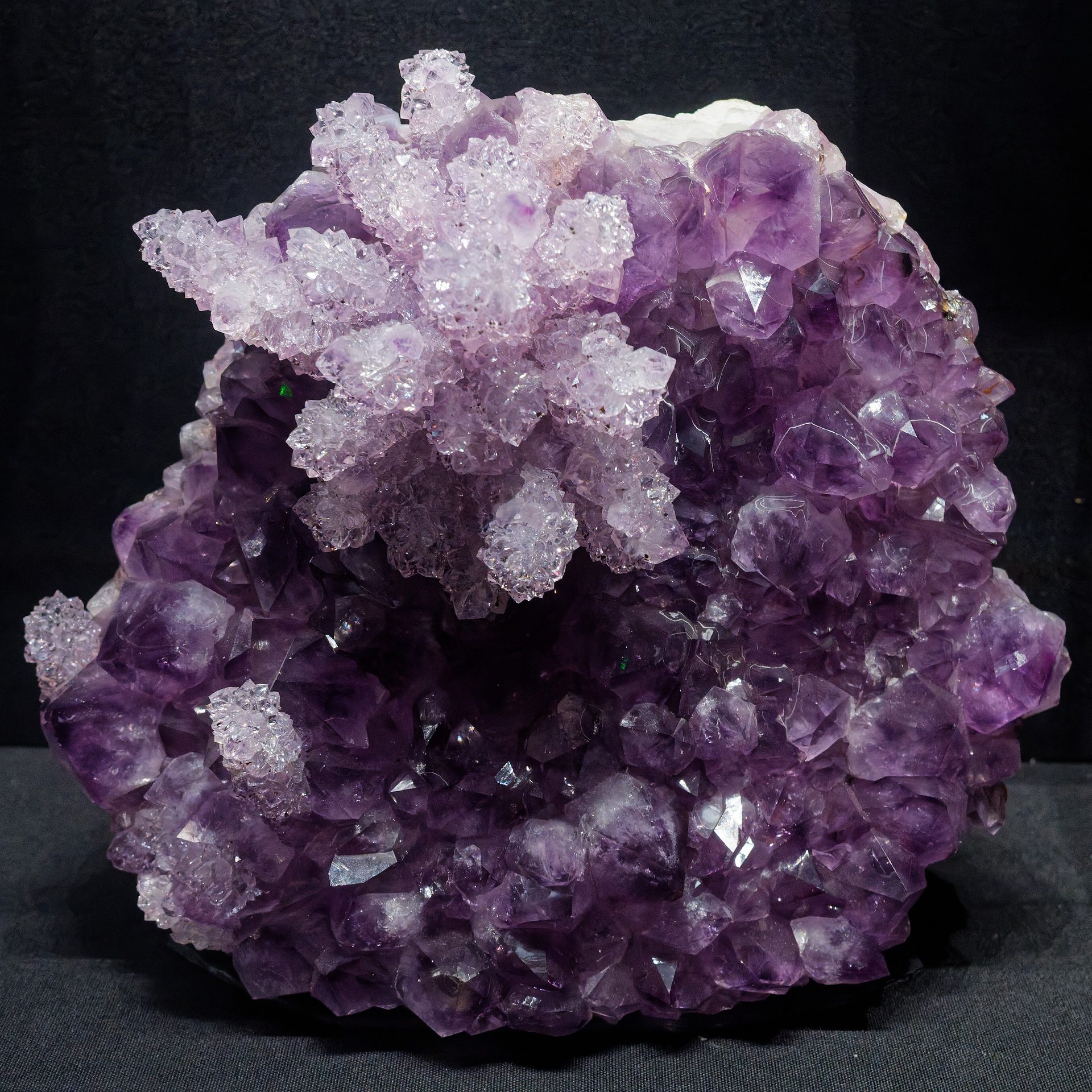
Brazilian Amethyst
From the cathedral geodes of Rio Grande do Sul to gem-grade faceted ovals, Brazil defines accessible amethyst beauty for the whole world.
- Before large Brazilian deposits were discovered, amethyst was as precious as ruby or sapphire - worn by European royalty and clergy as a symbol of divine grace and sobriety.
- The largest amethyst geode ever recorded - the Empress of Uruguay - stands 11 feet tall, weighs 2.5 tons, and is displayed at the Crystal Caves museum in Australia.
- Heat-treated amethyst from Brazil turns yellow-orange and is sold as citrine (called burnt amethyst or heat-treated citrine). Much commercial citrine originates as Brazilian amethyst.
- Color in amethyst is not evenly distributed - it concentrates in growth zones visible as color bands or patches. Cutters orient rough carefully to avoid these patches appearing face-up in finished stones.
- Brazil's Rio Grande do Sul produces geode cathedrals alongside the among the largest known supply of agate - both formed in the same ancient volcanic basalt flows that erupted roughly 130 million years ago.
- February birthstone buyers seeking genuine quartz at any budget
- Crystal healing enthusiasts beginning their collection
- Home decor lovers who want stunning geode clusters
- Anyone drawn to calming, intuition-enhancing violet energy
- Buyers who want maximum visual impact per dollar spent
- Collectors specifically seeking Siberian or Zambian deep violet (consider those origins for premium color)
- Investment gem buyers (amethyst is abundant and does not appreciate meaningfully)
- Those who will display in direct sunlight (color fades with prolonged UV exposure)
What Is Brazilian Amethyst?
Brazilian amethyst is quartz (SiO2) colored by iron impurities and natural irradiation, mined primarily in Rio Grande do Sul (for geodes and crystal clusters) and Minas Gerais (for gem-grade faceted material). Brazil supplies approximately 70% of the world's commercial amethyst by volume. It rates 7 on the Mohs hardness scale.
The characteristic violet color ranges from pale lilac to deep purple depending on iron concentration and irradiation levels. Brazilian material tends toward medium violet with frequent color zoning - alternating bands of deeper and paler purple visible in the crystal. This zoning is a natural characteristic, not a defect.
Brazilian geode cathedrals - the spectacular hollow amethyst-lined boulders ranging from dinner-plate size to walk-in size - come almost exclusively from Rio Grande do Sul. These formation pieces are among the most beloved natural history objects globally.
How Brazilian Amethyst Compares
| Property | Brazilian Amethyst | Zambian Amethyst | Siberian Amethyst |
|---|---|---|---|
| Color | Medium violet, often zoned | Deep blue-violet | Deep royal purple, rare |
| Price/ct | $ Budget | $ Budget | $ Budget |
| Availability | Highly abundant | More limited | Very limited |
| Best For | Fashion, décor, beginners | Premium faceted jewelry | Collector's investment |
Meaning and Symbolism
Amethyst has one of the richest metaphysical histories of any gemstone. The Greek word amethystos means not drunk, and ancient Greeks and Romans wore amethyst believing it prevented intoxication - a quality modern practitioners interpret as the stone's ability to maintain clarity of mind amid overwhelming circumstances.
Traditionally associated with sobriety, protection, and spiritual clarity, amethyst is said by practitioners to activate the third eye and crown chakras, enhancing intuition, psychic perception, and meditative depth. It is one of the most universally recommended crystals for anyone beginning a spiritual practice.
Brazilian amethyst, the most widely available form, carries all the traditional amethyst properties. Practitioners note that the abundance of Brazilian material means high-quality amethyst is accessible to virtually everyone, making it an ideal entry point for crystal healing and a democratic stone of spiritual opening.
Historical Timeline
Healing Tradition
Emotional
Amethyst is said to be the master calming and clarifying stone of the crystal world, with practitioners believing Brazilian amethyst delivers these properties fully regardless of its modest price. It is traditionally associated with mental clarity, protection from negative thought patterns, and the soothing of anxious or overthinking minds.
Crystal healing traditions particularly recommend amethyst for those dealing with stress, insomnia, grief, and the emotional aftermath of major life changes. Many practitioners keep amethyst near their bed for what they describe as deeply restful, protected sleep supported by the stone's calming field. These are personal accounts, not medically verified claims.
Spiritual
Practitioners believe amethyst is the premier spiritual protection and development stone - said to shield the aura from psychic intrusion, deepen meditation, and facilitate access to higher states of awareness.
The third eye activation associated with amethyst is described by crystal workers as a gentle, steady opening of intuitive perception rather than the more disorienting expansions associated with stronger stones. It is traditionally used as a bridge stone for those transitioning from secular to spiritual practice, providing a stable, grounded entry point.
Brazilian cathedral geodes are said to create powerful protective, meditative energy fields when placed in the home.
Physical
Crystal healing traditions associate amethyst with brain health, nervous system support, and improved sleep quality - none of which have scientific basis and amethyst should never replace professional medical care. Practitioners sometimes place amethyst on the forehead or temples during relaxation practices for what they describe as a cooling, tension-relieving sensation.
It is also traditionally associated with sobriety support, and some practitioners use it in wellness practices for those managing addiction recovery. As with all crystal healing practices, these rituals are best understood as complementary mindfulness tools rather than medical interventions.
Zodiac, Birthstone and Gifts
Pisces, whose deep spiritual sensitivity and watery emotional nature find a natural resonance with amethyst's traditionally calming and intuition-enhancing energy. Practitioners believe amethyst helps Pisces maintain energetic boundaries while staying fully open to their powerful empathic gifts.
Aquarius, the visionary innovator, is said to benefit from amethyst's third-eye activation, which practitioners suggest amplifies the Water-Bearer's already exceptional capacity for original, forward-thinking perception.
Capricorn, whose practical earth nature is sometimes at odds with spiritual inclinations, is traditionally paired with amethyst in practices aimed at bridging the material and spiritual, helping the Sea-Goat access the wisdom available in quieter, more contemplative states.
Care and Cleansing
Amethyst is one of the easiest crystals to cleanse: running water, salt water (brief), moonlight, smudging, sound, and earth burial are all effective. The most popular method is placing amethyst under the full moon overnight.
Avoid prolonged direct sunlight - amethyst's iron-based color fades with extended UV exposure over months or years. Cleanse in sunlight only briefly (under 30 minutes) for a solar recharge rather than as a regular practice.
To recharge amethyst physically and energetically, bury it in the earth for 24 hours or place it on a selenite charging plate. Both methods are said by practitioners to fully restore the stone's protective and calming energy.
- DO NOT leave amethyst in direct sunlight for extended periods - UV exposure causes progressive color fading that cannot be reversed.
- DO clean with warm soapy water and a soft brush - amethyst is safe in ultrasonic cleaners as long as it has no fractures.
- DO NOT expose to extreme heat - amethyst can turn yellow (becoming effectively citrine) at temperatures above 470 degrees Celsius.
- NOTE amethyst at 7 Mohs can scratch softer stones like calcite, fluorite, and opal - store separately.
- DO handle large geode cathedrals carefully - the crystal points are sharp and can damage surfaces, and falls can break individual crystal clusters.
Real vs Fake
Brazilian amethyst is abundant and inexpensive, making significant fraud less common than with rarer stones. However, glass amethyst is sold in tourist markets and online. Genuine amethyst is harder than glass (7 vs 5.5 Mohs) and will not be scratched by a copper coin.
Dyed quartz is sometimes sold as amethyst. Natural amethyst color is unevenly distributed in zones; dyed material often shows color concentrated along fractures or uniformly distributed throughout without zoning - unnatural for quartz.
Synthetic amethyst (hydrothermal grown) is genuine quartz but must be disclosed as synthetic if sold. It typically shows fewer inclusions and more perfect color than natural. Under magnification, the inclusion types and growth patterns differ from natural.
The most common upgrade fraud is labeling Brazilian commercial amethyst as Siberian or Zambian, commanding higher prices. The only way to verify origin is a reputable seller or gemological certificate. Siberian amethyst has been historically exhausted; genuine antique specimens are rare.
Color-banding under a loupe is a positive sign of natural amethyst. Natural color shows as irregular zones and wisps throughout the crystal; synthetic shows uniform chevron-pattern growth bands or no banding at all.
Brazilian Amethyst Jewelry & Gifts
Brazilian amethyst is among the best-value colored gemstones available. Faceted gemstones retail from $2-30 per carat for commercial to good quality. Premium deep-color Brazilian material with strong saturation and minimal zoning can reach $50-100 per carat.
For faceted gems, look for even violet color without excessive pale zones face-up. Color zoning is natural in amethyst but the best cut stones minimize its visibility by orienting the deepest color zones to show through the table.
Brazilian geode cathedrals range from $50 for small desk pieces to $5,000+ for large display specimens. Weight is the primary pricing metric; color saturation, crystal quality, and matrix stability also matter significantly.
Avoid stones with significant inclusions, white patches, or very pale color unless price reflects these factors. The best Brazilian faceted amethyst shows a consistent medium-deep violet with good transparency.
For February birthstone gifts, Brazilian amethyst delivers beautiful color at highly accessible prices. Top Zambian or Uruguayan material is richer and more saturated but significantly more expensive. For most gift applications, Brazilian quality is excellent.
Where to Buy Brazilian Amethyst
Affiliate disclosure: Some links below earn us a small commission at no extra cost to you. See our affiliate disclosure page.
Handmade, raw, and tumbled pieces from independent sellers worldwide.
Shop Brazilian Amethyst on Etsy →Accessories, tools, and specimen sets with fast Prime delivery.
Shop Brazilian Amethyst on Amazon →Certified loose gemstones graded and photographed for online buyers.
Shop Brazilian Amethyst on GemSelect →Pairs Well With


Where Brazilian Amethyst Is Found
