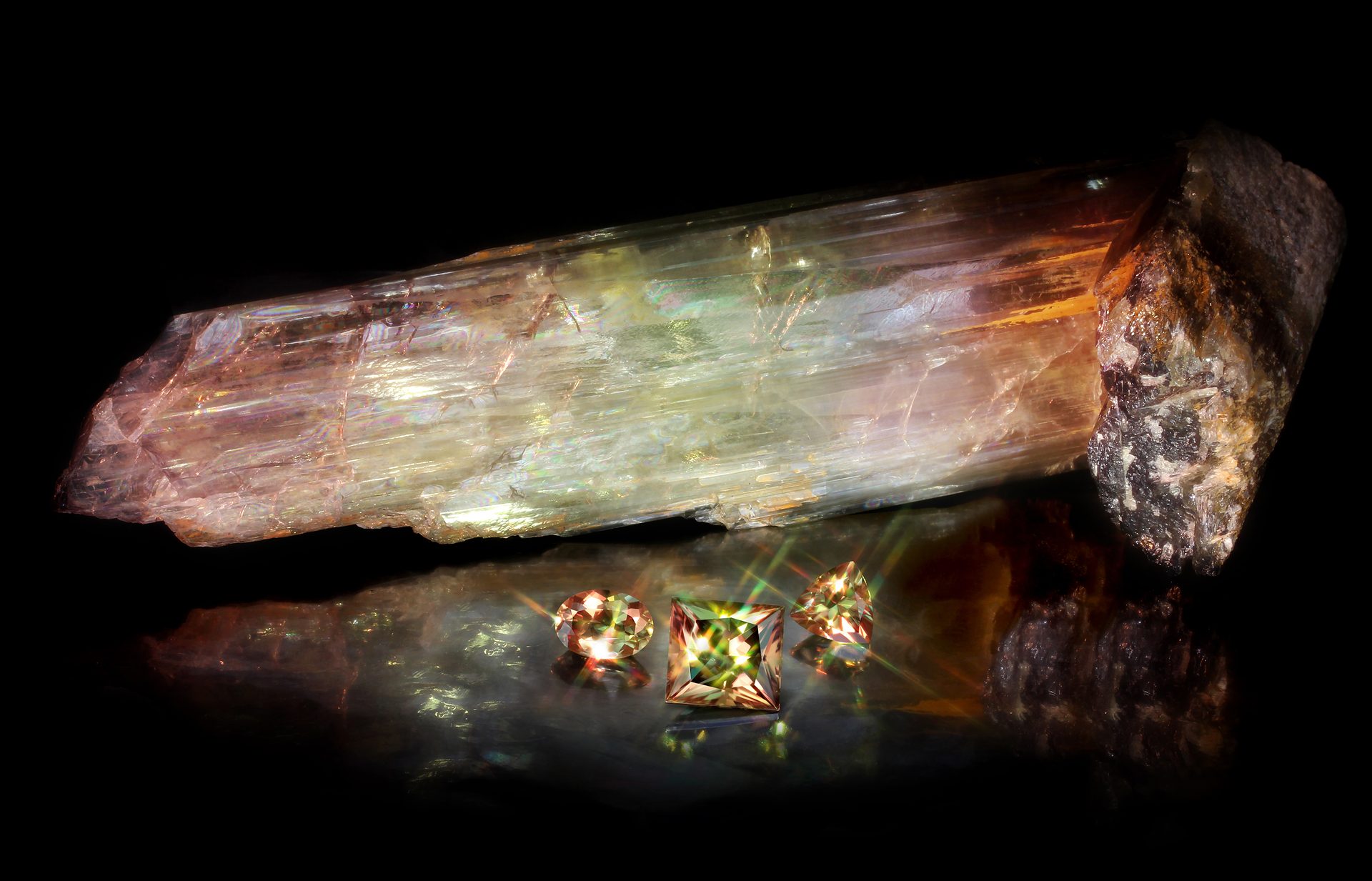
Diaspore
A rare aluminum oxyhydroxide mineral found in metamorphic bauxite deposits, diaspore shifts between pale green, yellow.
- Diaspore is named for its tendency to decrepitate (crackle and scatter) when heated - a behavior caused by the mineral losing its hydroxyl groups at moderate temperatures.
- Aluminum metal was more expensive than gold in the 1800s before the Hall-Heroult process was invented; diaspore, as an aluminum mineral, was part of this rare-element world.
- Some diaspore specimens from Turkey fluoresce pale green-white under UV light, adding another optical dimension to an already visually complex mineral.
- Diaspore's crystal structure is closely related to goethite (iron oxyhydroxide) and boehmite, sharing the orthorhombic aluminum oxyhydroxide family.
- A single large faceted diaspore gem of 50+ carats from the Turkish deposit sold at auction for over $100,000 - demonstrating the collector ceiling for exceptional specimens.
- Mineral collectors who want a scientifically interesting, rare aluminum oxyhydroxide specimen
- Practitioners drawn to crown chakra minerals with subtle optical properties
- Those seeking an alternative to zultanite at lower price points when gem-quality is not required
- Collectors building a comprehensive corundum and aluminum mineral suite
- Virgo and Libra placements drawn to Mercury-associated stones of subtle beauty
- Those wanting dramatic gem-quality color change - gem-quality diaspore (zultanite) commands much higher prices
- Buyers seeking a common or widely available mineral - facetable diaspore is genuinely rare
- People needing a rugged everyday stone - diaspore's cleavage makes it fragile for casual handling
What Is Diaspore?
Diaspore is an aluminum oxyhydroxide mineral with the formula AlO(OH), forming in metamorphic rocks derived from bauxite (aluminum ore) and in some marbles. It belongs to the orthorhombic crystal system and typically forms platy or prismatic crystals with a distinctive pearly to vitreous luster. It rates 6.5 - 7 on the Mohs hardness scale.
The mineral was named in 1801 from the Greek diaspora (to scatter) because of its tendency to decrepitate or crackle when heated.
The gem-quality variety from Turkey - sold commercially as Zultanite - represents only a fraction of diaspore occurrences worldwide. Most diaspore forms as small, opaque, or translucent pale crystals in metamorphic assemblages without the transparency needed for faceting.
Crystals from the Turkish deposit reach sizes suitable for gem cutting; most other localities produce collector minerals rather than facet grade.
At Mohs 6.5 to 7, diaspore is moderately hard but has perfect cleavage in one direction, making crystals prone to fracture along cleavage planes under stress. This property, combined with its relative rarity, makes diaspore a mineral best suited to protective jewelry settings or collector display rather than rugged daily wear.
Diaspore plays an important role in geological and industrial contexts: it is a significant component of bauxite deposits and serves as an indicator mineral in understanding the formation conditions of aluminum-rich metamorphic rocks. Its presence helps geologists reconstruct the pressure and temperature conditions of ancient mountain-building events.
How Diaspore Compares
| Property | Diaspore (mineral) | Zultanite (gem diaspore) | Corundum |
|---|---|---|---|
| Hardness | 6.5 - 7 | 6.5 - 7 | 9 |
| Gem quality | Rare | Single source | Widely available |
| Color change | Subtle to moderate | Strong (kiwi to champagne) | Some varieties |
| Price range | $$ Mid-range | $$ Mid-range | $ Budget |
Meaning and Symbolism
Diaspore is named for scattering - the quality of dispersing what is concentrated into a broader field. In crystal healing tradition, this etymological meaning translates into the stone's association with mental clarity and the ability to distribute or release what has been held too tightly.
Practitioners connect diaspore with the crown and third eye chakras, where its subtle color-change and translucent quality support expanded perception.
The stone's aluminum chemistry connects it energetically to the mineral kingdom's intelligence principle in some crystal healing traditions. Aluminum, as the most abundant metal in Earth's crust, is associated with adaptability and structural flexibility - properties that carry through to the mineral's metaphysical associations.
For collectors and practitioners who work with rare minerals, diaspore offers the satisfaction of holding a genuinely uncommon geological object - one that forms only in the specific pressure-temperature conditions of aluminum-rich metamorphic environments. This geological specificity resonates with the Virgo archetype of precision and purposeful formation.
The Turkish variety's color change from pale green to warm neutral in different lights is experienced by practitioners as a physical demonstration of the stone's core quality: the same essence looks different in different light, which is the essence of adaptable perception.
Historical Timeline
Healing Tradition
Emotional
Practitioners believe diaspore supports mental clarity and the kind of calm, adaptable intelligence that allows practitioners to hold multiple perspectives without anxiety. In crystal healing tradition, the stone is associated with releasing mental rigidity - the tendency to insist on a single correct interpretation when reality is more complex.
Many readers recommend diaspore for practitioners working through overthinking, analysis paralysis, or the exhaustion of maintaining absolute certainty in ambiguous situations. The stone's color shift is used as a visual meditation on how the same reality can be experienced differently depending on the quality of attention brought to it.
Diaspore is described as a gentle stone in emotional terms - not activating or intensifying but clarifying. It is said to help practitioners arrive at emotional truth through clear-seeing rather than through cathartic release.
Spiritual
Diaspore's crown chakra association in crystal healing tradition connects it to states of expanded awareness, clear perception, and the kind of spiritual intelligence that sees through conventional categories to underlying reality. Practitioners describe it as a mineral for those who want to understand, not just believe.
The stone's clarity and subtle color change make it suitable for contemplative practices that work with visual attention and shifting perception. Practitioners working with mindfulness, analytical meditation, or philosophical contemplation find diaspore's gentle, non-dramatic energy supportive of sustained inquiry.
For Virgo placements whose spiritual practice involves precision, attention to detail, and service through understanding rather than through feeling, diaspore's mineralogical intelligence and practical beauty make it a resonant companion stone.
Physical
Crystal healing tradition associates diaspore with the lymphatic system and the body's mechanisms for filtering and distributing necessary elements while dispersing what is no longer useful - a connection to the mineral's own name and etymological meaning.
The stone's aluminum composition connects it in some traditional energy medicine systems to the skin, kidneys, and the body's overall mineral balance management. These associations are metaphorical rather than biochemical.
Practitioners use diaspore in contemplative bodywork settings, placing the stone at the crown or holding it during sessions focused on releasing mental patterns held in the body's musculature. The stone's mild energy is considered appropriate for sensitive practitioners who find stronger minerals overstimulating.
Zodiac, Birthstone and Gifts
Diaspore's Mercury connection and its quality of precision-without-rigidity align naturally with Virgo's archetypal gifts: analytical clarity, service through understanding, and the capacity to hold complex information without becoming overwhelmed. Practitioners recommend diaspore to Virgo placements as a stone that honors the sign's intelligence while gently softening its tendency toward perfectionism.
For Libra, diaspore's Venus association and its color-shifting quality resonate with the sign's constant navigation of multiple perspectives in the search for genuine balance. The stone supports Libra's natural diplomatic intelligence by clarifying the practitioner's own perspective before they engage with another's.
Both signs benefit from diaspore's association with adaptable clarity - seeing what is true with precision while remaining open to the way that truth looks different in different light.
Care and Cleansing
Diaspore is stable in water and can be briefly rinsed under cool running water for cleansing. Avoid high temperatures and sudden temperature changes, which can cause the mineral to decrepitate (its defining property). Moonlight cleansing is particularly appropriate for this subtle, clarity-associated mineral. Place on a windowsill in indirect moonlight overnight.
Smoke cleansing and sound cleansing are both safe for diaspore. Avoid placing near flames or heat sources, which can physically damage the mineral by triggering the hydroxyl loss that gives the mineral its name.
Earth grounding in a dry location for a few hours is a gentle and resonant cleansing option for this metamorphic mineral.
Sunlight cleansing is safe for color stability but avoid extended exposure in a greenhouse or hot car where temperatures could rise enough to stress the mineral.
- DO NOT expose diaspore to high heat - the mineral decrepitates (crackles and loses hydroxyl groups) when heated strongly.
- DO NOT use ultrasonic or steam cleaners for diaspore jewelry - vibration and temperature stress the perfect cleavage.
- DO store diaspore away from harder minerals that could scratch the surface at Mohs 6.5-7.
- DO handle faceted diaspore gems carefully - the perfect cleavage means directional impact can split a stone cleanly.
- DO keep diaspore in individual fabric pouches or compartments during storage and transport.
- Note: diaspore is the same mineral as zultanite; only the Turkish Milas gem-quality variety uses the Zultanite trade name.
Real vs Fake
Diaspore as a raw mineral specimen is not typically faked because of its low commercial profile. The main concern is mislabeling - other pale yellow-green minerals being sold as diaspore to buyers unfamiliar with the mineral.
Genuine diaspore has a characteristic pearly luster on cleavage surfaces, an orthorhombic crystal habit (platy or prismatic), and moderate density that feels noticeably heavy for the crystal size.
For faceted gem-quality diaspore, the same color-change verification applies as for zultanite: genuine faceted diaspore from Turkey shows the characteristic kiwi-to-champagne shift in different light sources. Pale yellow-green stones without color change are likely other minerals (chrysoberyl, peridot, tourmaline) rather than diaspore.
Laboratory identification through X-ray diffraction or spectroscopy definitively confirms diaspore identity. For investment-grade specimens, this verification is worthwhile. Most collector-grade mineral specimens are accurately labeled by reputable mineral dealers who verify their stock through reference specimens and provenance documentation.
The Zultanite trademark applies only to Turkish gem-quality material; raw mineral specimens labeled simply as diaspore from other localities (Russia, USA, South Africa) do not require the trade name and are typically accurately described by mineral dealers.
Diaspore Jewelry & Gifts
Raw diaspore mineral specimens cost $30-$300 depending on crystal quality and size. Small platy crystals are more common; large, well-formed transparent specimens of gem-grade quality command significant premiums. Turkish faceted material (Zultanite) is priced separately as described under that entry.
For mineral specimens, look for clarity of crystal form, visible pearly luster on cleavage faces, and minimal matrix damage. Russian and South African diaspore occasionally produces attractive flat crystal groups suitable for display.
US diaspore from Chester, Massachusetts deposits occasionally appears through American mineral dealers as a locality-specific specimen. Chester diaspore has historical significance as one of the type localities described in early mineralogical literature.
Ask dealers about origin documentation and whether the specimen has been verified as diaspore versus visually similar minerals. Reputable mineral dealers provide species confirmation and locality provenance.
Where to Buy Diaspore
Affiliate disclosure: Some links below earn us a small commission at no extra cost to you. See our affiliate disclosure page.
Handmade, raw, and tumbled pieces from independent sellers worldwide.
Shop Diaspore on Etsy →Accessories, tools, and specimen sets with fast Prime delivery.
Shop Diaspore on Amazon →Certified loose gemstones graded and photographed for online buyers.
Shop Diaspore on GemSelect →Pairs Well With


Where Diaspore Is Found


