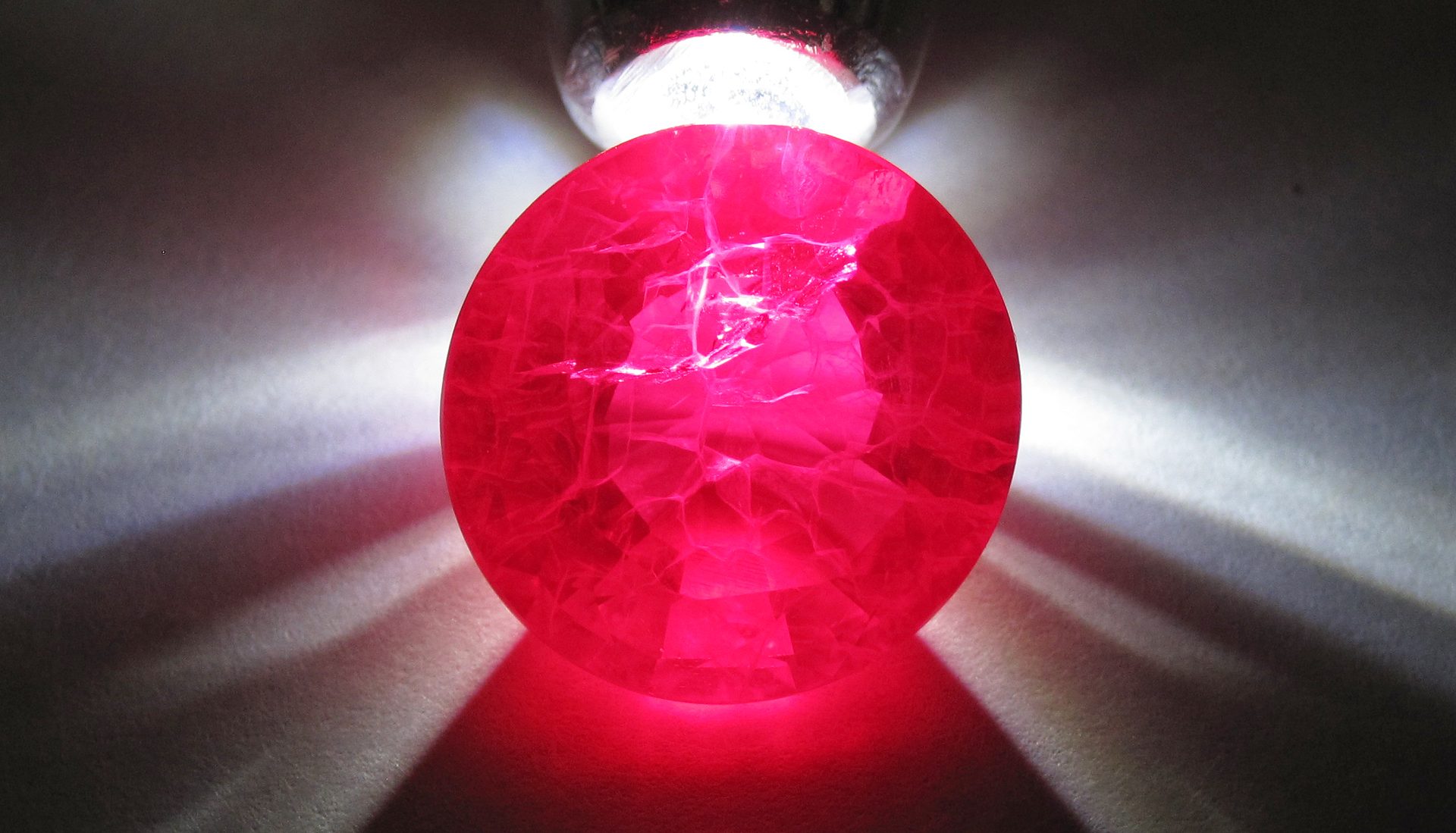
Lab Created Ruby
Lab Created Ruby is chemically and physically identical to natural ruby - the same pigeon-blood red.
- Lab Created Ruby is identical in chemical composition and crystal structure to natural ruby - only a trained gemologist with specialized equipment can reliably distinguish the two.
- The first commercial use of synthetic rubies was not jewelry but precision watch bearings in Swiss watchmaking - their hardness (Mohs 9) made them ideal for friction-resistant pivot points.
- Natural pigeon-blood rubies from the Mogok Valley of Myanmar can cost $10,000 to $50,000+ per carat for fine quality; a comparable lab ruby costs $10 to $50 per carat.
- Rubies were the first gemstones produced synthetically by science - predating lab diamonds, lab emeralds, and all other laboratory-grown gems by decades.
- Lab ruby's chromium content produces the same strong red fluorescence under UV light as natural ruby - making both glow red in certain lighting conditions.
- Fine jewelry buyers who want the vibrant red of ruby in an engagement ring or pendant without the premium natural price
- Everyday wearers who want an extremely durable red gemstone - Mohs 9 is second only to diamond
- Ethically conscious shoppers who want a ruby without concerns about mining conditions or conflict origins
- Those who want a large, vivid red center stone that would be prohibitively expensive in natural quality
- Budget-conscious gift givers who want to give a meaningful red gemstone in a real jewelry setting
- Collectors or investors who want gem value that appreciates - lab stones have negligible resale value
- Those who specifically want natural provenance and the geological story of a Myanmar or Mozambique ruby
- Buyers presenting the stone as natural ruby without disclosure - this is unethical and potentially illegal
What Is Lab Created Ruby?
Lab Created Ruby is aluminum oxide (Al₂O₃) with chromium impurities - exactly the same chemical composition and crystal structure as natural ruby - grown in a controlled laboratory environment rather than forming naturally in the Earth's crust over millions of years. It rates 9 on the Mohs hardness scale.
The result is a genuine corundum crystal: it tests identically to natural ruby on a refractometer, hardness tester, and spectroscope. The only difference is the conditions and timeline of formation.
Several production methods exist, each creating rubies with slightly different characteristics. The *Verneuil process* (flame fusion), developed in 1902, is the oldest and least expensive - it produces large crystals quickly by melting aluminum oxide powder in a flame. *Hydrothermal synthesis* grows rubies in pressurized solutions at high temperature, more closely mimicking natural conditions, producing stones with fewer growth stress lines. *Flux growth* uses molten salt solutions and produces the most inclusion-free, natural-looking stones at higher cost.
Lab Created Ruby was the first commercially produced synthetic gemstone, developed by French chemist Auguste Verneuil in 1902. His flame fusion rubies were initially used as watch bearings in Swiss timepieces before entering the jewelry market.
Today, lab rubies are produced in large quantities globally and are widely used in jewelry at multiple price points. Ethical disclosure is required under US FTC regulations - lab-created stones must always be sold as 'lab created' or 'synthetic,' never simply as 'ruby.'
Lab Created vs Natural Ruby
| Property | Lab Created Ruby | Natural Ruby | Natural Garnet (Red) |
|---|---|---|---|
| Hardness | 9 | 9 | 7 - 7.5 |
| Price / carat | $ Budget | $$ Mid-range | $ Budget |
| Chemical identity | Al₂O₃:Cr (identical) | Al₂O₃:Cr | Various garnets |
| Inclusions | Few or none | Natural inclusions | Natural inclusions |
| Resale value | Minimal | High for fine quality | Low to moderate |
Meaning and Symbolism
Ruby's meaning is ancient - the stone of kings, warriors, and passionate love in virtually every culture that has encountered it. Sanskrit texts called it 'ratnaraj' - king of precious stones.
Medieval European tradition held that ruby's inner fire could not be hidden by clothing and would glow through any covering, a metaphor for the unkillable nature of passionate life force. In Burmese warrior tradition, rubies were inserted under the skin before battle for invincibility.
Lab Created Ruby carries the same symbolic inheritance. The intention placed in a ruby - whether it formed over millions of years or over several weeks in a laboratory - activates the same cultural and spiritual meaning.
Crystal healing practitioners generally hold that the energetic properties of a stone derive from its chemical and crystalline structure, which is identical in lab and natural ruby. The distinction matters primarily for commercial and geological provenance, not for spiritual application.
In contemporary spiritual practice, lab ruby is increasingly accepted as a fully valid choice - particularly for practitioners who value ethical sourcing and are uncomfortable with the human rights records of some natural ruby mining regions.
The fire, passion, and life-force associations remain fully intact: what you work with is chemically and crystallographically ruby in every way that matters to the stone's energetic identity.
Historical Timeline
Healing Tradition
Emotional
Ruby - whether natural or lab created - is one of the premier stones in crystal healing for stimulating vitality, passion, and the will to engage fully with life. Practitioners believe it works as a powerful energizer for those who have grown emotionally flat, withdrawn, or disconnected from their sense of purpose.
It is said to reignite the inner fire - the core emotional drive that motivates action, connection, and the pursuit of what genuinely matters. Many crystal healers recommend it for those recovering from depression, emotional exhaustion, or long periods of grief where life has felt colorless and distant.
The fire element associations make it a stone for bringing heat back to a life that has gone cold.
Spiritual
In crystal healing tradition, ruby is associated with the life force itself - the prana or chi that flows through living systems and fuels all spiritual practice. Lab-created ruby is said to carry this association fully, since the chromium-corundum matrix that produces ruby's fire is identical in composition.
Practitioners use it to activate and strengthen the Root chakra, the foundation of the body's energetic system, and to draw that activated energy upward through the heart as passion and vitality rather than simply physical survival energy.
Ruby is considered one of the key stones for those who have strong spiritual aspiration but struggle to ground that aspiration in consistent, embodied daily action.
Physical
Crystal healing tradition associates ruby with the circulatory system, the heart, the blood, and the overall vitality of the physical body. Its deep red color in traditional color-healing systems is linked to warmth, stimulation, and the activation of the body's regenerative systems.
Practitioners sometimes place it at the root chakra during body layouts to stimulate foundational physical vitality, or at the heart to support circulatory health work.
These are traditional metaphysical associations - not medical claims - and ruby's energetic properties should always be used as a complement to, never a replacement for, qualified medical care.
Zodiac, Birthstone and Gifts
Ruby's birthstone association with July (Cancer/Leo cusp) gives it natural zodiac connections to both Cancer and Leo. Cancer, the emotionally deep and home-loving water sign, benefits from ruby's warming fire energy as a counterbalance to its natural tendency toward introspection and emotional self-protection - the stone invites Cancer to come out of its shell with vitality and courage.
Leo, the sign of the sun and creative self-expression, finds in ruby a perfectly matched companion - both are associated with fire, royalty, generosity of spirit, and the desire to shine.
Scorpio, the intense water sign associated with passion, depth, and the extremes of emotion, resonates with ruby's fire in a different way - as fuel for transformation and the intensity of genuine feeling.
Care and Cleansing
Lab Created Ruby is corundum - extremely hard and chemically stable - and accepts all cleansing methods without concern. Running water, salt water, sunlight, moonlight, earth, sound, and smoke all work effectively.
Ultrasonic cleaners are safe for lab ruby in clean settings (no fracture filling or surface coatings, which are sometimes applied to lower-quality natural ruby but not to lab material).
Energetically, fire-based cleansing methods have obvious resonance - passing lab ruby through candle flame smoke or smudging with frankincense (associated with solar fire) connects the cleansing to the stone's elemental nature. Sunlight cleansing is poetically appropriate and physically safe.
Regular cleansing is particularly important when using ruby actively for energy and vitality work, as it is said to absorb the energetic debris of what it has been helping to clear.
- DO wear daily - lab ruby's Mohs 9 hardness makes it more scratch-resistant than most gemstones.
- DO NOT assume all lab rubies are fracture-filled - check with the seller. Some lower-quality lab material may have filling treatments, though high-quality lab ruby does not.
- DO clean with a soft brush, mild soap, and warm water for regular maintenance.
- DO disclose to any jewelry appraiser or future buyer that the stone is lab created - required by FTC regulations.
- DO NOT use bleach or harsh chemicals in cleaning - not because of stone damage, but to protect the metal setting.
- Note: Lab ruby is virtually indistinguishable from natural ruby to the eye - gemological testing (spectroscope, inclusion analysis) is needed to confirm origin.
- DO protect the setting rather than the stone - lab ruby at Mohs 9 is very durable; the metal prongs holding it are more vulnerable than the gem itself.
Real vs Fake
Lab Created Ruby is real ruby - the question is not whether it is genuine but whether it is natural or laboratory-grown. Both are genuine rubies. The identification challenge is distinguishing lab from natural, which requires gemological expertise.
Key tells for lab origin: extreme clarity with no natural mineral inclusions (natural rubies almost always have rutile needles or other inclusions), curved growth striations visible under magnification (Verneuil flame-fusion creates curved striae rather than straight), and gas bubbles in some Verneuil material.
Hydrothermal and flux-grown lab rubies are harder to distinguish - they can include flux-related inclusions that resemble natural inclusions. Gemological laboratories like gemological laboratories can identify lab origin in almost all cases using a combination of inclusion study, UV fluorescence, spectroscopy, and trace element analysis.
For buyers: purchase lab ruby only from sellers who explicitly state 'lab created' or 'synthetic.' Any seller offering what appears to be a high-clarity, vivid-red ruby at prices significantly below market for natural ruby should be questioned about origin.
The ethical and legal requirement is clear disclosure - if it is not stated, ask directly.
Lab Created Ruby Jewelry & Gifts
Lab Created Ruby offers extraordinary value compared to natural ruby. Small faceted lab rubies (under 0.5 carat) are available for as little as $5 to $15 per stone. Good quality faceted lab rubies in the 1 to 3 carat range typically run $15 to $80.
Fine quality flux-grown or hydrothermal lab rubies in larger sizes can reach $50 to $200 per carat, which is still dramatically below natural equivalent prices.
Color is the primary quality factor - look for vivid pigeon-blood red (slightly bluish-red, not orange-red). Clarity is excellent in most lab material; eye-clean is the norm. Cut quality affects brilliance significantly.
Hydrothermal and flux-grown material is generally considered higher quality than Verneuil flame-fusion for its more natural-looking inclusions and superior color distribution.
Reputable jewelry retailers that carry lab gemstones will clearly label them as such. Online laboratory gemstone wholesalers often offer excellent quality at competitive prices. For fine jewelry settings, request a grading report or lab identification certificate from GIA, Mindat, and USGS to confirm the stone's identity and quality parameters.
Where to Buy Lab Created Ruby
Affiliate disclosure: Some links below earn us a small commission at no extra cost to you. See our affiliate disclosure page.
Handmade, raw, and tumbled pieces from independent sellers worldwide.
Shop Lab Created Ruby on Etsy →Accessories, tools, and specimen sets with fast Prime delivery.
Shop Lab Created Ruby on Amazon →Certified loose gemstones graded and photographed for online buyers.
Shop Lab Created Ruby on GemSelect →Pairs Well With


Where Lab Created Ruby Is Found


