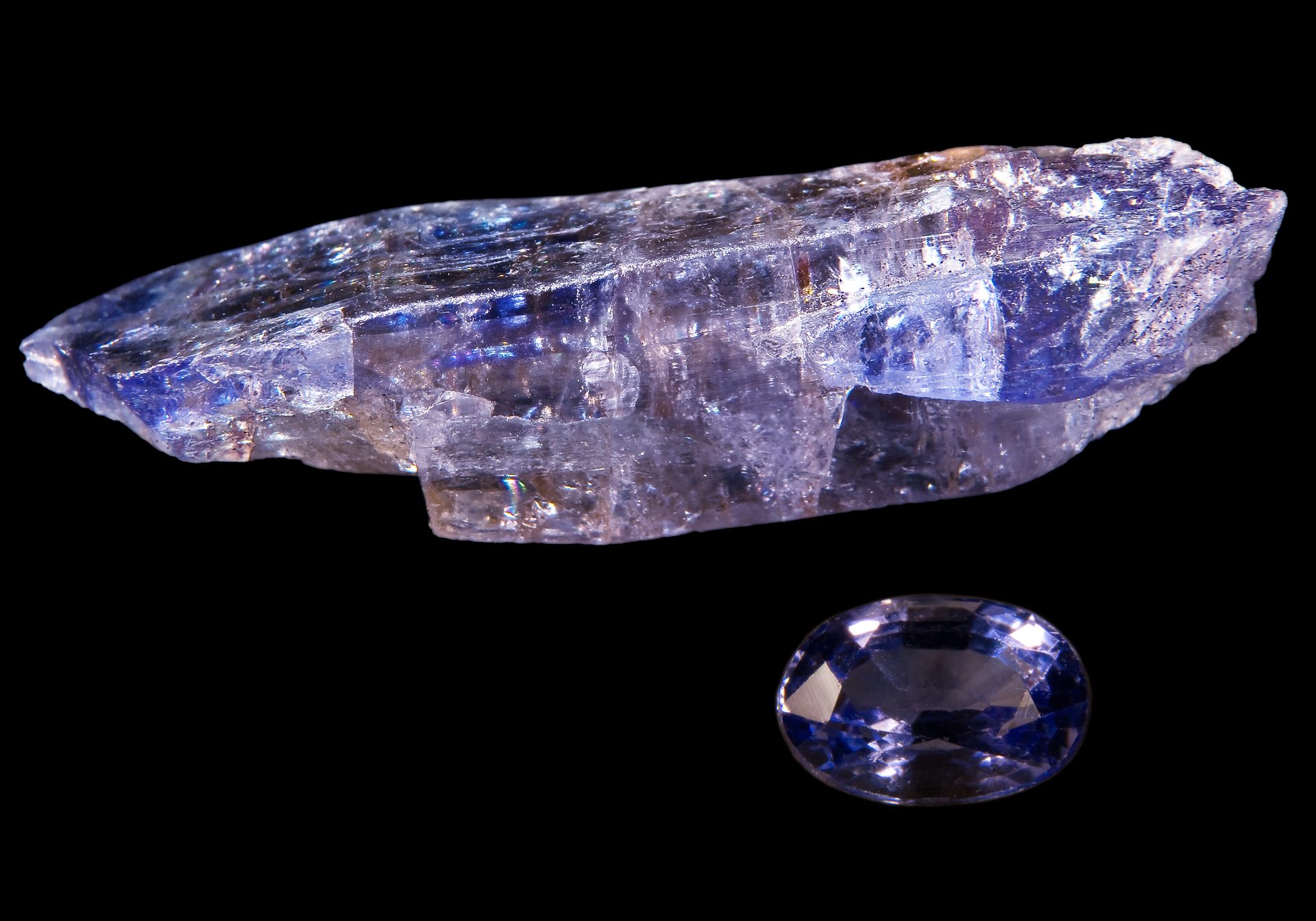
Lab Created Tanzanite
The same electric blue-violet trichroism as Kilimanjaro's rarest gem, grown in a controlled environment for consistent brilliance.
- Natural tanzanite forms only in a geological corridor roughly 4km wide near Mount Kilimanjaro - making it geographically rarer than diamonds by deposit footprint.
- The gem displays 3 colors simultaneously: sapphire blue, amethyst violet, and warm burgundy-red, all visible by rotating the stone under light.
- Natural tanzanite is typically heat-treated at 500-600 degrees Celsius to convert brownish-red raw crystals into the signature blue-violet; lab stones skip this step entirely.
- Tanzanite was used as a talisman for safe childbirth by Maasai people, who traditionally presented it to new mothers and newborns as a blessing gift.
- Despite its moderate hardness, tanzanite's perfect cleavage in one direction makes cutting and setting it a genuine test of a lapidary's skill.
- Budget-conscious shoppers wanting tanzanite's iconic color
- Ethical buyers avoiding single-source mined gems
- December birthstone jewelry seekers
- Collectors who prize consistent quality over provenance
- Designers needing matched stones for multi-stone settings
- Investment collectors (consider natural mined tanzanite for resale value)
- Everyday wear rings without protective settings (6.5-7 Mohs - softer than ideal)
- Those seeking mineral rarity certificates (consider natural tanzanite)
What Is Lab Created Tanzanite?
Lab created tanzanite is a flux-grown or hydrothermal zoisite crystal with the identical chemical formula, crystal structure, and optical properties as its mined counterpart found only near Mount Kilimanjaro in Tanzania. It rates 6.5-7 on the Mohs hardness scale.
The gem's defining feature is trichroism - the ability to display 3 distinct colors (blue, violet, and burgundy) depending on viewing angle and lighting conditions. This phenomenon occurs in both natural and lab stones because it is a function of the crystal structure itself.
Gemological labs cannot distinguish lab tanzanite from natural by standard testing alone; advanced trace element analysis or inclusion mapping is required. The lab-grown version simply contains fewer natural inclusions and shows more consistent color saturation throughout.
How Lab Tanzanite Compares
| Property | Lab Tanzanite | Natural Tanzanite | Iolite |
|---|---|---|---|
| Hardness | 6.5-7 | 6.5-7 | 7-7.5 |
| Price/ct | $ Budget | $$ Mid-range | $ Budget |
| Rarity | Readily available | Single-source, rare | Common |
| Best For | Fashion jewelry | Investment, heirloom | Budget trichroic alt |
Meaning and Symbolism
Tanzanite is traditionally associated with transformation and higher consciousness, qualities that practitioners believe are fully present in the lab-grown version since the metaphysical properties are said to stem from the crystal structure rather than geological origin.
The deep blue-violet spectrum is said to bridge the throat, third eye, and crown chakras, supporting clear communication, intuitive insight, and spiritual connection. Many crystal workers use it in meditation for what they describe as an elevated, calming mental clarity.
Lab tanzanite is sometimes called a stone of awakening, and practitioners believe its energy encourages self-awareness and the courage to pursue authentic life changes. Its relatively recent emergence in crystal healing circles mirrors the stone's young geological discovery history.
Historical Timeline
Healing Tradition
Emotional
Practitioners believe lab tanzanite carries the same emotionally supportive energy as its mined counterpart, said to help dissolve old patterns of fear, anxiety, and self-doubt. It is traditionally associated with the courage required to make meaningful life changes.
Those drawn to it often describe a sense of calm clarity when working with the stone in meditation or carried daily. Crystal healing traditions suggest it may be especially supportive during major life transitions such as career changes, relationship endings, or personal reinvention.
While these accounts are experiential and not medically verified, many users report that simply holding a tanzanite stone during moments of stress brings a centering, grounding sense of perspective.
Spiritual
Lab tanzanite is said to be among the most potent stones for multi-chakra activation, particularly the throat, third eye, and crown centers. Practitioners believe it facilitates communication with higher guidance, enhances psychic sensitivity, and supports deep meditation states.
It is traditionally used in spiritual practices focused on soul-level healing and accessing higher dimensions of awareness. Many crystal workers place it on the forehead during meditation, describing vivid visual imagery and an expanded sense of consciousness.
Its trichroic nature - showing 3 colors at once - is symbolically linked by practitioners to the integration of mind, body, and spirit into unified awareness.
Physical
In crystal healing traditions, tanzanite is said to support the immune system and upper respiratory health, though these claims are not supported by medical evidence and the stone should never replace professional medical care.
Practitioners sometimes place it near the throat or upper chest area during relaxation practices, believing it supports the body's natural recovery processes. It is also said to be beneficial for those experiencing exhaustion, with practitioners suggesting its calming energy may promote restful sleep when placed near the bed.
As with all crystal healing applications, individual experiences vary widely and these practices are best understood as complementary wellness rituals rather than medical treatments.
Zodiac, Birthstone and Gifts
Sagittarius, the eternal seeker, finds a resonant companion in tanzanite's expansive blue-violet energy. Practitioners believe it amplifies the Archer's natural philosophical curiosity while adding the grounding clarity needed to turn big visions into actionable paths.
Pisces, ruled by Neptune and deeply attuned to spiritual realms, is said to benefit from tanzanite's third-eye activation, which practitioners suggest helps the Fish distinguish intuitive guidance from wishful thinking. Both signs are known for their idealism, and tanzanite's traditional association with transformation and authentic self-expression speaks directly to their deepest aspirations.
Care and Cleansing
Cleanse lab tanzanite with a brief rinse under cool, gently running water, then pat dry immediately. Avoid prolonged soaking as it can affect surface polish, and skip salt water entirely to protect the stone's integrity.
Sound cleansing is an excellent option - a singing bowl, tuning fork, or soft chanting held near the stone is traditionally considered effective without any physical contact or moisture risk.
To recharge, place lab tanzanite under moonlight rather than direct sunlight, as prolonged UV exposure may gradually affect color saturation. A windowsill during a full moon is a traditional and gentle recharging method.
- DO store tanzanite in a soft pouch or padded box separately from harder gems like diamonds, sapphires, or rubies that can scratch its surface.
- DO NOT expose to ultrasonic cleaners - the vibrations can exploit tanzanite's perfect cleavage and cause internal fracturing.
- DO NOT use steam cleaners or expose to sudden temperature changes, which can cause thermal shock to the stone.
- NOTE tanzanite has perfect cleavage in one direction - avoid sharp knocks or dropping the stone on hard surfaces.
- DO NOT use abrasive polishing cloths or chemical jewelry cleaners; a soft cloth with mild soapy water is the safest cleaning method.
Real vs Fake
Lab tanzanite is itself a genuine tanzanite by chemistry and crystal structure - the distinction is origin, not authenticity. What buyers should watch for is glass, synthetic corundum dyed blue-violet, or synthetic spinel being sold as tanzanite at any price point.
A key test is trichroism: genuine tanzanite (lab or natural) shows distinct color shifts between blue, violet, and burgundy depending on the viewing axis. Glass and most simulants show no such directional color change.
Refractive index testing (1.691-1.700) and specific gravity (3.35) definitively identify tanzanite. A refractometer reading outside this range points to a simulant. Dealers offering lab tanzanite should provide a certificate identifying the growth method.
Price is a useful red flag: if a seller claims a stone is natural tanzanite at prices below $100 per carat for a clean, well-cut stone, extreme skepticism is warranted. Lab tanzanite at $15-80 per carat is legitimate; natural at that price almost certainly is not.
Under magnification, lab tanzanite shows fewer and different inclusion types than natural stones. Natural tanzanite often contains brown or colorless zoisite patches, graphite flakes, or needle-like inclusions absent in most lab specimens.
Lab Created Tanzanite Jewelry & Gifts
Lab created tanzanite typically retails between $15-80 per carat depending on cut quality, color saturation, and clarity grade. This compares dramatically with natural tanzanite at $200-1500+ per carat, making lab stones the accessible choice for most jewelry buyers.
Color is the primary value driver: look for stones showing a vivid blue-violet with strong trichroism visible to the naked eye. Pale or washed-out stones that only show color under certain lighting represent lower-quality lab production.
Cut quality matters significantly for tanzanite because poorly cut stones mute the trichroism. Seek well-proportioned ovals, cushions, or emerald cuts where the long axis is oriented to show the best blue-violet face-up.
Purchase from dealers who openly state lab-grown origin and provide basic documentation. Reputable sellers distinguish between flux-grown and hydrothermal varieties; both are genuine, but hydrothermal stones tend to show slightly different inclusion patterns.
For jewelry settings, choose protective designs such as bezel or halo settings rather than exposed prong settings, given tanzanite's moderate hardness and perfect cleavage direction.
Where to Buy Lab Created Tanzanite
Affiliate disclosure: Some links below earn us a small commission at no extra cost to you. See our affiliate disclosure page.
Handmade, raw, and tumbled pieces from independent sellers worldwide.
Shop Lab Created Tanzanite on Etsy →Accessories, tools, and specimen sets with fast Prime delivery.
Shop Lab Created Tanzanite on Amazon →Certified loose gemstones graded and photographed for online buyers.
Shop Lab Created Tanzanite on GemSelect →Pairs Well With



Where Lab Created Tanzanite Is Found


