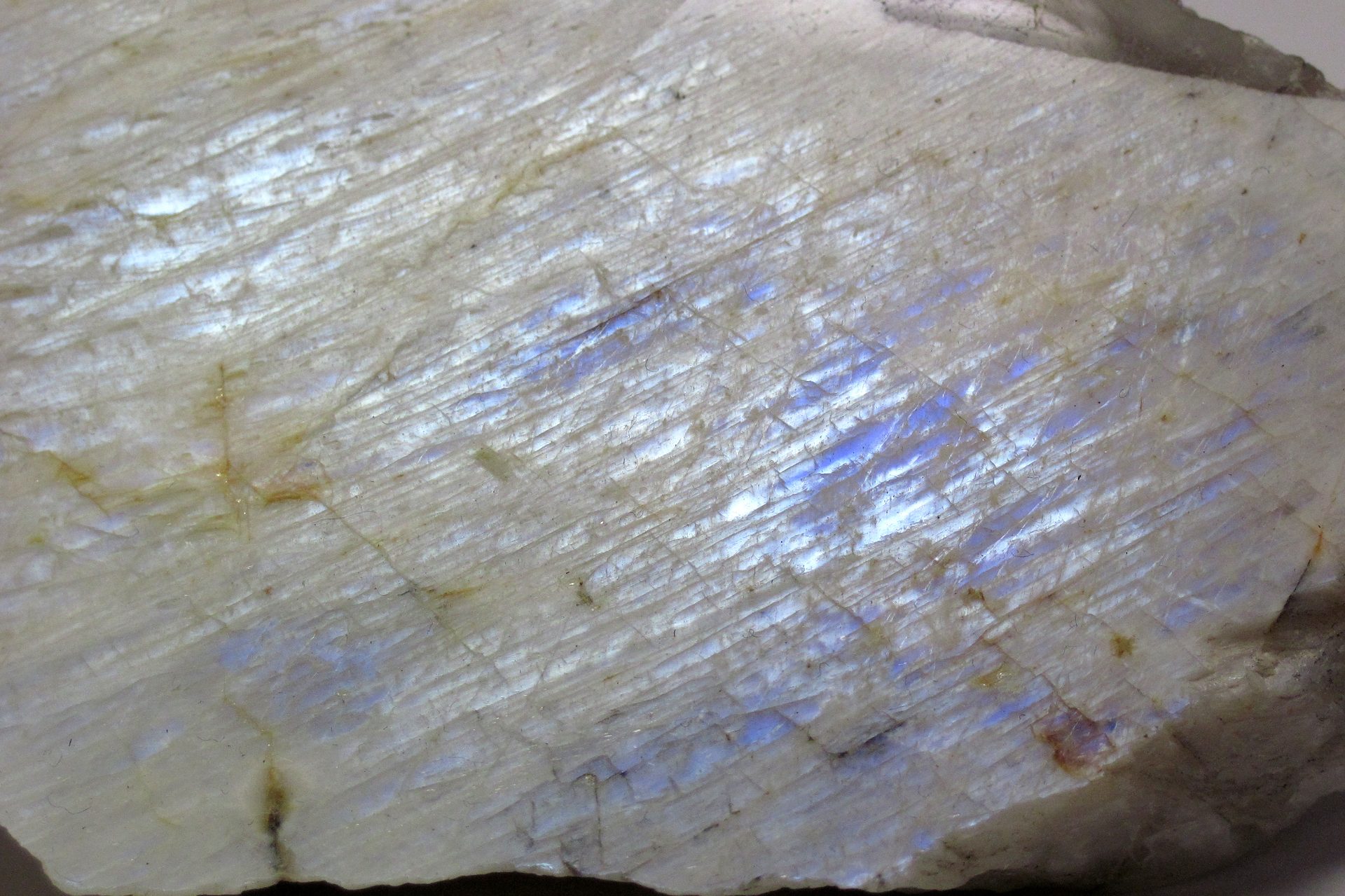
Peristerite
A white to gray feldspar with a ghostly blue adularescence hovering just below the surface.
- Peristerite is named after the pigeon (Greek: peristera) because the blue-white neck iridescence of certain pigeon species resembles the stone's adularescent sheen.
- Much of what is sold as 'moonstone' in lower price ranges is actually peristerite or other plagioclase feldspars - the distinction matters for mineralogical accuracy but not necessarily for practical use.
- The Perth area of Ontario, Canada, has produced some of the most admired North American peristerite - crystalline specimens with strong adularescence sold to collectors by regional mineral dealers.
- Peristerite forms when a cooling feldspar crystal unmixes into alternating albite-rich and oligoclase-rich layers too thin to see individually but thick enough to diffract visible light.
- The softer, less blue sheen of peristerite compared to orthoclase moonstone reflects the different layer thickness in the lamellar structure - a difference of nanometers that creates a distinctly different optical experience.
- Mineral collectors who want an uncommon feldspar variety with genuine adularescent beauty
- Practitioners working with crown and third eye energy who want a cooler, more mineralogical moonstone alternative
- Those drawn to North American geological materials with Canadian or New York State provenance
- Cancer placements seeking a lunar feldspar with a more understated energy than commercial moonstone
- Crystal practitioners who appreciate nuance and subtlety in both mineralogy and energy
- Those who want the strong, dramatic blue flash of premium orthoclase moonstone
- Buyers seeking easily available or widely stocked crystal shop material - peristerite is a specialist find
- Anyone needing a very durable stone - at Mohs 6 with feldspar cleavage, peristerite requires careful handling
What Is Peristerite?
Peristerite is an intergrowth of albite and oligoclase feldspars - two closely related plagioclase feldspar species that crystallize together in alternating microscopic layers during cooling. It rates 6 - 6.5 on the Mohs hardness scale.
This lamellar structure diffracts light in a way that produces adularescence, a floating blue-white sheen visible on the stone's polished surface, similar to (and often confused with) the adularescence of orthoclase moonstone.
The name derives from the Greek peristera (pigeon), referencing the soft, iridescent neck colors of certain pigeon species. This apt naming captures the stone's characteristic quality: a gentle, somewhat muted iridescence that moves as the stone tilts, hovering just below the surface like a wing sheen.
Unlike orthoclase moonstone (which is a single potassium feldspar species), peristerite is specifically the sodium-calcium intergrowth in the albite-oligoclase series. The distinction is mineralogically important but often overlooked in commercial markets where peristerite is frequently sold under the moonstone name.
At Mohs 6 to 6.5, peristerite shares the moderate hardness and two-directional cleavage of all feldspars. Fine specimens from Ontario, Canada, and New York state, particularly the Perth area, have been collected by mineral enthusiasts for decades and represent excellent quality for North American-origin collections.
How Peristerite Compares
| Property | Peristerite | Orthoclase Moonstone | Labradorite |
|---|---|---|---|
| Feldspar type | Plagioclase (albite-oligo) | Potassium feldspar | Calcium plagioclase |
| Optical effect | Soft blue-white sheen | Strong blue flash | Full-spectrum labradorescence |
| Price range | $ Budget | $ Budget | $ Budget |
| Best For | Collector, subtle jewelry | Jewelry, spiritual work | Jewelry, collection |
Meaning and Symbolism
Peristerite shares the lunar associations of all adularescent feldspars, but its softer, more understated sheen gives it a quality practitioners describe as quiet moonlight rather than the dramatic blue flash of premium orthoclase moonstone. This subtlety is the stone's defining characteristic in both mineralogical and metaphysical terms.
In crystal healing tradition, peristerite is connected to the same lunar, intuitive. Emotional intelligence associated with moonstone. With an emphasis on the quieter dimensions of this energy: the soft knowing that comes in the liminal hours, the gentle receptivity that does not announce itself, the moon behind clouds rather than the full moon at zenith.
The stone's association with Cancer through its lunar connection resonates with the sign's most characteristic quality: an emotional intelligence that is often invisible to others but profoundly reliable and self-consistent. Peristerite is said to support practitioners in trusting their own internal knowing even when it is not reflected back by their environment.
Collectors who specialize in the feldspar family sometimes treat peristerite as the unsung member of a remarkable group - less showy than labradorite, less commercially promoted than moonstone, but with a genuine and distinctive beauty that rewards careful attention.
Historical Timeline
Healing Tradition
Emotional
Practitioners believe peristerite carries a particularly soft and patient lunar energy - more appropriate for quiet inner work than for dramatic energetic shifts. In crystal healing tradition, the stone is associated with the kind of emotional knowing that comes through stillness rather than through active inquiry: the soft awareness that surfaces when the practitioner stops seeking and simply receives.
Many readers describe peristerite as the stone for the end of the day - the moment of transition between active engagement and rest, when the day's experiences begin to settle and clarify. The stone is said to support this natural processing that happens in the liminal space between doing and dreaming.
Peristerite is also recommended for practitioners who find louder, more activating stones overwhelming. Its gentle, muted quality makes it appropriate for highly sensitive people and for children's energy work where stronger stones might be too activating.
Spiritual
Peristerite shares moonstone's crown and third eye associations while offering a gentler activation that practitioners describe as appropriate for the beginning stages of intuitive development. In crystal healing tradition, the stone is associated with the initial opening of sensitivity - the first soft impressions of intuitive awareness before it becomes reliably accessible.
The stone's lunar connection also associates it with cyclical spiritual practice - working with moon phases, tidal rhythms, and the natural patterns of expansion and retreat that govern emotional and spiritual life. Peristerite is said to help practitioners attune to these cycles and work with them rather than against them.
For Cancer placements and practitioners with strong Water element emphasis, peristerite is particularly resonant as a stone that validates and supports the kind of intuitive, emotionally intelligent spiritual orientation that does not always fit into more structured or intellectually rigorous practice frameworks.
Physical
Crystal healing tradition connects peristerite to the same physical associations as moonstone: hormonal cycles, the immune system's response to emotional stress, and the body's natural rhythms of rest and activity. The softer energy of peristerite is considered particularly suitable for practitioners who are physically sensitive or in recovery from illness.
Some practitioners use peristerite specifically for the physical manifestations of emotional exhaustion - the fatigue that comes not from physical activity but from sustained emotional weight. The stone's restoring, lunar quality is said to support the body's recovery from this kind of depletion.
Practitioners working with sleep quality and dream recall sometimes use peristerite under the pillow or on a bedside table, treating it as a gentler alternative to moonstone for those who find moonstone's energy too activating for nighttime use.
Zodiac, Birthstone and Gifts
Peristerite's quiet lunar energy resonates deeply with Cancer's governing archetype of emotional intelligence, domestic sanctuary, and the cyclical rhythms of feeling. Practitioners recommend peristerite to Cancer placements as a stone that honors the sign's characteristic knowing without requiring it to be louder or more demonstrative than it naturally is.
For Libra, peristerite's gentle blue-white aesthetic and lunar associations offer a quiet companion for the sign's natural orientation toward beauty and relational attunement. The stone's subtlety suits Libra's appreciation for refinement over display.
Both signs benefit from peristerite's quality of soft, sustainable lunar awareness - the kind of knowing that does not exhaust the practitioner because it operates from a place of receptivity rather than effort.
Care and Cleansing
Brief water rinsing is safe for peristerite. Moonlight cleansing is the most resonant method for a lunar-associated stone - place on a windowsill overnight during the full or new moon.
Smoke cleansing and sound cleansing are both safe and appropriate. Avoid extended direct sunlight to prevent any gradual shift in the stone's delicate optical layers. Salt bed cleansing for 1-2 hours (dry salt, not saltwater) is safe for loose stones.
Store gently and cleanse when the stone feels energetically heavy or when the adularescence appears visually duller than usual under light.
- DO handle peristerite carefully - feldspar cleavage in 2 directions means directional impact can cleave the stone.
- DO store away from harder minerals that can scratch the surface at Mohs 6.
- DO use protective jewelry settings - bezel or halo preferred for any ring applications.
- DO NOT confuse with moonstone for high-value purchases - request mineral species confirmation for stones above $100.
- Note: many commercial 'moonstones' are actually peristerite or other plagioclase - for mineralogical accuracy, request species identification.
Real vs Fake
Peristerite is more likely to be mislabeled as moonstone than to be counterfeited itself. Because peristerite shows moonstone-like adularescence, it is commonly sold under the moonstone name without distinction.
This is not fraud per se - both are naturally adularescent feldspars - but it affects mineral accuracy and in some cases price expectations.
True orthoclase moonstone has a distinct optical quality: a strong, deep blue adularescence that can appear to float above the surface and moves dramatically as the stone tilts. Peristerite's adularescence is typically softer, whiter, and more diffuse.
This difference is visible to the naked eye in quality specimens but may be subtle in average commercial material.
For collectors who specifically want peristerite for mineralogical completeness, requesting the specific species identification (plagioclase series, albite-oligoclase intergrowth) and locality (Ontario, New York, Norway) from the dealer provides the most reliable identification.
Glass imitation 'moonstone' exists but is identified by its warmer temperature in the hand, lighter weight, absence of natural mineral inclusions, and perfectly uniform distribution of the optical effect.
Peristerite Jewelry & Gifts
Peristerite is relatively affordable: cabochons suitable for jewelry run $10-$40; fine specimens from specific collector localities (Perth Ontario, Gouverneur New York) cost $30-$100. Exceptional specimens with strong, even adularescence can reach $150-$300 from specialist mineral dealers.
When evaluating peristerite, look for clean adularescence that moves across the surface as the stone tilts, a white to gray base color without significant brownish or yellowish cast, and surface quality without deep scratches or chips.
Ontario Canada and New York State material from named localities is the most mineralogically precise purchase; less specified 'moonstone' from Indian sources may be peristerite or orthoclase - request clarification if mineralogical accuracy matters.
For crystal practice purposes (rather than collector interest), the adularescence and energy properties are more important than the specific feldspar species, and commercial 'moonstone' priced similarly serves the same practical purpose.
Where to Buy Peristerite
Affiliate disclosure: Some links below earn us a small commission at no extra cost to you. See our affiliate disclosure page.
Handmade, raw, and tumbled pieces from independent sellers worldwide.
Shop Peristerite on Etsy →Accessories, tools, and specimen sets with fast Prime delivery.
Shop Peristerite on Amazon →Certified loose gemstones graded and photographed for online buyers.
Shop Peristerite on GemSelect →Pairs Well With


Where Peristerite Is Found


