Pietersite
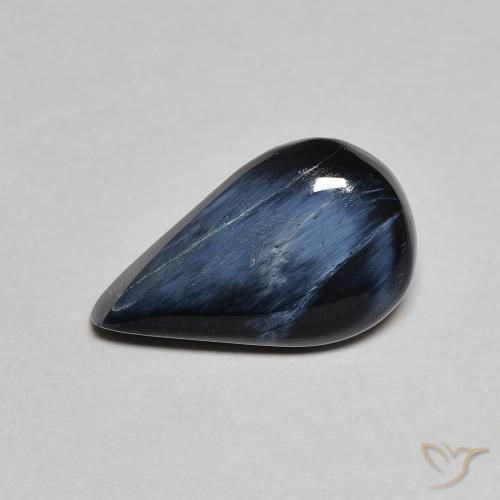
Called the tempest stone for its swirling blue, red, and gold fibers, pietersite is a rare breccia fixed forever in shimmering chatoyancy.
- Pietersite was discovered in 1962 by Sid Pieters, for whom the stone is named.
- The swirling fibers in pietersite are silica-replaced amphibole, cousin to the fibers in tiger's eye.
- The trade name tempest stone describes the storm-like motion of color beneath the polished surface.
- Namibian pietersite is typically more blue-dominated, while Chinese pietersite tends toward red-brown.
- Each pietersite cabochon is visually unique because the breccia formed in random geological chaos.
- Collectors who love chatoyant cabochons with strong color movement
- Readers drawn to stones with a storm-energy reputation
- Practitioners working on courage, leadership, and clarity under pressure
- Designer jewelry buyers looking for an unusual statement stone
- Pocket-stone users who want a worry stone with visual interest
- Buyers who want transparent faceted gems (try labradorite or spectrolite)
- Shoppers seeking widely recognized stones (pietersite is niche)
- Readers looking for an ancient tradition (pietersite is a 1962 discovery)
What Is Pietersite?
Pietersite is a chatoyant brecciated variety of silicified hawk's eye and tiger's eye, formed when original hawk's-eye (crocidolite-replaced quartz) was broken, reworked, and resilicified during geological faulting. It rates 6 - 7 on the Mohs hardness scale.
The result is a fibrous mass of blue, red-brown, gold, and occasionally black chatoyant fibers swirled together rather than aligned in parallel, which gives pietersite its characteristic “storm” look instead of the single-direction sheen of tiger's eye.
The stone was discovered in 1962 by Sid Pieters in the Kaokoveld region of northwestern Namibia, and was named after him in 1964. A second major source in China's Henan Province was identified in the 1990s, producing similar but visually distinct material with more red-brown fibers.
Mineralogically, pietersite is not a single mineral but an aggregate of silica-replaced amphibole fibers (primarily crocidolite and less commonly other iron-rich amphiboles) bound in microcrystalline quartz.
Hardness ranges approximately 6 to 7 on the Mohs scale depending on composition, with more silicified pieces approaching quartz-family hardness and less silicified pieces trending softer. Specific gravity is approximately 2.78 to 2.90.
Because pietersite is a breccia, each specimen is unique, and lapidaries prize material with strong color swirl, pronounced chatoyancy, and minimal matrix. Most pietersite is cut en cabochon to display the moving fibers, and some pieces are carved into beads or palm stones.
How Pietersite Compares
| Property | Pietersite | Tiger's Eye | Labradorite |
|---|---|---|---|
| Hardness | 6 - 7 | 6.5 - 7 | 6 - 6.5 |
| Price / carat | $ Budget | — | $ Budget |
| Rarity | Rare | Common | Moderate |
| Best For | Statement cabochons, worry stones | Daily wear, carvings | Statement jewelry |
Meaning and Symbolism
Pietersite's meaning is entirely modern because the stone was only identified in 1962. Its cultural weight has been shaped by American and European crystal writers in the late twentieth century, who quickly adopted the stone's swirling fibers as a visual metaphor for storm energy.
The trade name tempest stone captures this: pietersite is traditionally associated with the energy of a storm passing through, bringing both turbulence and the clarity that follows.
In contemporary crystal tradition, pietersite is traditionally associated with the third eye and solar plexus chakras. Practitioners believe the stone supports clarity under pressure, courageous leadership, and the capacity to see through confused or chaotic moments.
Many find pietersite a useful companion during career upheavals, legal transitions, or any period where a reader needs to stay focused despite external turbulence. The stone is sometimes called the leader's stone in modern crystal writing for these reasons.
Because pietersite is uncommon and visually distinctive, it has developed a small, loyal community of practitioners who collect it specifically. The 1962 discovery and naming story have given the stone a contemporary mythology of hidden treasure revealed.
Many crystal writers frame pietersite as a stone of timing, as in the right insight arriving at the right moment. Namibian material carries the strongest traditional association, and the later Chinese find has expanded supply without displacing the Namibian original.
Historical Timeline
Healing Tradition
Emotional
Practitioners believe pietersite is a stone of clarity during turbulent moments. In crystal healing tradition, it is said to support a wearer who needs to see through confusion, especially during conflict, legal uncertainty, career upheaval, or emotionally charged family situations.
Many find pietersite a useful daily carry during long work transitions, difficult moves, or periods of public-facing pressure where staying focused is the main task.
Pietersite is often paired with black tourmaline for active protective grounding, with smoky quartz when old fears need to settle before the current situation can be handled, and with rose quartz when the storm involves close relationships and requires the heart to stay tender.
Practitioners tend to describe pietersite as energizing rather than sedating, which is why it is typically recommended for daytime carry rather than sleep.
Spiritual
In crystal healing tradition, pietersite is said to bridge the third eye and solar plexus chakras with a dynamic, storm-like energy. Practitioners believe the stone supports readers whose spiritual path involves leadership, teaching, or service roles under pressure, where clear seeing and steady personal power must work together.
Because pietersite is a modern stone, it has no classical planetary assignment; contemporary practitioners often associate it with Mercury for its connection to communication in chaos and with Mars for courageous action.
Many find pietersite useful in meditation focused on discernment during transition, and some readers use the stone during new-moon intention-setting when a major decision is pending. Holding pietersite during difficult phone calls or before high-stakes meetings is a common ritual in contemporary crystal communities.
Physical
Practitioners believe pietersite supports what they describe as steady nervous-system response under pressure, with folklore tying the stone's storm imagery to the body's capacity to stay regulated during stress. Crystal healing tradition associates pietersite with metabolic warmth, lymphatic movement, and immune resilience in gentle, metaphorical terms.
Many find carrying a pietersite palm stone during high-pressure work days, demanding travel, or convalescent periods supportive. Pietersite is not a substitute for medical care, and practitioners frame its role as supportive rather than curative.
Readers with chronic anxiety, migraine, or stress-related conditions are encouraged to rely on qualified medical guidance and treat crystal practice as one element of a broader routine.
Zodiac, Birthstone and Gifts
Pietersite has no traditional birthstone role and is adopted in contemporary astrology on the basis of color, temperament, and energetic reputation rather than ancient assignment. Many astrologers suggest pietersite for Leos in leadership roles who want a stone that holds fire and clarity together during public-facing work.
Scorpios drawn to stones that handle intensity without becoming unmoored also frequently adopt pietersite, especially during transformative life chapters. In modern Western astrology, the stone is often associated with Mercury and Mars.
Because pietersite is a modern discovery, it has no Vedic prescription and is used on an intention basis by practitioners who find its energy a match for their current needs.
Care and Cleansing
Pietersite cleanses gently. Dry cloth wiping handles daily maintenance, and short lukewarm soapy rinses are acceptable for loose cabochons if dried immediately. Avoid ultrasonic and steam cleaners, which can stress the brecciated structure, loosen fibers, or propagate internal fractures. Saltwater should be avoided entirely because of the fibrous amphibole content.
Smoke cleansing with palo santo or sage is the most commonly recommended method for pietersite, echoing the stone's storm symbolism. Moonlight and brief sunlight exposure are safe because the stone is color-stable. Sound cleansing with a singing bowl placed near rather than under the stone is appropriate.
Many practitioners recharge pietersite by resting it on a clear quartz cluster or selenite slab overnight, a passive method that avoids any handling risk. Dry salt placement can be used briefly but should not be prolonged.
- DO store pietersite in a soft-lined box away from harder stones.
- DO NOT use ultrasonic or steam cleaners on pietersite.
- DO handle pietersite by the edges and wipe with a soft cloth.
- DO NOT soak pietersite in saltwater, harsh cleaners, or bleach.
- DO remove pietersite rings before sports and heavy housework.
- DO ask for disclosure of any stabilization or resin treatment.
- Note: pietersite contains amphibole fibers; avoid handling broken or raw surfaces without cleaning hands afterward.
Real vs Fake
Genuine pietersite shows swirling, multi-directional chatoyant fibers in a brecciated pattern rather than parallel fibers like tiger's eye. Colors typically include blue, red-brown, gold, and occasionally black, all visible within a single polished cabochon.
Common substitutes include dyed tiger's eye, composite reconstructed pieces bonded with resin, and entirely synthetic glass or resin imitations designed for costume jewelry.
Under 10x magnification, real pietersite shows fibrous mineral structures running in multiple directions within the breccia, with visible fine-grained silica matrix holding them together. Dyed tiger's eye retains its single-direction fiber pattern even when colored unusually.
Composite pietersite shows resin bonding lines between smaller pieces, and glass imitations reveal curved bubbles and mold seams. A scratch test with quartz will distinguish soft imitations from real pietersite's 6 to 7 hardness.
Practical at-home clues include checking whether the cabochon shows genuine moving chatoyancy (tilt the stone under a single light source. Fibers should flash across the surface in swirled patches rather than in one clean band), examining the back of the cabochon for matrix texture.
Weighing the stone (real pietersite is denser than typical glass imitations).
Because pietersite pricing is moderate rather than ultra-high, outright forgery is less common than misrepresented dyed tiger's eye or composite material; buying from established gem-show or online lapidary dealers reduces risk significantly.
Pietersite Jewelry & Gifts
Pietersite pricing depends on size, color balance, chatoyant quality, and origin. Small tumbled stones sell for $5 to $25, cabochons $15 to $100, palm stones $25 to $150, and larger designer cabochons $100 to $400.
Finished silver jewelry with pietersite runs $50 to $400, and larger showpiece cabochons set in designer pendants can reach $800 or more for exceptional material.
Namibian pietersite from the Kaokoveld region is the traditional benchmark and carries a modest premium for color-rich blue-dominated stones with sharp chatoyancy. Chinese pietersite from Henan Province supplies significant supply today, typically with more red-brown and gold-dominated fibers and slightly lower prices.
Both sources produce collector-grade material, and many buyers collect across both origins for color variety. Treatments are uncommon; most pietersite is sold natural with only polishing, and any stabilization or dyeing should be disclosed.
Reconstructed or composite pietersite occasionally appears in wholesale channels at lower prices and is typically acknowledged by reputable dealers.
Where to Buy Pietersite
Affiliate disclosure: Some links below earn us a small commission at no extra cost to you. See our affiliate disclosure page.
Handmade, raw, and tumbled pieces from independent sellers worldwide.
Shop Pietersite on Etsy →Accessories, tools, and specimen sets with fast Prime delivery.
Shop Pietersite on Amazon →Certified loose gemstones graded and photographed for online buyers.
Shop Pietersite on GemSelect →Pairs Well With



Where Pietersite Is Found

