Hawk’s Eye
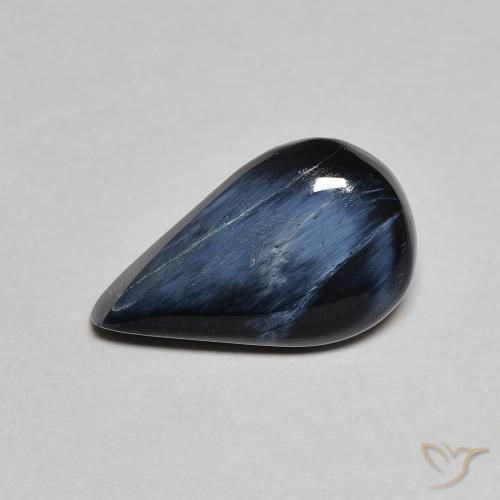
The blue-gray cousin of tiger's eye, hawk's eye is a chatoyant quartz practitioners associate with sharp perception and grounded vision.
- Hawk's eye is the geological pre-stage of tiger's eye; full silicification of crocidolite turns blue to gold.
- Both stones come from the same South African deposits and are often found together in adjacent layers.
- The chatoyant band of light moves across the stone as it tilts, mimicking the appearance of a hawk's pupil.
- Hawk's eye contains microscopic crocidolite fibers, so cutters use water cooling to avoid airborne dust.
- The stone has been called falcon's eye and rhodesite in different historical markets, but hawk's eye is now standard.
- Practitioners working with third eye perception and grounded vision
- Tiger's eye fans wanting the blue-gray pre-stage variant
- Daily-wear cabochon ring buyers wanting affordable chatoyant material
- Crystal carriers seeking a focus stone for goal-oriented work
- Collectors building a chatoyant quartz reference suite
- Buyers needing transparent faceted gemstones (try blue topaz)
- Shoppers wanting pure deep blue (try lapis lazuli)
- Those allergic to fibrous mineral dust during cutting (raw material only)
What Is Hawk’s Eye?
Hawk's eye is a chatoyant variety of quartz that forms when silica replaces fibers of the blue asbestos mineral crocidolite while preserving the original fibrous structure. The result is a translucent to opaque blue-gray stone that shows a moving silky band of light, called chatoyancy, when polished into a cabochon.
Hawk's eye is a key step in the geological story of tiger's eye formation.
When the silicification process is incomplete or stops early, the stone retains its original blue-gray color and is sold as hawk's eye. When the iron in the crocidolite fibers oxidizes and the silica fully replaces them, the stone changes to the golden-brown of tiger's eye.
Both stones come from the same deposits and often appear together, with hawk's eye usually as the deeper, less weathered material.
Most hawk's eye on the market comes from South Africa's Northern Cape province, specifically the Asbestos Mountains where the crocidolite-bearing banded ironstone formations are exposed. Western Australia, Brazil, and India produce smaller quantities.
The stone is cut as cabochons, beads, or carvings to display the chatoyant effect, never as facets, since faceting destroys the silky band of light. A high-quality hawk's eye shows a single sharp band of moving light across a deep blue-gray body.
How Hawk's Eye Compares
| Property | Hawk's Eye | Tiger's Eye | Pietersite |
|---|---|---|---|
| Hardness | 6.5 - 7 | 6.5 - 7 | 6.5 - 7 |
| Price / carat | $ Budget | $ Budget | $ Budget |
| Color | Blue-gray with chatoyancy | Golden brown with chatoyancy | Blue-gold storm pattern |
| Best For | Vision work, grounding | Confidence, courage | Storm-energy work |
Meaning and Symbolism
Hawk's eye carries meaning shaped by both its name and its geological origin. The stone is named for the sharp watchful eye of the hawk, and across cultures the hawk has long been associated with keen vision, alertness, and the ability to see clearly from a high vantage point.
Modern crystal tradition has carried this symbolism directly into the stone's reputation, framing hawk's eye as a tool for perspective and discernment.
Because hawk's eye and tiger's eye form from the same crocidolite-replacement process, the two stones are sometimes called sister stones. Hawk's eye represents the cooler, earlier stage of the transformation, while tiger's eye represents the warmer, later stage.
Practitioners often use this geological story symbolically: hawk's eye for the planning and seeing phase, tiger's eye for the courage and action phase that follows.
In modern crystal healing tradition, hawk's eye is associated with the third eye and throat chakras. Practitioners believe it supports clear perception of complex situations, strategic thinking, and the discipline to articulate what one sees without distortion.
Many find it useful for analysts, planners, writers, and decision-makers in stressful environments. Hawk's eye is commonly recommended for travelers and people facing transitions because of its symbolic association with seeing the larger landscape ahead. It is sometimes called the boss's stone in casual crystal lore for its strategic-vision reputation.
Historical Timeline
Healing Tradition
Emotional
Practitioners believe hawk's eye supports calm, clear emotional perception during stressful periods. In crystal healing tradition, it is said to help readers see their own situation from a higher vantage point, much as a hawk circles above a landscape before deciding where to land.
Many find hawk's eye useful during workplace conflicts, family negotiations, or complex decisions where emotional reactivity is clouding judgment. The stone is often recommended as a daily-carry companion for analysts, managers, and parents handling competing demands.
Because hawk's eye carries cool blue-gray energy, practitioners sometimes pair it with warmer stones like carnelian when emotional clarity needs to translate into bold action. It is rarely described as a stone for catharsis or rapid mood shift; its reputation is observational, strategic, and slightly detached in the most useful sense.
Spiritual
In crystal healing tradition, hawk's eye is considered a strategic vision stone working at the third eye. Practitioners believe its blue-gray frequency supports inner sight that is grounded in practical reality rather than visionary abstraction, complementing more dreamlike stones like labradorite or moonstone.
The hawk symbolism connects the stone to many shamanic and indigenous traditions in which the bird represents messenger energy and high perception.
Many practitioners use hawk's eye during meditation focused on planning, discernment, or the willingness to look at a situation honestly before acting. The stone is also recommended for writers and creative workers translating large visions into structured plans.
It pairs naturally with tiger's eye for combined vision-and-courage practice and with clear quartz for amplification.
Physical
Practitioners believe hawk's eye supports what traditions describe as eye health, mental focus during fatigue, and the steady alertness needed for long demanding work. Folklore associating the hawk with sharp vision extends to the stone in modern crystal writing, though most physical correspondences are 20th-century rather than ancient.
Hawk's eye is not a substitute for medical care, and crystal traditions frame it as supportive rather than curative.
Many readers wear hawk's eye pendants during long screen-work days, intensive study sessions, or periods of professional stress. Practitioners sometimes place a polished cabochon on the brow during rest to echo the third-eye placement common with other vision stones.
Because hawk's eye contains crocidolite fibers, cutters take precautions during fabrication, but polished finished stones are completely safe to wear.
Zodiac, Birthstone and Gifts
Hawk's eye is not a classical birthstone, but modern crystal writers often suggest it for Capricorn because of the strategic, planning-oriented symbolism. Astrologers traditionally associate the stone with Saturn for its disciplined long-view quality and with Mars for its sharp alertness.
Sagittarius readers also respond well to hawk's eye for its travel and big-picture associations. Earth signs broadly find the stone grounding; air signs may use it to anchor floating ideas into structured plans. Water signs typically pair hawk's eye with a warmer stone for emotional balance in their work.
Care and Cleansing
Hawk's eye is generally stable and tolerates gentle cleaning. Lukewarm soapy water with a soft brush removes skin oils and grime safely; rinse and dry with a soft cloth. Avoid prolonged soaking, hot water, and ultrasonic cleaners because the stone's fibrous structure can be disturbed by vibration or extended moisture exposure.
Moonlight, smoke (sage, palo santo, cedar), and sound cleansing are all considered safe. Brief sunlight exposure for cleansing is acceptable, but prolonged sun can fade the deepest blue-gray hues over time, so practitioners generally favor moonlight or smoke methods.
Recharging on a clear quartz cluster overnight is standard, and many readers cleanse hawk's eye between major decision cycles.
- DO clean hawk's eye with lukewarm soapy water and a soft cloth; dry promptly to avoid moisture seeping along fibers.
- DO NOT soak hawk's eye for extended periods in any liquid, including saltwater.
- DO store hawk's eye separately from harder stones like sapphire and topaz.
- DO NOT use ultrasonic or steam cleaners; vibration can disturb the chatoyant fibers.
- DO limit prolonged direct sunlight exposure; some hawk's eye fades to gray over time in strong UV.
- DO use protective bezel settings for ring wear since the stone has only fair toughness.
- Note: cabochons and beads should not be re-faceted; faceting destroys the chatoyant band of light.
Real vs Fake
Genuine hawk's eye shows a clear chatoyant band that moves smoothly across the stone as it is tilted.
Imitations made from dyed glass or fiber-optic cat's-eye glass show a thin, sharp, perfectly straight line that does not move naturally with tilt; real hawk's eye chatoyancy is broader, softer, and has subtle texture from the underlying crocidolite fibers.
Color is another tell. Real hawk's eye runs from deep blue-gray to slate blue with subtle warm undertones from partial silicification.
Stones sold as hawk's eye that are uniformly bright royal blue are usually dyed howlite or glass. Place a small drop of acetone on an inconspicuous area; dye will lift, while real color will not.
At home, you can scratch glass easily with hawk's eye and check for the subtle banded structure visible against strong light. Real hawk's eye also feels cool and dense; very light pieces with hollow sound on tap are likely glass.
Some sellers market mixed hawk-tiger's eye material (often called blue-gold tiger's eye or pietersite-style stone) as hawk's eye; while these are real chatoyant quartz, they are not pure hawk's eye and should be priced accordingly.
For larger pieces above two inches, request provenance documentation if the stone is sold as Northern Cape South African material, since this commands a small premium. Synthetic chatoyant glass exists but is easily distinguished by a flawless internal structure under magnification.
Hawk’s Eye Jewelry & Gifts
Hawk's eye is one of the most affordable chatoyant gemstones in the trade. Small tumbled pieces run $2 to $10 each. Cabochons in the 10mm to 20mm range with sharp chatoyancy and good color saturation run $5 to $40.
Larger statement cabochons above 30mm with single, well-centered chatoyant bands can reach $50 to $150 depending on quality.
Beaded hawk's eye necklaces and bracelets are widely available in the $15 to $80 range, with finer-quality strands showing strong consistent chatoyancy across all beads. Carvings and small sculptures vary by craftsmanship and size, often falling between $30 and $300.
Hawk's eye is generally untreated. Heat treatment is occasionally used to enhance the gold tones in mixed hawk-tiger's eye material, but pure hawk's eye is sold in its natural state. Always ask about disclosure, especially for stones marketed as deep-blue Northern Cape material.
For collector specimens with named-locality provenance, expect modest premiums but verify with photographic documentation.
Where to Buy Hawk’s Eye
Affiliate disclosure: Some links below earn us a small commission at no extra cost to you. See our affiliate disclosure page.
Handmade, raw, and tumbled pieces from independent sellers worldwide.
Shop Hawk’s Eye on Etsy →Accessories, tools, and specimen sets with fast Prime delivery.
Shop Hawk’s Eye on Amazon →Certified loose gemstones graded and photographed for online buyers.
Shop Hawk’s Eye on GemSelect →Pairs Well With




Where Hawk’s Eye Is Found


