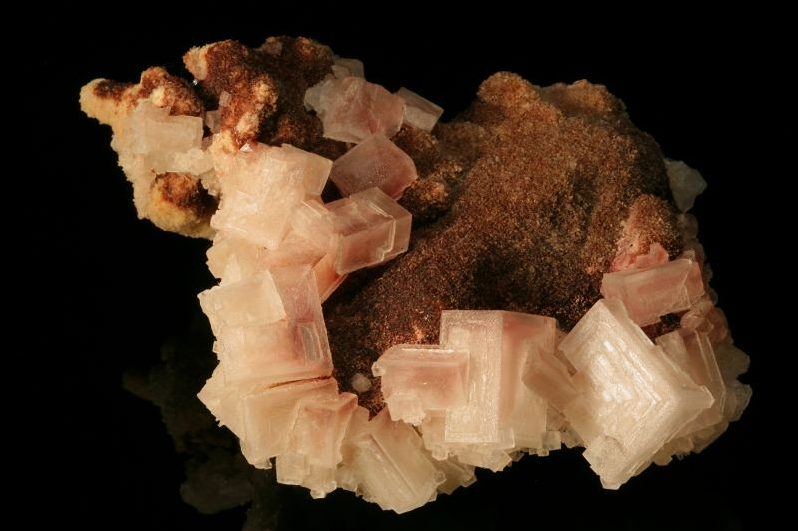
Pink Halite
Delicate cubic pink salt crystals from ancient Permian evaporite deposits, prized for rarity, pastel color, and heart chakra associations.
- Pink halite gets its color from beta-carotene-producing halobacteria or iron inclusions trapped in ancient evaporite deposits - essentially ancient microscopic life gives it its pink hue.
- Halite's perfect cubic cleavage means it breaks into perfect cubes when struck - the same geometry as its crystal form, right down to the atomic level.
- The word 'salary' is derived from the Latin 'salarium' - Roman soldiers were sometimes partially paid in salt (sal), reflecting salt's extraordinary historical value.
- Pink halite dissolves completely in water - a specimen left on a damp surface overnight could be noticeably smaller by morning.
- Halite is the most common evaporite mineral on Earth, found in sedimentary sequences on every continent, but naturally pink specimens represent only a small fraction of total halite deposits.
- Heart chakra practitioners who want a delicate, emotionally soft crystal companion
- Mineral collectors interested in cubic crystal habit and evaporite mineralogy
- Gift givers who want something genuinely rare and visually unusual for a crystal-loving friend
- Display collectors comfortable with delicate specimen care requirements
- Practitioners who use the visual quality of crystals as a meditation focal point
- Those wanting a durable everyday handling stone - pink halite dissolves in water and scratches at Mohs 2; choose rose quartz for durable heart energy
- Homes with high humidity or near water sources - the crystal will literally dissolve over time in humid conditions
- Pet households where animals might lick specimens - while salt is food-grade, large crystal ingestion can be harmful to pets
What Is Pink Halite?
Pink halite is naturally colored halite (NaCl, common salt) that forms pastel pink to deep rose cubic crystals due to trace amounts of beta-carotene-producing bacteria or iron inclusions trapped during crystallization in ancient evaporite basins. It rates 2 - 2.5 on the Mohs hardness scale.
The color can range from barely-there blush to vivid salmon pink, depending on the concentration of pigmenting compounds at the time of crystal formation. Halite crystallizes in the cubic (isometric) system and is the mineral form of ordinary table salt.
The Mohs hardness of 2 to 2.5 makes pink halite among the softest collectible minerals - softer than a fingernail at Mohs 2.5. The cubic crystal habit is perfecty geometric, with natural 90-degree cleavage planes creating the characteristic blocky, stepped appearance.
Specimens from Trona, California, and the Permian Basin of Kansas are most commonly available in the US crystal market, though notable deposits also exist in Germany, France, and Poland.
Pink halite's most critical physical property for collectors is its water solubility. As the mineral form of table salt, it dissolves rapidly in water - a brief splash can damage delicate crystals. Storage in low-humidity environments is essential for specimen preservation.
Despite its fragility, fine pink halite specimens are genuinely beautiful, with gem-like translucency and perfect cubic geometry that no other mineral replicates.
How Pink Halite Compares
| Property | Pink Halite | Rose Quartz | Pink Calcite |
|---|---|---|---|
| Hardness | 2 - 2.5 | 7 | 3 |
| Price / piece | $ Budget | $ Budget | $ Budget |
| Water Safe | No - dissolves | Yes | Brief only |
| Crystal Habit | Perfect cubic | Massive | Rhombohedral |
Meaning and Symbolism
Salt has been among humanity's most symbolically significant substances for thousands of years - used in religious ritual, trade, preservation, and as the source of the word 'salary' (Roman soldiers were sometimes paid in salt). Pink halite inherits this ancient symbolism of purity, preservation, and fundamental necessity.
Its pink color adds a layer of softness and heart energy to salt's traditionally cleansing and protective associations.
In crystal healing tradition, pink halite is associated with gentle emotional cleansing - not the dramatic transformation of more intense stones, but a soft, steady clarification. Practitioners describe it as releasing emotional residue accumulated over time, like a gentle salt rinse for the energetic body.
The cubic crystal form is seen as representing structure, order, and the perfect geometric laws underlying apparent chaos.
Many practitioners use pink halite specifically for self-compassion practices, noting its visual delicacy as a reminder to treat oneself with the same gentle care required to preserve the crystal.
Its rarity and fragility are themselves part of its metaphysical significance - the most tender and beautiful things require careful attention and the right conditions to flourish.
Historical Timeline
Healing Tradition
Emotional
Practitioners believe pink halite carries a gentle, clarifying emotional energy that gently releases accumulated emotional residue without forcing dramatic catharsis. It is said to support self-compassion and the ability to receive care from others, making it useful for individuals who habitually prioritize others' needs over their own.
Many crystal workers use it in heart chakra practices focused on softening emotional self-criticism and releasing old grief that has calcified over time. The stone's own fragility is traditionally interpreted as wisdom: that tenderness requires care and the right conditions, and that honoring this is not weakness but intelligence.
Practitioners describe it as particularly helpful for those in healing professions or caretaking roles who need support in receiving as well as giving.
Spiritual
In crystal healing tradition, pink halite is associated with the heart chakra and the energetic cleansing that salt has represented across spiritual traditions for thousands of years.
Practitioners use it in energy clearing rituals, noting that salt's purifying association combined with pink's heart energy creates what many describe as a gentle emotional detox effect.
The cubic crystal form is said to bring geometric clarity and order to emotionally chaotic states, supporting the perception of underlying structure and meaning within difficult experiences. Many practitioners include pink halite on altars during new moon ceremonies focused on emotional release and renewal.
Physical
Practitioners traditionally associate salt minerals including pink halite with the concept of cellular cleansing and purification in the energetic body. It is placed near the heart center during relaxation sessions by those working with emotional and physical integration.
Crystal wellness practitioners sometimes use pink halite as a visual meditation anchor during breathwork focused on releasing physical tension held in the chest. Important note: pink halite should never be used to make water elixirs or gem water because it dissolves into the water, creating a salt solution.
Use visual and dry energetic engagement only.
Zodiac, Birthstone and Gifts
Pisces, a water sign associated with emotional sensitivity and compassionate empathy, resonates with pink halite's gentle emotional cleansing tradition. Practitioners suggest that Pisces individuals, who often absorb others' emotional states, may find the stone's clarifying energy helpful for distinguishing personal feelings from absorbed emotional residue.
Cancer's deep emotional nature and association with nurturing, home, and the lunar cycle connect naturally to pink halite's moon and Venus planetary associations. The stone's fragility mirrors Cancer's need for safe, caring environments to thrive. Practitioners recommend pink halite for Cancer individuals working on healthy emotional boundaries.
Care and Cleansing
Never use water or any wet method to cleanse pink halite. This is not a preference - halite dissolves in water, and even brief moisture contact can damage or destroy crystal faces and edges. Similarly, do not place in salt bowls or near humidifiers.
The crystal itself is salt and needs no salt cleansing.
Safe cleansing options are dry only: sunlight on a dry surface for 30 to 60 minutes, sound cleansing with a singing bowl or bell, or visualization. Selenite plate charging is popular and effective.
Smudging with sage or palo santo is safe as long as no water or moisture is involved in the process. Many practitioners feel pink halite needs less energetic cleansing than other stones because of salt's inherently purifying nature.
- CRITICAL: Do NOT let pink halite contact water, even briefly - the mineral dissolves and crystal faces will be permanently damaged.
- DO store in a cool, low-humidity environment - a sealed display case or cabinet is ideal to protect from atmospheric moisture.
- DO NOT use as a water elixir or gem water - dissolving halite creates a salt solution, not a safe elixir.
- DO handle gently with dry hands - fingerprint oils and moisture from skin can dull crystal faces over time.
- DO NOT store near indoor plants, aquariums, or other humidity sources.
- DO wrap in dry tissue paper or store in a sealed container for transport to prevent moisture and physical contact damage.
- NOTE: if a crystal surface becomes dull from handling, do not attempt to clean with water - consult a mineral preservation specialist.
Real vs Fake
Genuine pink halite is identifiable first by its perfect cubic crystal geometry with clean 90-degree cleavage faces. The color should be a natural pastel pink to salmon, distributed unevenly within the crystal mass rather than uniformly throughout.
Dyed salt crystals are sometimes sold as pink halite, but natural specimens have color arising from within the crystal structure rather than coating or surface treatment.
The simplest verification test is touching a small inconspicuous spot with a barely damp fingertip. Genuine halite immediately shows a dull, dissolved surface spot - it is literally salt reacting to moisture. Colored glass or resin fakes will not react this way.
Taste is also diagnostic (and safe with natural halite) - genuine halite tastes salty because it is sodium chloride.
Pink color in genuine specimens may be uneven or concentrated in certain growth zones, reflecting variation in bacterial or iron concentrations during crystallization. Uniformly bright, vivid, unnaturally even pink coloring in what is claimed to be natural crystal suggests dyed material.
Price is also a useful signal: genuine mineral-grade pink halite costs significantly more than bulk pink salt sold for bath use.
Pink Halite Jewelry & Gifts
Pink halite is a mid-range specialty mineral with prices reflecting rarity and crystal quality rather than common crystal economics. Small individual crystals or clusters typically sell for $15 to $40. Larger, well-formed specimens with vivid color and multiple cubic crystal faces range from $40 to $120.
Museum-grade pieces with exceptional clarity and color reach higher prices at mineral shows.
The key quality factors are color intensity, crystal clarity, and completeness of cubic faces. Deep salmon or rose-pink specimens with minimal matrix and clearly formed cubic crystal geometry command the highest prices. Pale or barely-pink specimens are less prized but still collectible.
Look for crystals where the cubic cleavage planes are clean and sharp, indicating careful collection and handling.
Purchase from reputable mineral dealers or specialty crystal shops that can confirm origin and crystal integrity. California's Searles Lake (Trona area) and Kansas Permian Basin are the most reliable US sources. European salt mine specimens from Germany and Poland also appear in collector markets.
Verify the seller stores specimens in appropriate low-humidity conditions before shipping.
Where to Buy Pink Halite
Affiliate disclosure: Some links below earn us a small commission at no extra cost to you. See our affiliate disclosure page.
Handmade, raw, and tumbled pieces from independent sellers worldwide.
Shop Pink Halite on Etsy →Accessories, tools, and specimen sets with fast Prime delivery.
Shop Pink Halite on Amazon →Certified loose gemstones graded and photographed for online buyers.
Shop Pink Halite on GemSelect →Pairs Well With

Where Pink Halite Is Found
