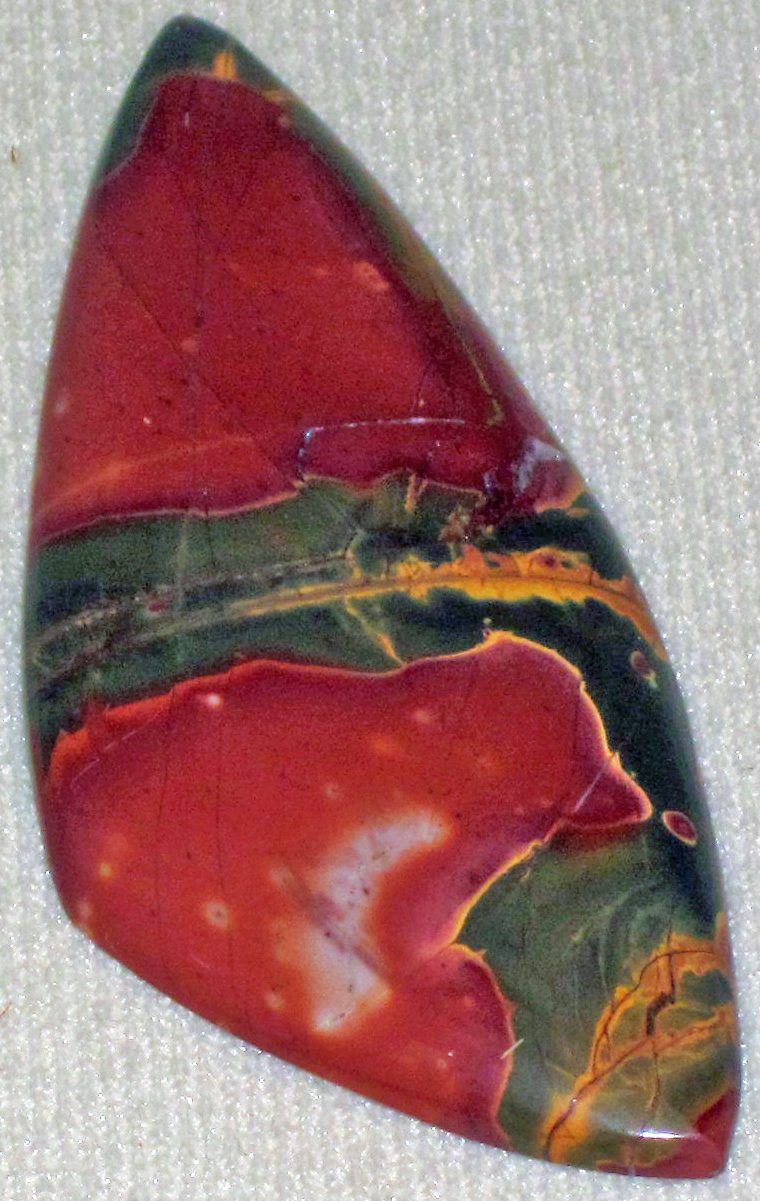
Red Creek Jasper
A river-canyon palette in stone - Red Creek Jasper swirls red, cream, and gold in patterns no two specimens share.
- No two Red Creek Jasper slabs share the same pattern - the formation process ensures total uniqueness.
- The red color comes from hematite and goethite inclusions, not from dyes or treatments.
- Jasper is derived from the Greek 'iaspis,' itself borrowed from a Semitic root meaning 'speckled stone.'
- China is the among the largest known supplier of jasper rough, exporting to lapidary markets on every continent.
- The 'creek' in the name refers to iron-stained river sediment zones in Gansu Province, not a single named waterway.
- Collectors who prize wild, one-of-a-kind patterning over uniform color
- Anyone drawn to earthy warm palettes for home decor or altar displays
- Budget lapidary students who want a forgiving, polishable material
- Practitioners working with Root or Sacral chakra grounding practices
- Gift buyers seeking a visually dramatic stone under $30
- Jewelry shoppers wanting a consistent color - each stone looks different; consider carnelian for uniformity
- Fine jewelry settings requiring a hard, scratch-resistant gem - consider red garnet (Mohs 7-7.5)
- Anyone who needs a well-documented Western provenance - this stone's trade name is informal
What Is Red Creek Jasper?
Red Creek Jasper is a multicolor microcrystalline quartz mined from the Gansu Province of northwestern China, near the historic Red Creek riverbed. Its iron-oxide inclusions produce swirling bands of brick-red, cream, tan, olive, and occasional blue-gray that no lapidary could replicate artificially. It rates 6.5 - 7 on the Mohs hardness scale.
The stone belongs to the broad jasper family - opaque, fine-grained chalcedony stained by mineral impurities during silica deposition millions of years ago.
Mineralogically, the stone is silicon dioxide (SiO2) with iron, manganese, and clay mineral inclusions driving the color variation. Hardness ranges from 6.5 to 7 on the Mohs scale, making it durable enough for pendants and cabochons but softer than corundum or topaz.
Specimens are almost always opaque, with a smooth waxy luster when polished. The trade name 'Red Creek' is a marketing label; gemological literature may list it simply as multicolor Chinese jasper.
The appeal lies entirely in pattern. Each slab reveals a landscape-like scene - canyon walls, desert sunsets, or river silt - depending on how the material is cut. This makes it popular among cabochon cutters and slab collectors who want a showpiece rather than a matched set.
Rough material sells in kilogram lots from Chinese suppliers, and finished cabochons reach US markets through lapidary trade shows and online vendors.
How Red Creek Jasper Compares
| Property | Red Creek Jasper | Picture Jasper | Polychrome Jasper |
|---|---|---|---|
| Hardness | 6.5 - 7 | 6.5 - 7 | 6.5 - 7 |
| Color Range | Red, cream, olive, tan | Brown, tan, beige | Red, yellow, gray, blue |
| Origin | China | USA / Africa | Madagascar |
| Price / cab | $ Budget | $ Budget | $ Budget |
Meaning and Symbolism
Jasper has carried symbolic weight across cultures for at least 6,000 years. Ancient Egyptians buried jasper amulets with the dead as protective talismans, and the stone appears in the breastplate of the Hebrew high priest described in Exodus.
Red Creek Jasper's own documented history is shorter - the trade name emerged in the 1990s as Chinese lapidary material entered Western markets - but it inherits the full symbolic tradition of the jasper family.
In crystal healing tradition, multicolor jaspers are associated with wholeness and integration. Practitioners believe that stones blending several colors simultaneously carry the qualities of each, making Red Creek Jasper a stone said to bridge grounding stability (red tones) with creativity and warmth (orange and gold tones).
Many find it useful as a reminder that complexity and beauty coexist, which resonates with its visually intricate patterning.
The stone is also linked to slow, steady nurturing energy in folklore - jasper is sometimes called the 'supreme nurturer' in crystal healing texts. Red Creek Jasper's earthy warmth makes it a popular choice for meditation spaces where the goal is calm focus rather than high stimulation.
Historical Timeline
Healing Tradition
Emotional
Practitioners believe Red Creek Jasper carries a slow, steady emotional frequency that many find grounding during periods of stress or transition. The warm earthy tones are traditionally associated with feelings of security, belonging, and patience. Many crystal healing practitioners use it in sessions focused on releasing anxiety tied to instability or change.
The stone is said to encourage a gentle, practical mindset rather than reactive thinking, helping the holder pause before responding. Some describe working with Red Creek Jasper as similar to sitting beside a slow river - calming, unhurried, and restorative.
Spiritual
In crystal healing tradition, Red Creek Jasper is linked to the Root and Sacral chakras, the two energy centers traditionally associated with physical safety and creative life force.
Practitioners believe the multicolor patterning reflects an integration of several vibrational frequencies simultaneously, making it useful for those working on balancing multiple aspects of their spiritual practice.
The stone is said to support shamanic journeywork and past-life exploration in some traditions, with its landscape-like patterns described as 'windows' into other realms.
Many practitioners place it on the lower abdomen or base of the spine during meditation to encourage a sense of rootedness and creative flow.
Physical
Crystal healing practitioners traditionally associate jasper varieties with physical stamina and endurance, and Red Creek Jasper is said to share these qualities. Many who work with it report a sense of sustained energy rather than stimulation - more marathon than sprint.
In crystal healing texts, red-toned jaspers are traditionally associated with circulatory vitality and physical resilience, though these are belief-based associations with no medical evidence. Practitioners suggest placing it on the lower back or abdomen during rest.
It is considered safe for all cleansing methods and poses no known toxicological risk in polished form.
Zodiac, Birthstone and Gifts
Red Creek Jasper is traditionally associated with Leo and Aries - the two fire signs that most benefit from the grounding counterbalance the stone is said to provide.
Leo's bold creative energy, practitioners believe, is supported by Red Creek Jasper's nurturing warmth, while Aries' impulsive drive is said to be steadied by its slow, patient frequency. The earthy tones appeal visually to both signs' appreciation for dramatic, eye-catching aesthetics.
Many astrology-informed crystal practitioners recommend this stone to fire signs during periods of burnout or overextension.
Care and Cleansing
Red Creek Jasper is one of the most cleansing-friendly stones available. Its hardness of 6.5-7 and non-porous polished surface mean it can be rinsed under lukewarm running water without risk of surface damage.
Brief soaks in clean water are safe; avoid extended submersion in salt water, which can eventually dull the polish on any microcrystalline quartz.
Sunlight cleansing is safe for this stone - unlike amethyst or rose quartz, Red Creek Jasper's iron oxide colors do not fade with UV exposure. Moonlight charging overnight on a windowsill is also popular among practitioners. Smudging with sage, palo santo, or incense smoke works well for those who prefer dry methods.
Placing the stone on a selenite charging plate overnight is another widely used option that requires no water or smoke.
- DO store away from harder stones (quartz crystal points, topaz, sapphire) that can scratch the polished surface at Mohs 7 boundary.
- DO rinse under lukewarm water after salt water or salt-based cleansing methods - prolonged salt exposure dulls the polish.
- DO NOT use ultrasonic cleaners, which can fracture the microcrystalline structure along inclusions.
- DO NOT use steam cleaners; sudden heat can cause micro-fractures along clay mineral inclusions.
- Note: the trade name 'Red Creek Jasper' is informal; no certification body issues origin documentation for this material.
- DO wrap individually when traveling - contact with harder gems in a bag will leave surface marks.
- DO clean jewelry settings with a soft damp cloth only; avoid chemical jewelry cleaners.
Real vs Fake
Red Creek Jasper is not commonly faked outright, but dyed or stabilized Chinese mudstone slabs occasionally appear in the same price tier. Authentic specimens are fully opaque with a waxy to slightly resinous luster when polished.
The color transitions are gradual and flow organically through the stone; artificially dyed material shows sharp color boundaries, color bleeding into cracks, or unnaturally saturated hues in only one band.
A simple test is to hold the stone up to strong transmitted light. Genuine microcrystalline jasper blocks nearly all light; if any light transmits evenly through thin edges, the material may be dyed agate or glass.
Check cut surfaces: jasper shows a fine granular texture under magnification, not the smooth glassy surface of glass or resin imitations.
Price is also a useful signal. Authentic polished cabochons sell for $2-$15 depending on size and pattern quality. Stones marketed as 'Red Creek Jasper' priced above $30 per small cab without any extraordinary pattern merit closer inspection.
Buy from lapidary suppliers who can show rough material and cutting photos, or from vendors who attend regional gem shows where provenance is easier to verify.
Red Creek Jasper Jewelry & Gifts
Red Creek Jasper is sold almost exclusively as rough slabs, tumbled stones, and hand-cut cabochons. Slab quality is the primary value driver: tight, complex patterning with strong color contrast commands the highest prices, while muddy or single-dominant-color material sells for rock-bottom rates.
Expect to pay $3-$8 per pound for rough and $2-$15 per finished cabochon at US lapidary shows.
No treatments are standard or expected for this material. The colors are entirely natural iron oxide staining; reputable sellers do not heat, dye, or stabilize it. If a seller claims 'enhanced' or 'color-stabilized' Red Creek Jasper, treat that as a red flag. The stone's appeal is its completely natural formation.
For lapidary students, Red Creek Jasper is an excellent practice material - it cuts and polishes predictably, takes a good polish with standard silicon carbide and cerium oxide steps, and is inexpensive enough to learn on without anxiety.
Where to Buy Red Creek Jasper
Affiliate disclosure: Some links below earn us a small commission at no extra cost to you. See our affiliate disclosure page.
Handmade, raw, and tumbled pieces from independent sellers worldwide.
Shop Red Creek Jasper on Etsy →Accessories, tools, and specimen sets with fast Prime delivery.
Shop Red Creek Jasper on Amazon →Certified loose gemstones graded and photographed for online buyers.
Shop Red Creek Jasper on GemSelect →Pairs Well With




Where Red Creek Jasper Is Found


